

At this month's World Artificial Intelligence Conference in Shanghai, Moonshot AI's Kimi K3 helped draw renewed attention to China's increasingly capable and cost-competitive AI models. Yet Zheng Weimin, an academician of the Chinese Academy of Engineering, argues that China's deeper challenge lies not only in access to advanced chips, but also in an immature software ecosystem that leaves much of its existing computing power underused.
Zheng Weimin (郑纬民) is a member of the Chinese Academy of Engineering and a professor in Tsinghua University's Department of Computer Science and Technology. A specialist in computer architecture and high-performance computing, his research spans parallel and distributed computing, CPU design, cloud computing, and network storage and disaster recovery. He formerly headed Tsinghua's Institute of High Performance Computing and also serves as chief scientist at Haizhi Technology.
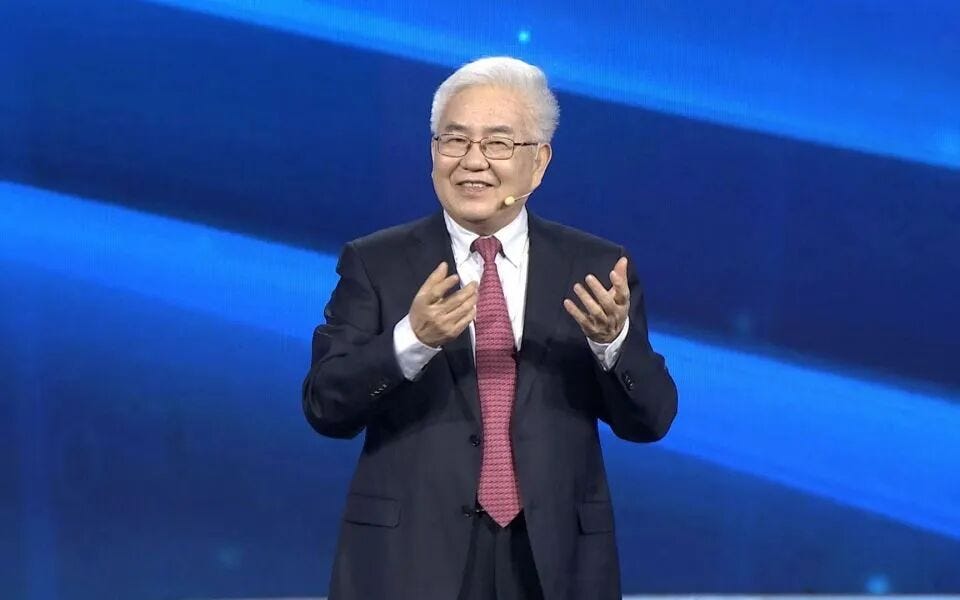
Zheng sees China's AI compute problem as a structural mismatch: high-end capacity remains scarce, while much of its low- and mid-range computing power is underused because the software, scheduling and application layers are not yet mature enough. He argues that investment in domestic chips must be accompanied by stronger foundational software, high-performance graph computing and full-stack solutions that work in real industrial settings. Ultimately, he says, AI infrastructure should be judged not simply by how much computing power it provides, but by how efficiently it converts that power into high-quality tokens and deployable intelligence.
Below is a translation of his discussion with Tencent. Please note that the translation is mine and has not been reviewed by Prof. Zheng.
中国工程院院士郑纬民:中国AI算力,真正缺的是什么?
Zheng Weimin of the Chinese Academy of Engineering: What Does China Really Lack in AI Computing Power?
China's AI computing sector is experiencing an apparently paradoxical moment.
On the one hand, large models and AI agents are being deployed across industries at an accelerating pace, token consumption is rising rapidly, and high-end computing power remains in short supply. On the other hand, some computing resources that have already been built are not being fully utilized because of inadequate software compatibility, poor alignment between supply and demand, and limited scheduling capabilities.
This issue was also highlighted in the Research Report on AI Computing Infrastructure as an Enabler, published by the China Academy of Information and Communications Technology in 2025. According to the report, utilization loads vary considerably across China's AI computing infrastructure. In particular, some intelligent computing facilities led by local governments or state-owned investment platforms have yet to deliver their full practical value.
What this reveals is not merely a question of chip supply. A more complex set of factors must also be considered: whether the software ecosystem is mature; whether domestically produced chips can support real-world workloads; whether models, knowledge and tools can be effectively organized; and how many high-quality tokens each unit of computing power can produce. Here, "high-quality tokens" refers to effective model inputs and outputs that accurately carry business knowledge, generate reliable reasoning results and create tangible business value, rather than merely increasing token volume. Together, these factors are redefining the efficiency of China's AI infrastructure.
Zheng Weimin, an academician of the Chinese Academy of Engineering and chief scientist at Haizhi Technology, believes that China's AI computing sector is at a critical stage of transition. The shortage of high-end computing power is only the most visible contradiction. The deeper challenge is how to use foundational software, graph computing and a full-stack ecosystem to unlock the value of existing computing resources—and how to move infrastructure beyond merely providing models toward providing schedulable and executable intelligent production capacity.
During the 2026 World Artificial Intelligence Conference (WAIC), Zheng spoke with media about the structural imbalances affecting China's domestic computing capacity, the sovereign AI ecosystem and computing infrastructure.
Q: At what stage is China’s AI computing infrastructure currently? You have said that "high-end computing power is in short supply, while low- and mid-range computing power is oversupplied." How should this structural imbalance be addressed?
Zheng Weimin: China’s AI computing infrastructure is currently at a critical stage of transition and faces a pronounced structural imbalance.
Frankly speaking, the United States' export controls on high-end AI chips to China are the direct cause of the domestic shortage of high-end intelligent computing power.
At the same time, the fundamental reason China's market for low- and mid-range computing power is "oversupplied" is that its software ecosystem is not yet mature, making it difficult to mobilize large amounts of hardware efficiently.
At a time when high-end computing power is scarce, China must steadily advance domestic substitution and expand its hardware capacity. At the same time, however, it must rely on independently developed and controllable "foundational software" to unlock the value of its existing computing resources and make efficient use of low- and mid-end computing power as well.
This involves a crucial underlying technology: high-performance graph computing.
When large models are deployed in enterprise settings, they commonly suffer from hallucinations and a lack of controllability. A software system is therefore needed to organize and constrain models, knowledge, tools and business processes. This is known as an AI Harness. Such a system makes it possible to complete tasks more accurately while using less computing power.
This is also why I have always advocated "doing useful research." The academician and expert workstation jointly established by our team and Haizhi Technology, for example, is deeply engaged in this field. Our goal is to turn laboratory technologies into products that the country can genuinely use.
Q: You have identified three pillars of sovereign AI: autonomous computing power, stronger algorithms and ecosystem self-reliance. Which of the three is currently the most obvious weak link? What is the most important breakthrough needed to move domestically produced chips from being merely "capable of running" to being something users are "willing to use"?
Zheng Weimin: The most obvious shortcoming at present is ecosystem self-reliance.
Autonomous computing power provides the physical foundation, while strong algorithms serve as the core engine. But ecosystem self-reliance determines whether the entire system can genuinely take root in practice. For domestically produced chips to bridge the gap between being "capable of running" and being products that users are "willing to use," China urgently needs mature, fully domestic full-stack solutions. Only when domestically produced chips are actually operating in real and complex industrial settings can the ecosystem become truly self-reliant.
China must therefore clarify the entire chain of needs extending from technology providers to end users, including public services, security and banking, and deploy technical talent appropriately. Building on underlying technologies, it must pursue the highest possible cost-effectiveness and efficiency.
An ecosystem combining a "domestic computing foundation" with "top-tier capabilities for deploying industrial AI" represents the crucial breakthrough needed to make China’s domestic computing ecosystem more self-reliant and competitive.
Q: You have proposed a shift "from MaaS (Model as a Service) to TaaS (Token as a Service)," describing tokens as the "new oil" of the AI era. Token consumption in China has increased a thousandfold in two years. Why is existing infrastructure unable to "produce" enough tokens, and what new requirements does TaaS impose on computing infrastructure?
Zheng Weimin: The transition from MaaS to TaaS represents an important direction in the evolution of AI infrastructure.
In the past, MaaS primarily addressed the supply of model capabilities. As large models enter the stage of large-scale application, however, the focus of future competition will gradually shift toward the ability to efficiently generate, organize and use high-quality tokens.
We must recognize that enhancing token capabilities does not depend solely on expanding the scale of computing capacity. It depends even more on the coordinated optimization across computing, data, knowledge and application systems, so that computing resources can be effectively converted into intelligent capabilities.
From a technological perspective, the development of TaaS requires two core challenges to be addressed simultaneously.
First, it is necessary to improve resource-utilization efficiency across the entire chain of large-model inference and service delivery, and to establish a new type of computing infrastructure designed for token generation.
Second, the underlying token-service platform must be connected with knowledge bases for specific vertical industries and with end-to-end business processes. This will create a complete closed loop extending from basic token-computing units to deployable and schedulable intelligent execution capabilities.
Looking at the broader development trend, TaaS requires a technological system in which computing infrastructure, knowledge infrastructure and intelligent execution infrastructure evolve in coordination. This will drive a shift in AI away from a model centered primarily on supplying model capabilities and toward one that supplies intelligent production capabilities for specific industry scenarios.
Q: You have consistently advocated "doing useful research." Against the current backdrop of "choke-hold" vulnerabilities in China's domestic foundational software, what is the strategic significance of research platforms built on deep collaboration among industry, academia and research institutions in bridging the last mile from the "laboratory" to the "production line"?
Zheng Weimin: The most important institutional breakthrough offered by deep collaboration among industry, academia and research is that it breaks down the barrier between universities "publishing papers" and companies "developing products," while establishing a long-term and in-depth mechanism for collaboration.
In foundational software, universities possess cutting-edge theoretical and technological research capabilities, while companies bring real application scenarios and engineering experience. Neither can be dispensed with.
Universities and research institutes have advantages in theoretical research, but academics do not always understand what the market actually needs or have familiarity with specific business scenarios. Companies, having served customers over long periods, have a clearer understanding of practical needs and the problems that arise when technologies are deployed.
Bringing the two sides together can make university research more targeted and increase the practical value of companies' technologies and products.
To return to the example of Haizhi Technology, in 2021 we established an Academician and Expert Workstation for High-Performance Graph Computing, bringing together university research capabilities and the company's industrial experience.
In 2023, the two sides jointly advanced the development of AtlasGraph, a domestically developed distributed graph database, helping extend the relevant technologies from underlying foundational software into higher-level AI applications.