

On the second day of China's May Day holiday, when much of Beijing is sleeping, traveling, or taking a rare break from work, we turn our lens somewhere else: to the people still moving through the city after midnight.
They are the delivery riders running red lights on empty avenues, the wholesale vendors shivering in the pre-dawn chill, and the aging freight workers waiting for a forklift in the dark. They operate in the margins of our circadian rhythms, largely out of sight, and thus, out of mind.
Their reasons for working through the night are different. Some are between jobs. Some need extra income for children, rent, or a mortgage. Some have simply found that the night is less crowded, slightly faster, and, in its own way, more bearable. What connects them is not a single story of hardship, but a quieter and more complicated kind of endurance.
There was fatigue, certainly, and sometimes a sharp awareness that this kind of work is precarious, dangerous, or damaging to the body. But there was also a stubborn steadiness: the belief that earning money is already something to be grateful for.
The following video was produced by Hong Kong–based Phoenix Weekly, and you can watch it here. What follows is my English translation of the interviews in that short film.
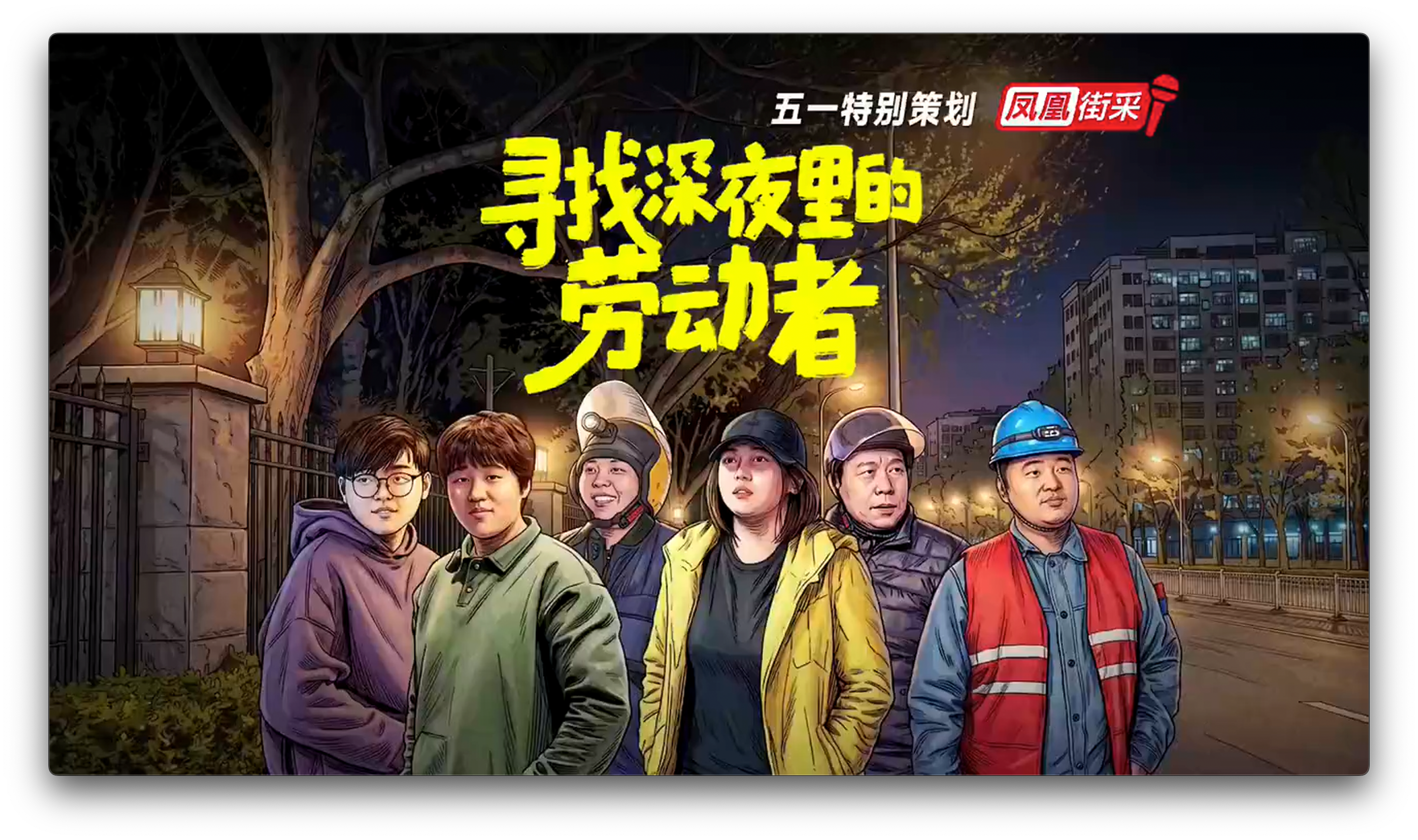
寻找深夜里的劳动者
Looking for the people who work through the night
Mr. Jia, 40, food delivery rider, from Xingtai, north China's Hebei Province
Guijie, 2:20 a.m.
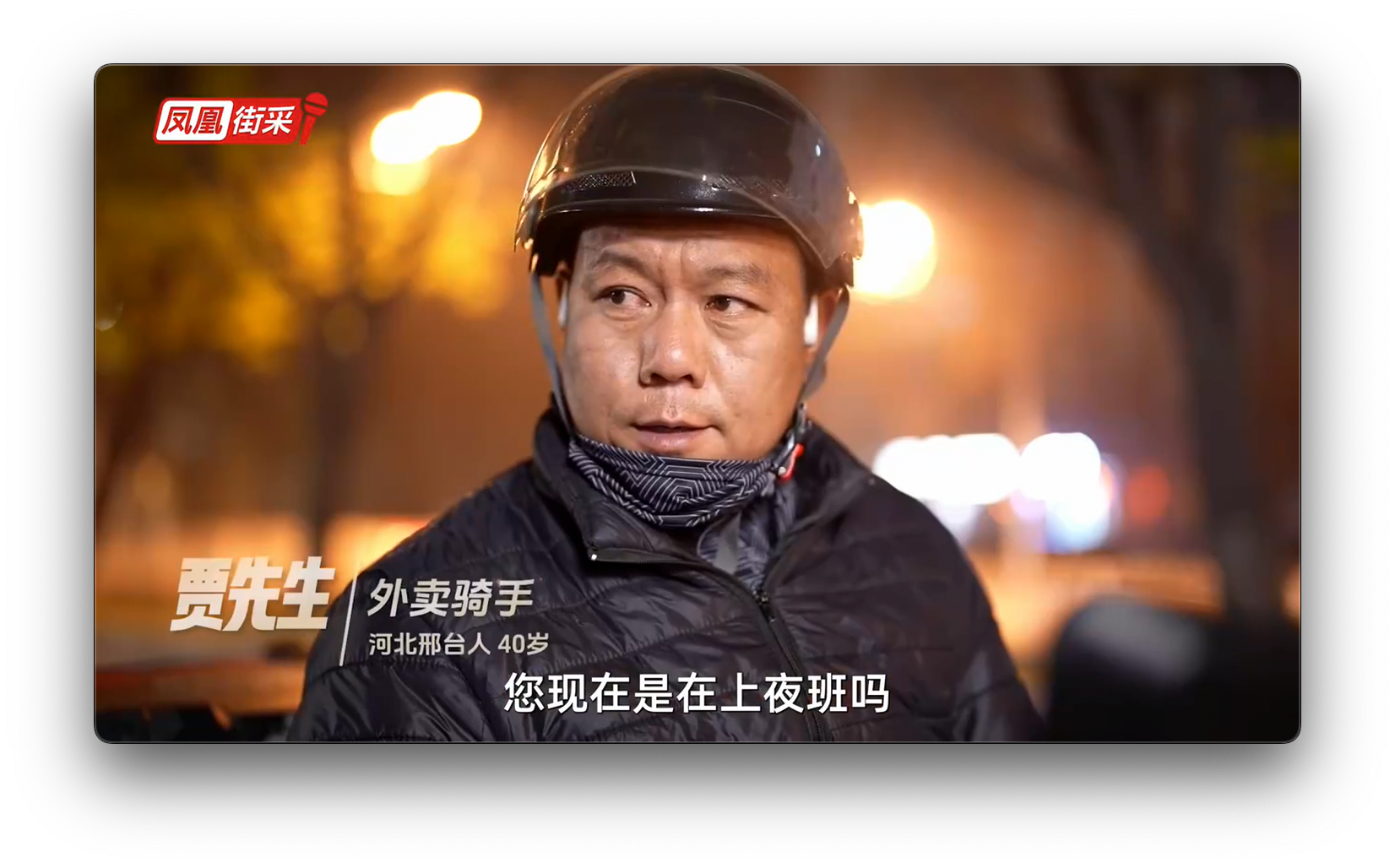
Reporter, 00:41
Are you still on the night shift?
Mr. Jia, 00:43
Yeah, from 5 p.m. to 5 a.m. I personally just prefer nights because the traffic is a nightmare during the day. It’s exhausting riding in the daytime. Honestly, I just want to go home right now. Haha, I'm just tired, you know? Sleepy.
I turned 40 this year. I'm unemployed right now—I mean, I don't have a formal job. I wasn't always doing this. Actually, I used to really dislike this line of work. Day or night, I felt that, honestly, this job was almost not meant for people. Running around on the streets all day, running red lights, going the wrong way down the street... Everyone sees it every day, and it really is dangerous. Yesterday, I saw a delivery guy get hit on the road. But what can you do? I'm out of work, I don't have a job, and I have to live.
Reporter, 01:35
How long have you been in Beijing?
Mr. Jia, 01:38
Seven or eight years. My family is back in my hometown. I used to be in the perfume business and had a stable job, but things just haven't been going well these past couple of years. I'm pretty much at the bottom of the ladder now. If I felt this was beneath me or something, I definitely wouldn't be doing it. But when you've fallen this hard, when you've failed to this extent, do you really care about that stuff anymore? Why would you? Who even knows who you are?
I feel like for most people, this is just a transition. You definitely can't rely on this for your future, because there is no future in it. You don't make that much, and it's not stable. I just get the feeling that society doesn't really respect this job, but they also can't live without it.
Reporter, 02:25
Do you run red lights now?
Mr. Jia, 02:28
To be honest, I have. Because you're tied to the platform. Once you choose it, you have to keep up with its pace. But I try my best not to.
Ms. Liu, 44, food delivery rider, from Luoyang, central China's Henan Province
Guijie, 3:35 a.m.
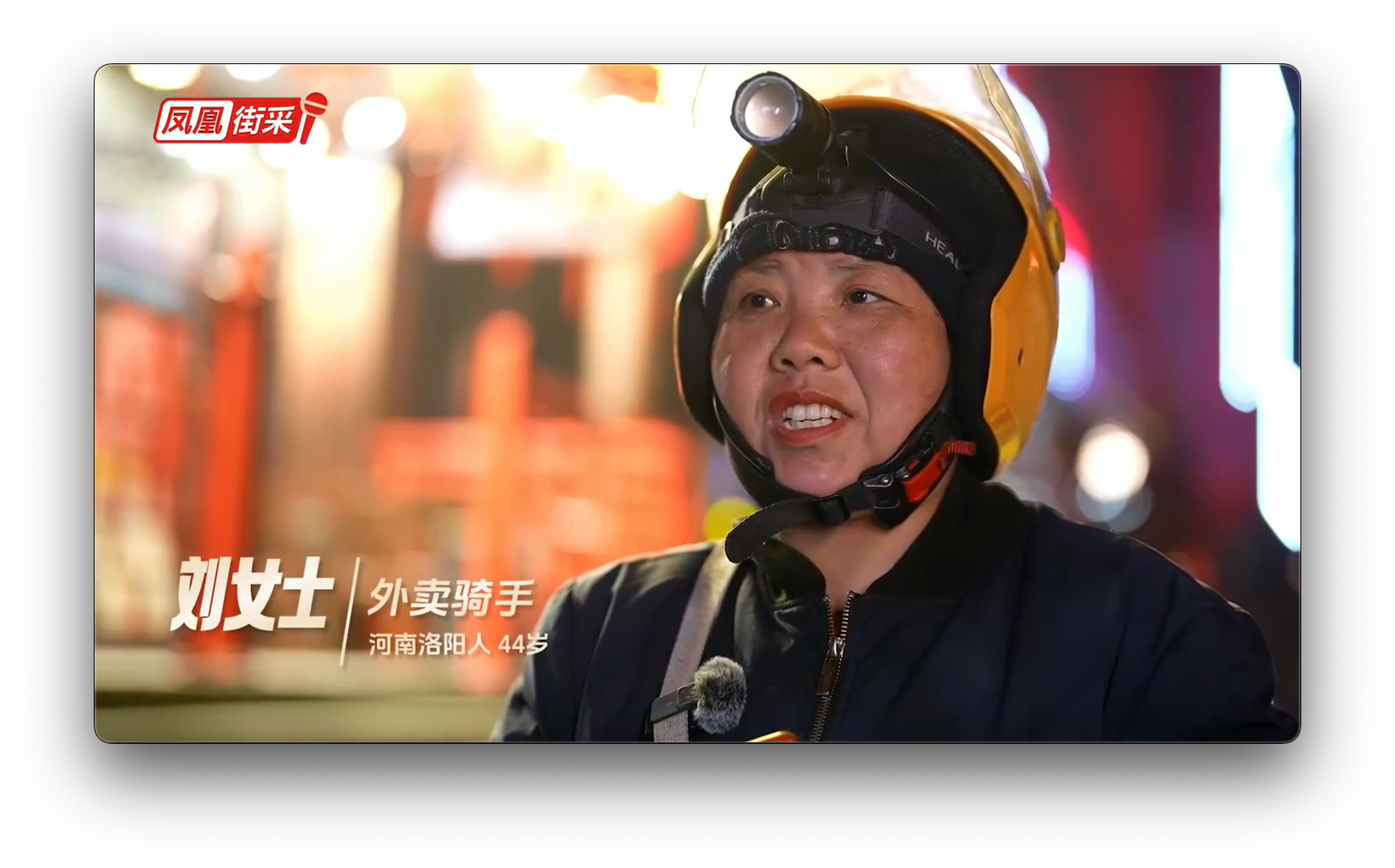
Ms. Liu, 02:39
It depends on the situation, but you really have to wait at the lights. You can't run red lights.
Reporter, 02:42
Have you ever been hit?
Ms. Liu, 02:44
I have. Close calls, or sometimes actual crashes, it happens. Making money isn't easy, haha. We're all just out here trying to make a living.
Reporter, 02:51
What hours do you work?
Ms. Liu, 02:52
I usually just do nights. I head out around midnight and ride until 7-something in the morning. Then I'll do a bit during the day at lunch, maybe for two hours. Orders are hard to get during the day; there are way too many riders, so you can't grab them. So I just do nights.
Reporter, 03:08
How much can you make in a night?
Ms. Liu, 03:09
Around 200 yuan (roughly USD 29).
Reporter, 03:10
Do you make more working at night compared to the daytime?
Ms. Liu, 03:13
Yeah. Mainly because there are fewer cars at night, so you can go a bit faster and it doesn't feel as exhausting. I just catch some sleep beforehand—sleep through the first half of the night.
I used to have a regular job, but I quit after having kids. When they're little, if they need you, you can't really work. Their dad works, and he tells me to take it easy, not to work too hard if I don't have to. He doesn't want me getting too tired. Doing this delivery gig just brings in a little extra to help out with family expenses, maybe a few thousand yuan a month. When the kids are a bit older, I'll go find a regular job again.
Making money... the more you make, the more energized you feel. I don't feel like I'm living a bad life. It's just taking orders, delivering them, back and forth in a loop. Being able to make a bit more while I'm still at an age where I can—it makes me happy. I have one kid at hom and one in school. The older one goes to school in Yanjiao燕郊. We bought a place in Yanjiao—actually, two places in Yanjiao, Hebei Province. It's close to Beijing.
Reporter, 04:18
How long have you been in Beijing?
Ms. Liu, 04:19
Over a decade, maybe 15 or 16 years. I want to stay in Beijing, but the conditions don't allow it. So we work in Beijing and live in Yanjiao nearby, hoping the kids can stay around here.
(Note from Yuzhe: There may be several reasons behind it, but many of them may get tied with China's hukou system.)
"Being able to make a bit more while I’m still at an age where I can—it makes me happy."
Mr. Cui, in his 40s, market delivery worker, from Northeast China
Dayanglu Wholesale Market, 4:05 a.m.
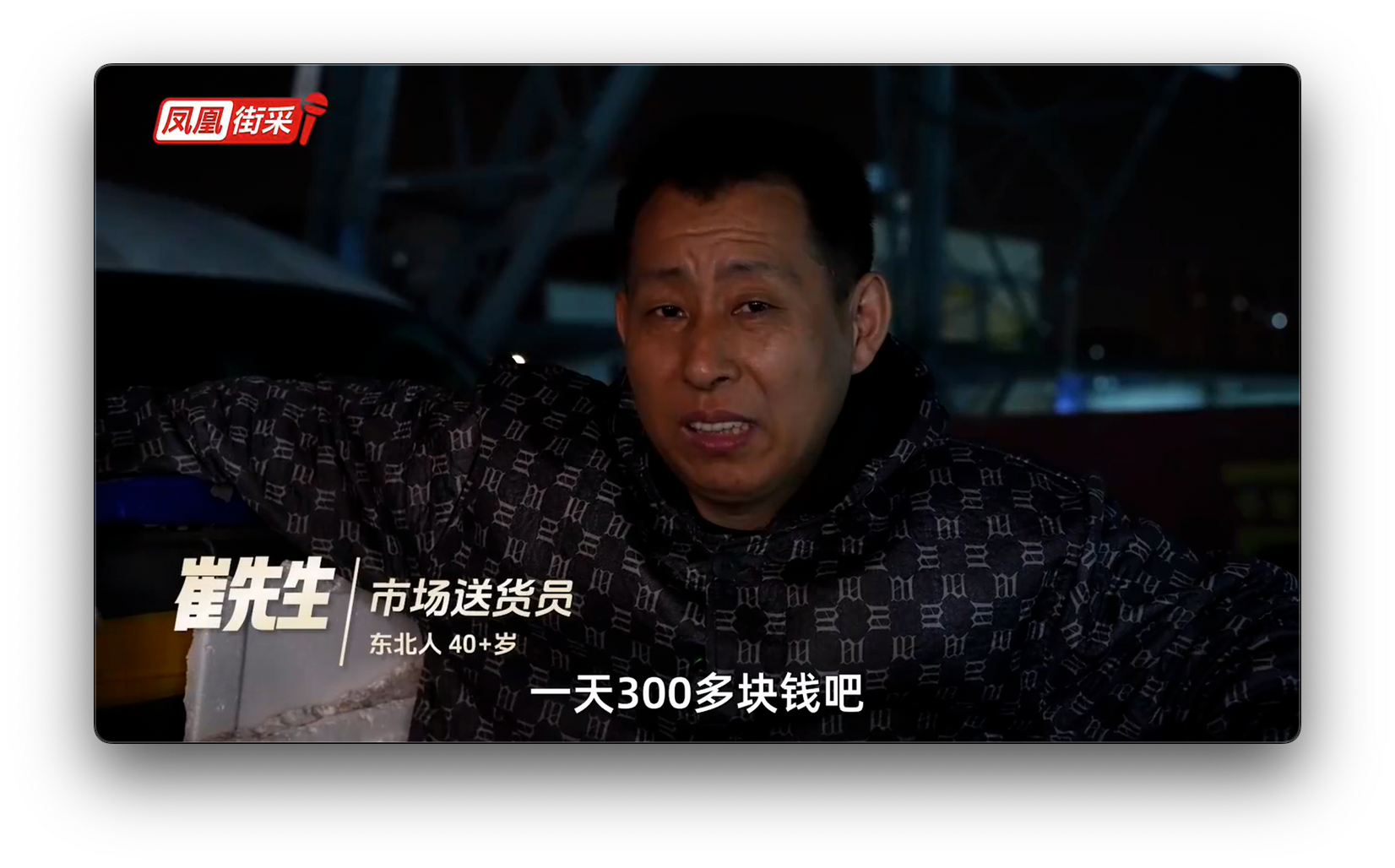
Mr. Cui, 04:41
I just work for folks here, delivering vegetables and stuff. Make about 300-something yuan a day. It's tough. Nothing is easy these days.
Reporter, 04:50
Where are you heading right now?
Mr. Cui, 04:51
Off to work! Gotta go make money. Let me get you a proper interview. I'll take you to one of the stalls, and you can ask them.
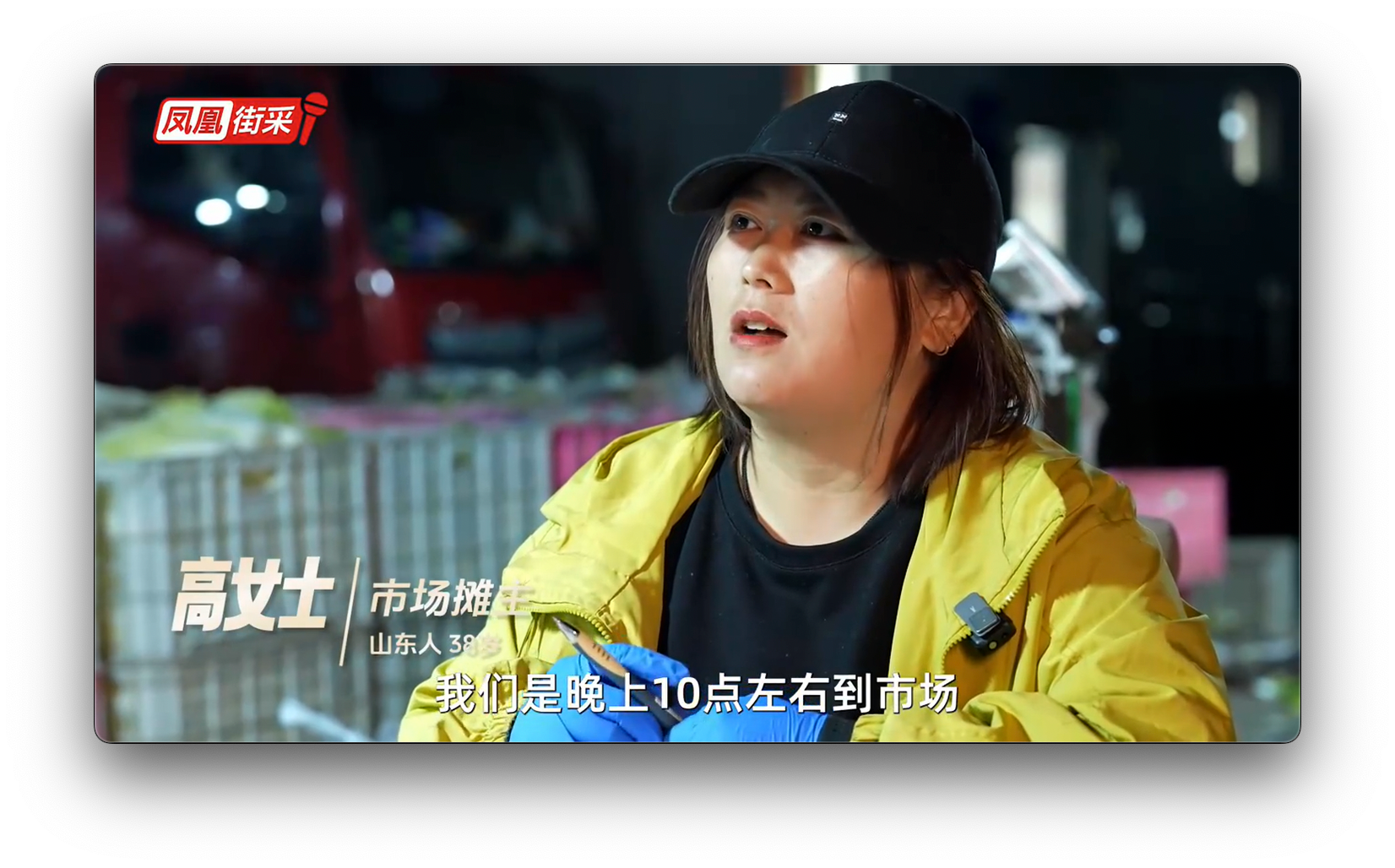
Ms. Gao, 38, stall owner, from east China's Shandong Province
Ms. Gao, 04:58
We get to the market around 10 PM and stay until about 11 AM the next day. It's like this every day. We might take two or three days off for Chinese New Year, but sometimes we don't even get that. Usually, after settling bills with the clients, I sleep from around 5 or 6 AM until 9 AM. It's the same in winter. The faces of the lady working for us and our delivery guy both got frostbite this winter. Plus, there are a lot of younger people in our market who've had strokes or heart attacks. I feel like it's all connected to the night shifts. Staying up all night long-term is terrible for your body. It's exhausting, every single day. You just constantly feel like you can't recover. But it's always been like this. I'm just pushing through, forcing myself to hold on.
Reporter, 05:43
What gives you a sense of achievement in this job?
Ms. Gao, 05:46
My achievement is having a truck fully loaded with goods in the afternoon, and seeing it completely sold out by the morning.
Reporter, 05:53
How long have you been in Beijing?
Ms. Gao, 05:54
I came in 2012, so it's been 14 years. Sometimes when business is really tough, like when we're losing money, I honestly just want to quit. But then I think about it, and life has to go on.
Reporter, 06:06
Your schedule is completely flipped. How does that work with your kids' normal routines?
Ms. Gao, 06:10
We're totally out of sync. We rent a two-bedroom apartment. When we get up, we're super quiet, moving really slowly so we don't wake them. Their grandma is here watching them. We manage to take them to school, but otherwise, we're just glued to the market here.
Reporter, 06:25
Do you get to talk to your kids much?
Ms. Gao, 06:27
Yeah. When I go back in the afternoon, they are usually at home. Sometimes I also pick up the little one. Our oldest is in middle school, and the youngest is in kindergarten. Because the kids go to school here, we're staying for now. Once we stop doing this, we'll have to go back to our hometown. It won’t be too long. My rough plan is to go back when the younger one starts primary school.
The cost of living in Beijing is just way too high. Honestly, if the whole family stayed here, what we earn wouldn't be enough to spend. And business is hard right now.
If I could choose again, I wouldn't pick this industry. Definitely not. I'd pick something that, at the very least, doesn't mess up my circadian rhythm with night shifts. I'd definitely choose a daytime job. I just want to end this kind of lifestyle soon, haha, and get back to normal life. This industry is just too exhausting. I want to treat myself a bit better. Basically, I just tell myself to push a bit harder, keep going, stick it out for a few more years, and then it'll be over. I don't really think about anything else. I just feel like I've been way too tired and worked way too hard these past few years.
"I just want to end this kind of lifestyle soon, haha, and get back to normal life."
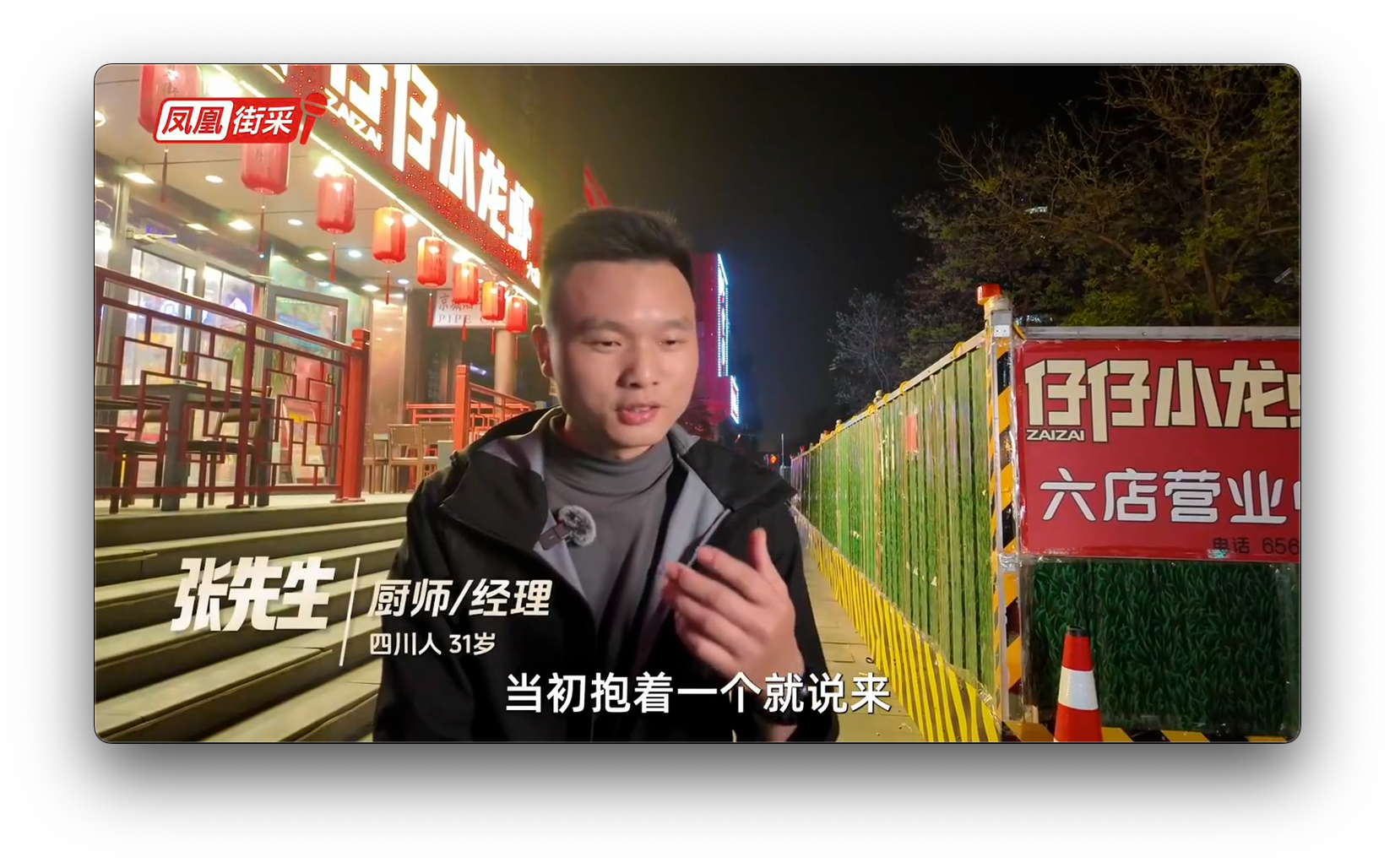
Mr. Zhang, 31, chef/manager, from southwest China's Sichuan Province
Guijie, 3:08 a.m.
Mr. Zhang, 07:36
Who wants to work the night shift? Nobody does. I came here with the dream of making big money and starting a business in the big city. That's why I came to Beijing. So if you ask why I chose the night shift... it's to make a living, because the job I chose is just like this. I'm a chef and also a manager. Restaurants operate at night, so almost everyone works the night shift, from 5 or 6 PM to 3 or 4 AM. I remember once staying as late as 8 AM because we still had customers. Since you're on duty, you have to wait until the guests leave.
Mr. Zhang, 08:11
I dropped out of high school pretty early on. Actually, my grades weren't even that bad back then. I just felt like even if I took the college entrance exam, I wouldn't get into a great university.
When I first started working, I went into factories—electronics, clothing. Eventually, I figured I needed to learn a proper trade, so I chose the catering business and became a chef. Of course it felt hard at first. I've been working here for about 10 years now. My wife and I actually met in Beijing. I got married young, before I was 22. Yeah, there's hope for the future. Mostly because we have a kid now, in the first grade, so it makes us want to hustle even harder.
Reporter, 08:49
Do you still have your dream?
Mr. Zhang, 08:51
Of course I have. My original dream is very simple: make money. The dream of a regular person. You just hope that once you step into the real world, you can support yourself, and once you're married, you can support your family. So that if you run into hardship one day, you won't be stuck with empty pockets.
“You just hope that once you step into the real world, you can support yourself, and once you're married, you can support your family.”
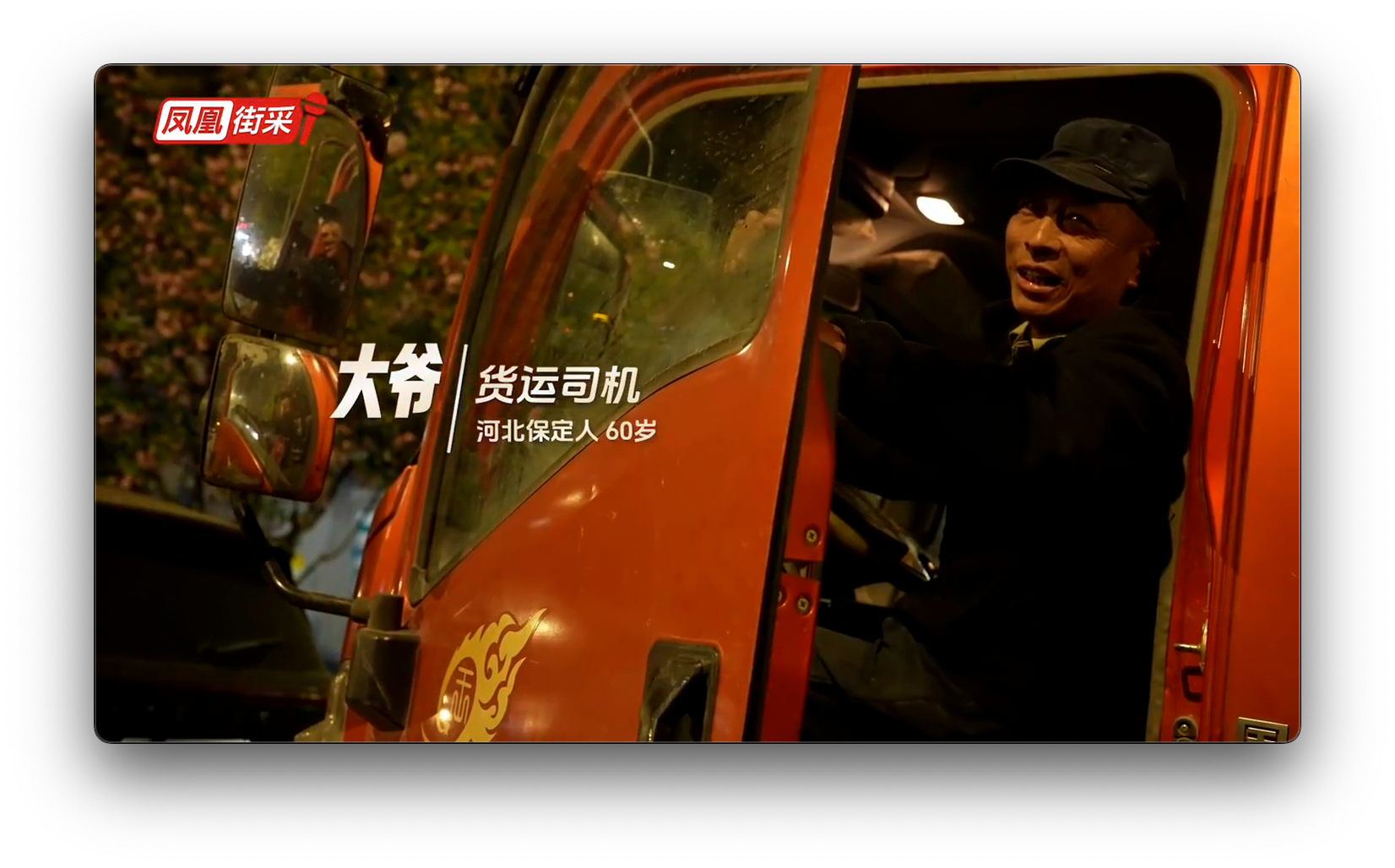
Older man, 60, freight driver, from Baoding, north China’s Hebei Province
Drum Tower, 12:47 a.m.
Reporter, 09:13
Are you working right now?
Older man, 09:15
I'm not working. I'm waiting for the forklift. You call this a job? We just sell our physical labor. I'm not putting myself down, but people like us aren't worth filming.
I'm a bit sleepy right now. I'm used to it, a quick nap is enough. Just snooze until the forklift gets here, unload the truck, and then head home. We just haul freight at night, and once it's unloaded, we head back.
Reporter, 09:36
What time can you leave?
Older man, 09:38
Hard to say. Maybe around 2 AM. What's hard about it? At this point, I'm just getting through the days. Right now it's one trip a night, around 500 or 600 RMB. I used to be a bricklayer and carpenter. Quit that and started driving. Just scraping by to feed the family. At my age, 60 years old, I'm not thinking about doing anything else.
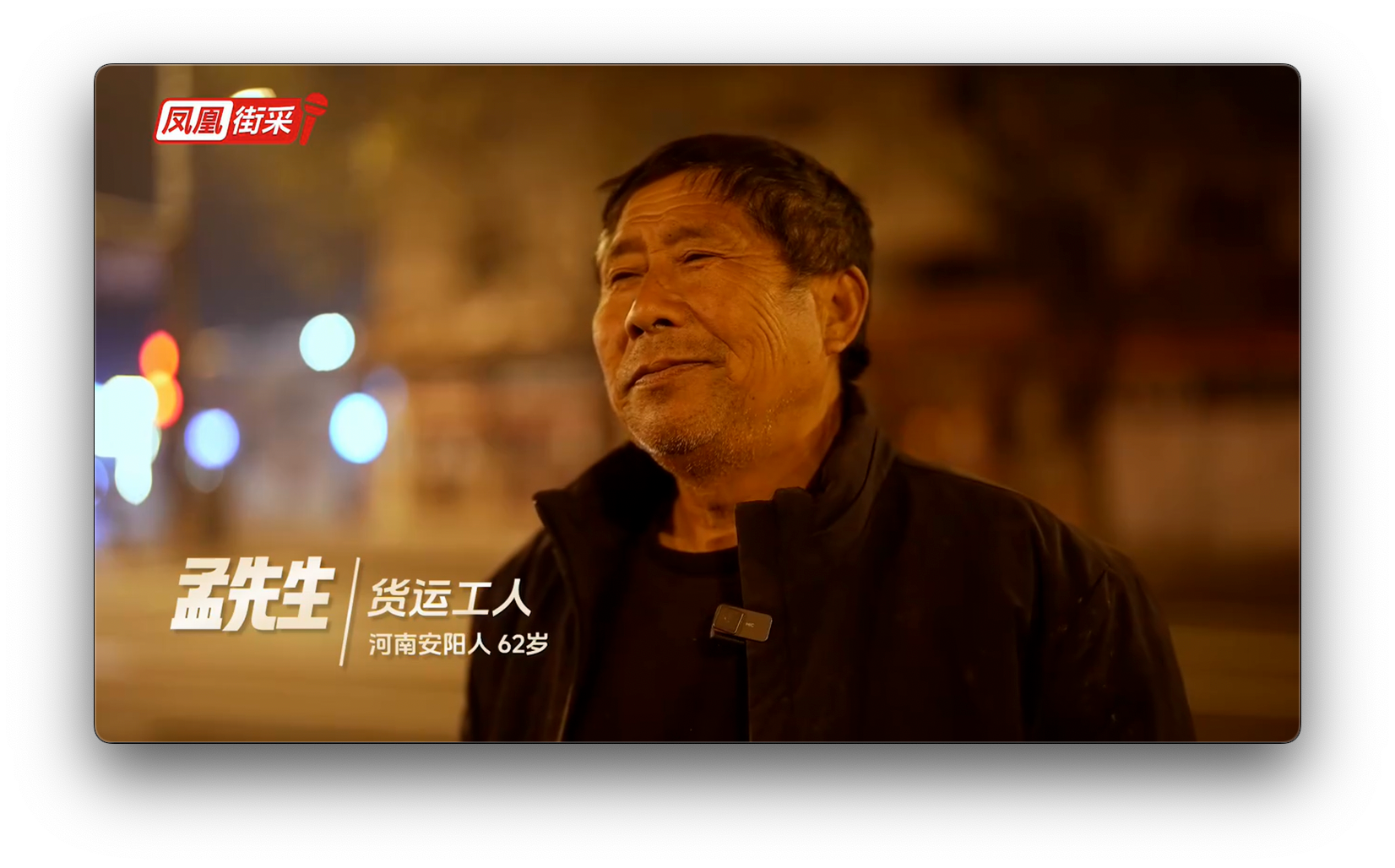
Mr. Meng, 62, freight worker, from Anyang, central China’s Henan Province
Guang'anmen Street, 1:07 a.m.
Mr. Meng, 10:04
I'm 62. The three of us came from Henan, just wandering around Beijing doing odd jobs for people. When you get old, it's hard to find any work. I just do landscaping for folks. Once you're over 59, nobody wants to hire you. I just make a little money as a laborer.
Reporter, 10:21
How much do you make in a night?
Mr. Meng, 10:23
A hundred something. Sigh, you can't make much money. Just out here looking around, trying to catch a gig. It's better than sitting around at home doing nothing. Why am I working overtime tonight? Because China's May Day holiday is coming up. The road landscaping is super busy right now. Putting out flowers and all that, all the government departments are super busy.
"Just out here looking around, trying to catch a gig. It's better than sitting around at home doing nothing."
Sanitation Worker, in his 60s, from Anyang, central China’s Henan Province
Drum Tower, 4:42 a.m.
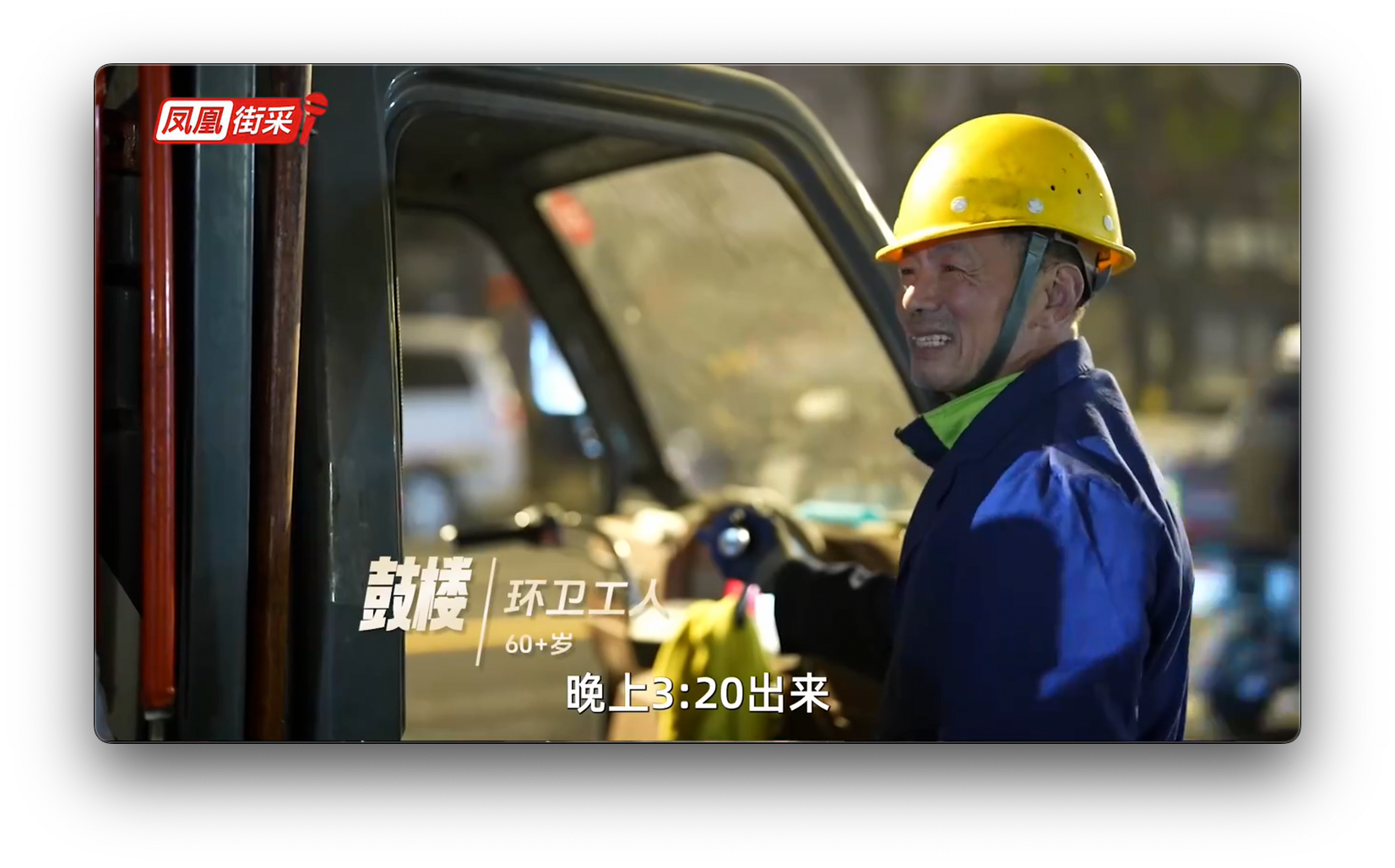
Sanitation worker, 10:55
I come out at 3:20 AM, get off at 11:00 AM, and start again at 1:30 PM. I only need a few hours of sleep. As long as I'm happy, as long as I'm in a good mood, that's what matters.
Reporter, 11:03
Are you happy right now?
Sanitation worker, 11:05
I'm happy, hahaha. You gotta appreciate having a job, right? Work hard—first to give back to the country, and second to give back to your family. I'm telling you this from the bottom of my heart. Alright, bye-bye.
Ms. Zhang, 21, restaurant worker, from north China's Shanxi Province
Drum Tower, 12:25 a.m.
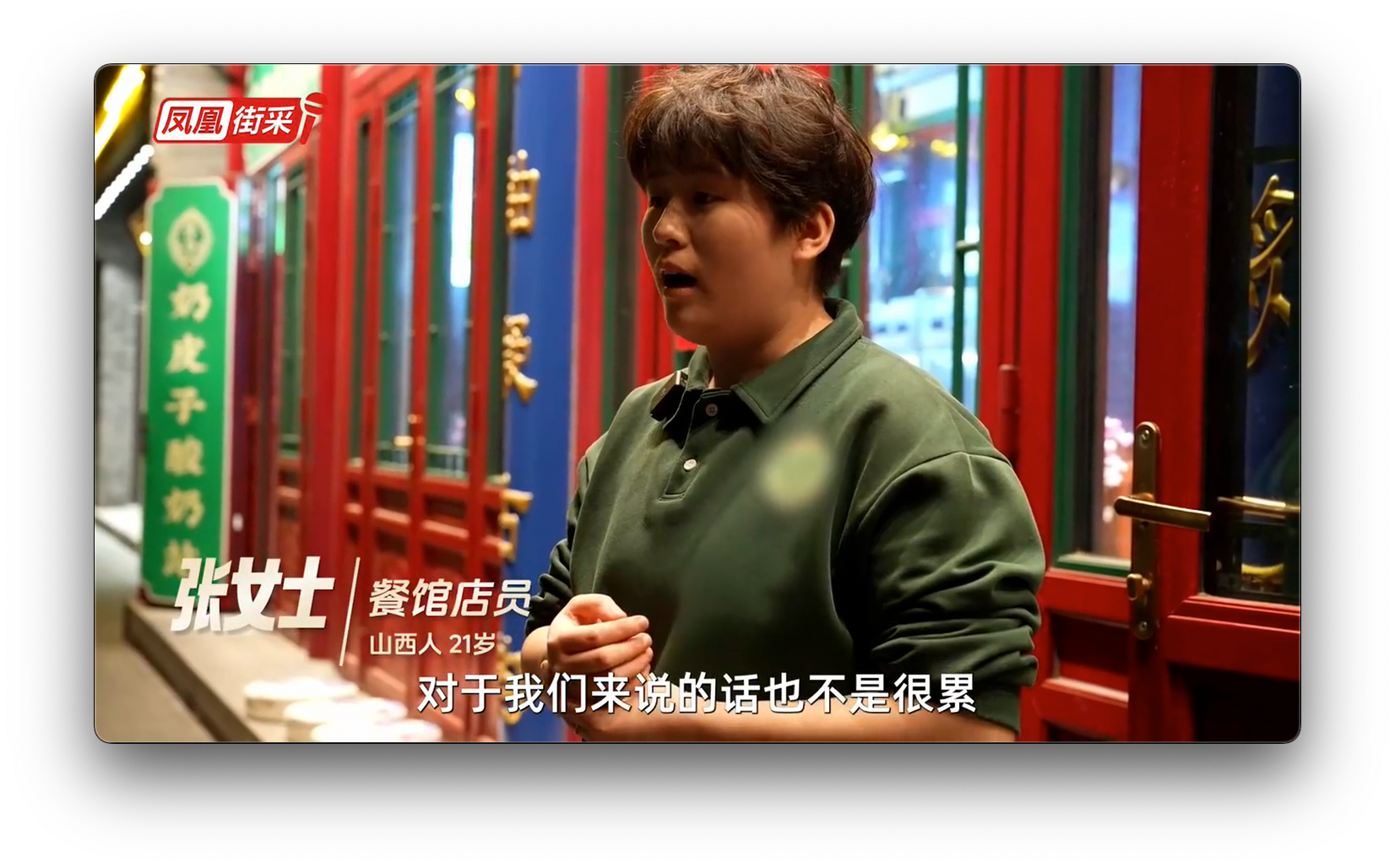
Ms. Zhang, 11:22
Night shifts are a bit better. For us, it's not that tiring. The shift starts at 4 PM, and by the end, around 11 or 12, there's basically nobody left.
Reporter, 11:31
Does the night shift pay more?
Ms. Zhang, 11:33
Not really. The restaurant industry in Beijing isn't like that. There's no such thing as overtime or night shift bonuses. None of that. It definitely has an impact, though. Like, we have to stagger our hours around the morning rush, so our meal times are totally irregular. Every day is just going to work and getting off work. It's a bit tiring, but hey, I get my money at the end of the day. I make a decent amount in a month, and you gotta earn it if you want their money. Plus, we don't have degrees, so roughing it a little bit doesn't mean much to me.
For those of us who stop studying after high school, we basically all come to Beijing to work. Beijing was my first stop. After high school, I spent a long time just traveling and having fun. From 2023 until last August, I was traveling all over the country—Changsha, Guangzhou, everywhere.
I'll probably work in Beijing for a year or two, save up my own money, and then maybe head back to my hometown. In a year or two, I might be able to put down a down payment back home. I actually feel pretty happy at work every day because I finally have things I'm aiming for.
I'm studying English right now. Teaching myself. Since my time is limited, I just have to learn a bit slower.
Reporter, 12:36
Do you want to go abroad?
Ms. Zhang, 12:37
I have that idea, but financially, I can’t do it for now.
Reporter, 12:40
Which country do you want to go to?
Ms. Zhang, 12:41
I want to go to Germany to study law, because I feel some people really need it.
Reporter, 12:45
What kind of people do you want to help?
Ms. Zhang, 12:47
People who need help.