

I finished this piece on a high-speed train, somewhere between Beijing and my hometown.
Outside the window, the landscape is a blur; inside the carriage, people doze, scroll, unwrap instant noodles, waiting to arrive. Like hundreds of millions of others, I am part of the world's largest annual human migration: Chunyun春运, the Spring Festival travel rush.
I am one of the lucky ones. Thanks to China's high-speed rail, it takes me less than four hours to cross roughly 1,200 kilometers from Beijing back to my hometown. Four hours, a coffee, a nap — and I am home.
But for another group of people, traversing that same distance is an ordeal that spans dozens of hours, sometimes days.
Instead of boarding the sleek, ubiquitous bullet trains, millions of migrant workers choose the slowest options still running: old slow trains, hard-seat carriages, overnight journeys that leave your back aching and your legs numb.
Each of them has a reason for choosing this route. Most of those reasons have to do with children and parents, with saving every possible yuan for the people waiting at home.
For years, high-speed rail has been held up as one of China's proudest achievements. In this piece, I simply hope to turn the spotlight, for a moment, towards the more than 300 million migrant workers whose labor keeps Chinese cities running. We rarely see them in headlines, but no city could function a single day without them.
The video that prompted this reflection was produced by Hong Kong–based Phoenix Weekly, and you can watch it here. What follows is my English translation of the interviews in that film.
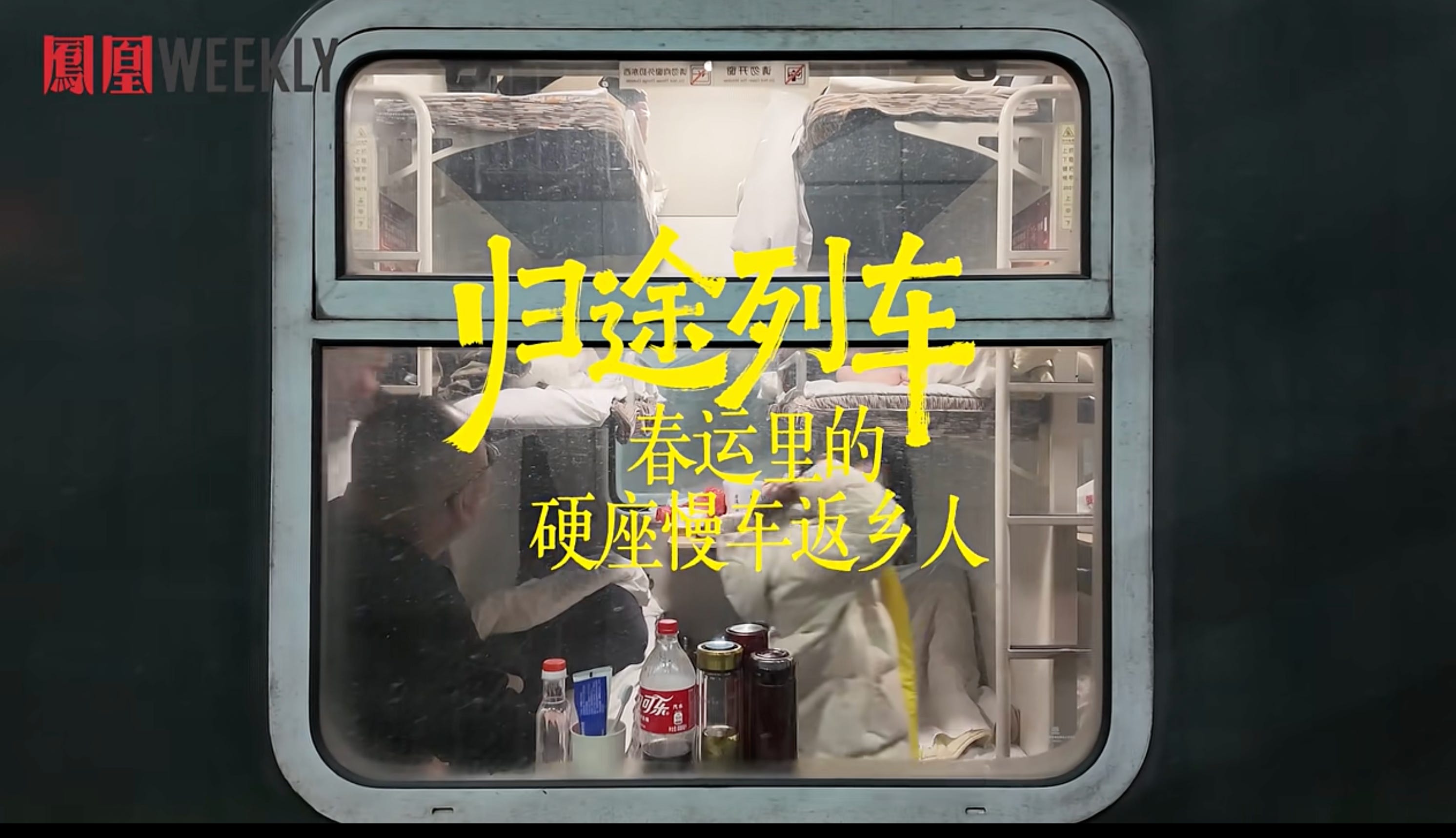
归途列车:春运里的硬车慢座返乡人
Homebound Train: Hard-seat travelers on the Spring Festival rush
Narrator 00:21
Spring Festival rush is when people head home. High-speed rail has made "far away" feel closer, but plenty of migrant workers still take the slow trains, sitting on hard seats for tens of hours, to get back. They carry big bags, with tired faces, but also the hope of finally getting home.
High-speed rail is everywhere now, and why do they still choose a slow train, a hard seat? The answer is hidden in their stories.
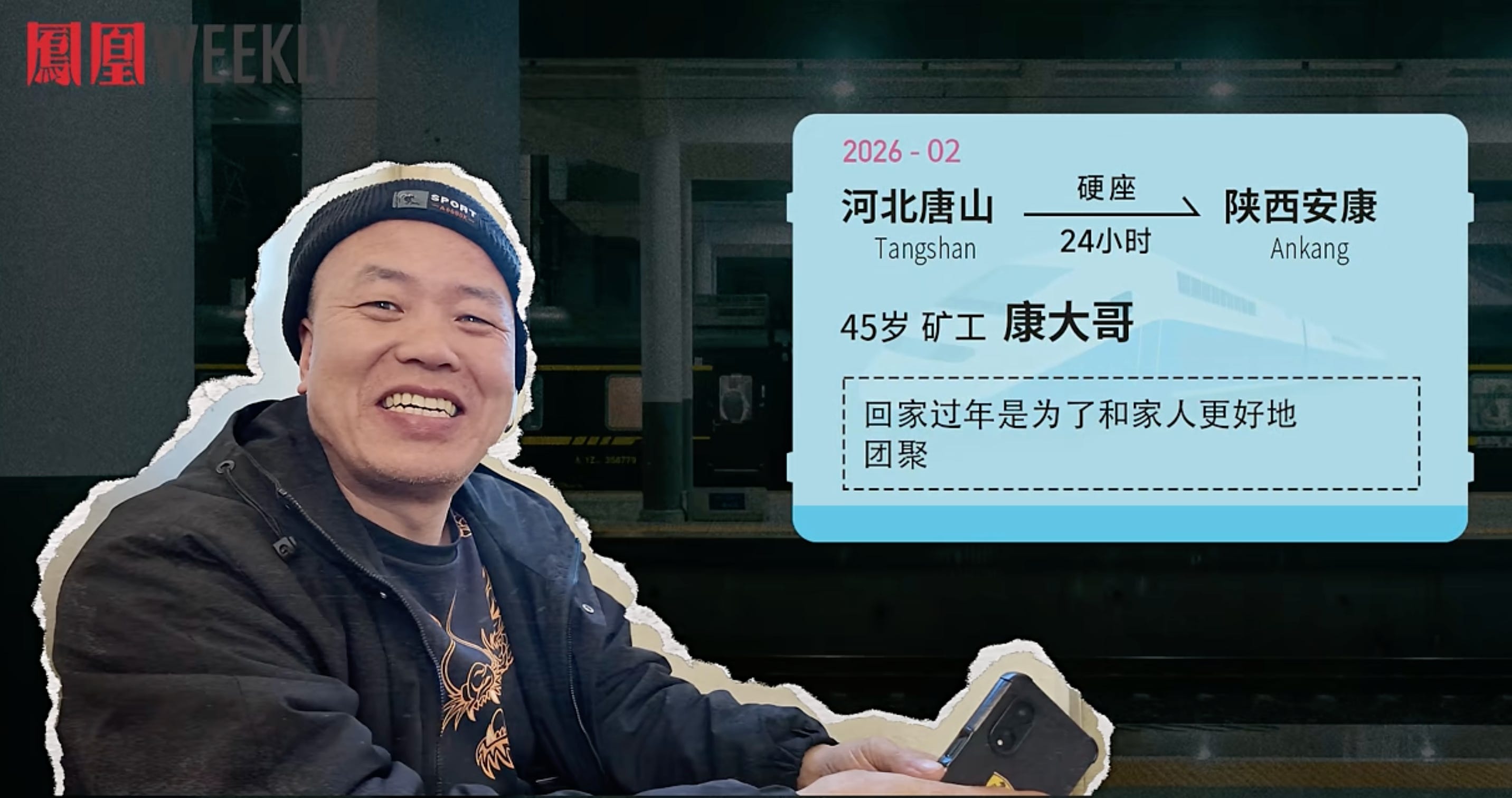
Mr. Kang, 45, miner
Tangshan, north China's Hebei Province → Ankang, northwest China's Shaanxi Province (hard seat, 24 hours, nearly 1,500 km)
"Going home for New Year is about being with the family"
Reporter 00:51
Where did you get on?
Mr. Kang 00:54
I'm taking it from Tangshan in Hebei to Ankang in Shaanxi. All in all it takes more than 40 hours to actually get home. A hard seat is 198 yuan (roughly USD 28). I buy hard seat to save a bit of money, that's one thing. Another thing is, even if I am willing to spend more and buy a faster train, sometimes I just can't get one. But this trip home for New Year, I still have to make it. I have to go back.
My parents are getting old, and my kid is still small. If I didn't go home, even if nobody said anything, I wouldn't be able to live with my own conscience.
I got into mining because some neighbors and friends took me along to work for a while. Started off just doing hard physical labor. Now if I want to change to something else, like go straight into a factory, the problem is, we're older now, we don't really fit in at the factory, the pay is lower.
To tell the truth, when I think about it I feel pretty bad sometimes. Lots of my workmates going home for New Year, they don't even have money for the trip. Many of them work outside all year and, in the end, still have to ask family back home for money just to afford the ticket.
Mr. Kang 01:46
People hear it on the surface and go, "Oh, mining pay is good, right? You make eight, ten thousand a month?" Yeah, on paper it sounds pretty good.
But they don't think about how this job isn't stable like a factory. In a factory, one has got work every day, every month. In the mines, one might work a month, then be off two months.
Those months with no work, we are living off our savings, eating away what we made before. Then we're on the road again looking for work, spending on train tickets, cheap places to sleep, food on the way… and the money's gone.
This year, how to put it… To be conservative, I just made enough for living expenses, just a few tens of thousands of yuan.
Mr. Kang 02:17
I'm almost 50 now. I got married late, so my kid is only in junior high.
There are lots and lots of workers like me. You know how it is: at our age we've got elderly parents and younger kids. For the sake of the family, we can't just stop working, right? Farming at home isn't an option either, as there isn't much land.
Doing this job… honestly, I'm tired of it. A lot of the guys say the same to me: they've been sick of it for years, but there's no way out. I might be fed up, but my family still has to live. If I don't do it, what else can I do? That's the biggest, most real problem.
When we were young, Spring Festival felt really joyful. We counted the days, just waiting for New Year to come, itching to rush back home, see my kid, see my parents.
Now we're middle-aged, more steady. For people our age, New Year isn't exactly "happy" any more — it's more like making up for something, making up for all the family time we miss during the year.
The old saying is right: rich or poor, we go home for New Year. Get everyone together. Nothing too exciting, just have to adjust your mindset.
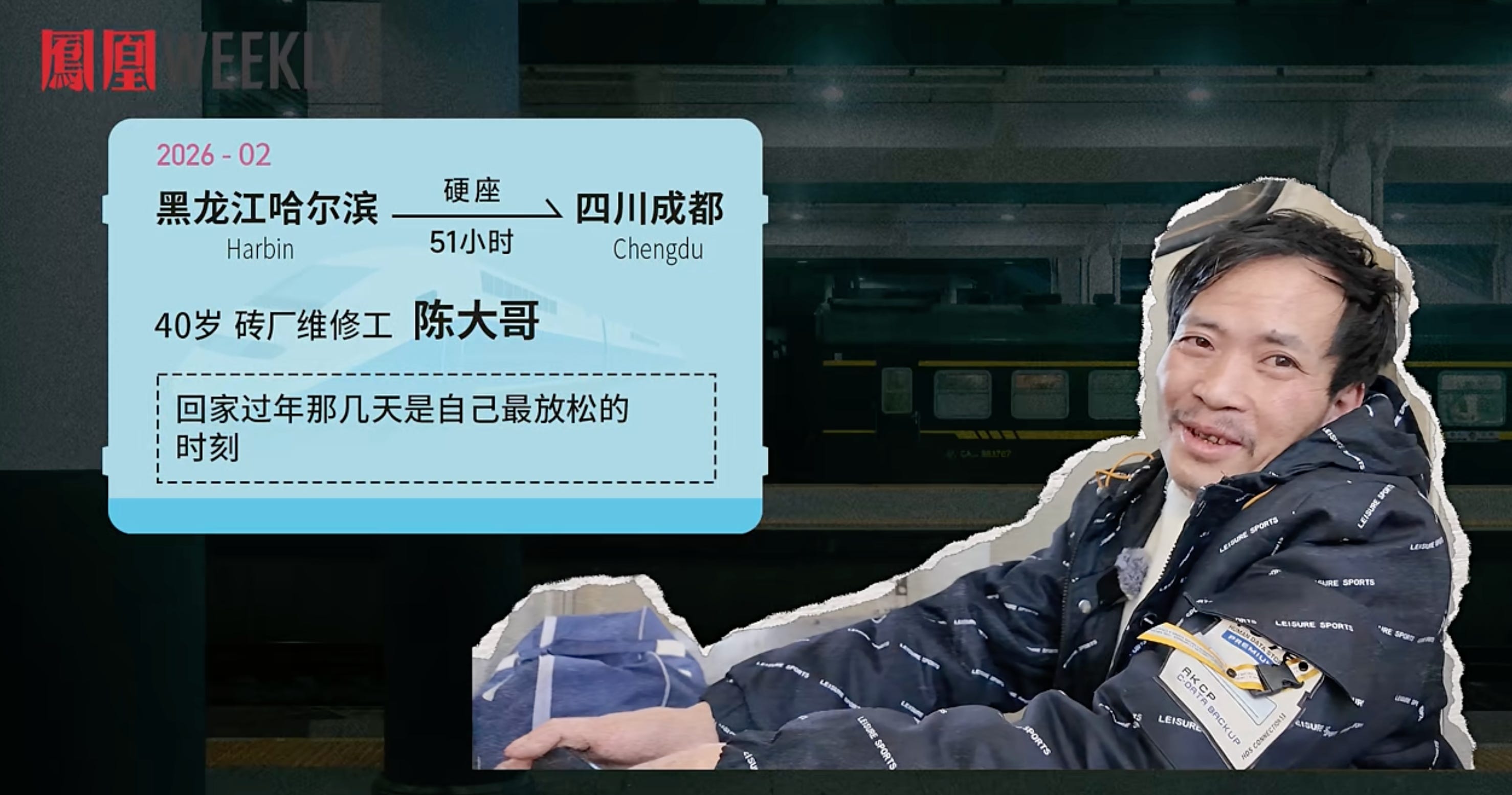
Mr. Chen, 40, brick factory maintenance worker
Harbin, northeast China's Heilongjiang Province → Chengdu, southwest China's Sichuan Province (hard seat, 51 hours, nearly 3,000 km)
"Those few days at home for New Year are when I relax the most."
Reporter 03:22
Where did you get on?
Mr. Chen 03:25
Harbin.
Reporter 03:25
And you're riding to where?
Mr. Chen 03:27
To Chengdu. It'll be more than 50 hours, almost 60 hours to get home.
Can't be helped. Right now the train is the only cheap way. The trip home costs about 1,000 yuan.
I do maintenance, machine repair. Normally people doing this kind of work should be making over 10,000 yuan a month, but in the last couple of years it's only 8,000 or 9,000. You just get used to the job.
I've got elderly parents and kids at home. Family expenses are 5,000 to 6,000 a month.
Mr. Chen 04:02
I've only got one child. He's at a vocational school in Panzhihua, Sichuan Province. He's on holiday now, already back home, staying with his grandpa.
I'm divorced. Back then lots of people asked why I didn't let his mom take him. They said, "You're alone. You've got to raise the kid and work." I said, "It's fine. I'll just work harder." If I can't be a good husband, can't I at least be a good father? Right?
I started working away from home really young, sixteen, seventeen. It's mainly for the sake of the elders and the kid. Otherwise I'd have gone abroad already. That's just how life is.
Tired or not, you still have to keep working. Recently back in our hometown there have been lots of "events," weddings, funerals, that sort of thing. And the gifts we give are pretty big.
If you run into a few events in one year, you're in trouble. My yearly spending is 50,000 to 60,000 yuan. Gift money alone is 30,000 to 40,000. Daily living doesn't cost that much. Out here I live on a few hundred yuan a month. The thing I worry about most is the elderly and the kid.
Mr. Chen 05:14
I don't know if it's just me, or if all men are like this. But once I get home, it feels like nothing matters. I can sleep like a rock. After New Year, when I go and pay respects at the graves, I can even fall asleep up there by the graves.
Sometimes sitting here I just think, wow, if only I were at home right now, that'd be so nice. Hahaha. It always feels like once you're back in your own place, the pressure isn't as heavy.
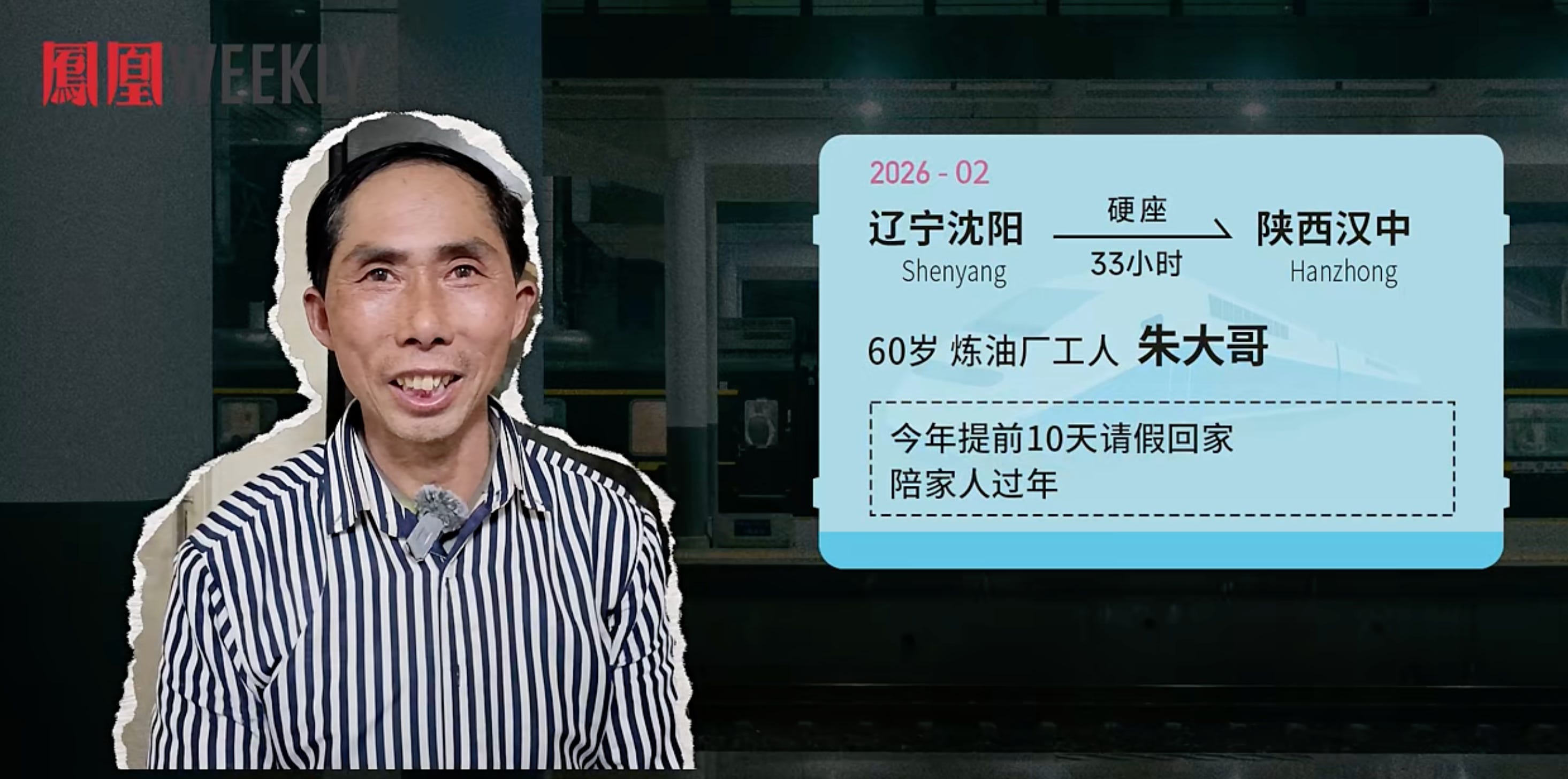
Mr. Zhu, 60, refinery worker
Shenyang, northeast China's Liaoning Province → Hanzhong, northwest China's Shaanxi Province (hard seat, 33 hours, nearly 2,000 km)
"This year I took ten days' leave early, just to be home for New Year."
Mr. Zhu 05:49
I got on the train at three in the morning last night, and I won't arrive until one in the afternoon tomorrow.
I always go back by train, usually hard seat. To be blunt, people like us working outside all just want to save a few money.
High-speed trains are fast, sure, but they cost a lot more. I bought three tubs of instant noodles – eat those, and just now I got some snacks, eat those too.
If I feel sleepy, I just curl up on the seat and get a bit of sleep.
Working outside like this these days… I'd say I don't really make money. In a good year I can just about support the family. In a bad year I can't even do that.
I make six, seven thousand a month, maybe seven, eight thousand. Out of that I send some to the kids, some to my wife, and when I add it up, there's not much left for myself.
The factory does cover meals. They give us a daily food allowance of a dozen yuan or so. It's not great, but at least they're feeding us.
Mr. Zhu 06:58
We work so hard outside all year, and back home my wife works just as hard looking after the kids.
At the end of the year, if my wife and I can sit together and have a proper reunion, that's the best thing I can hope for. Nothing else really.
A few days ago we had a meeting and the company set the holiday to start on the 25th of the last lunar month. I said, if we only get off on the 25th, then the 26th and 27th we're still on the road for two days, so there's hardly any time left at home.
So I took leave. That's what it's like as a migrant worker: if you work today, you get paid today. If you don't work, there's no money.
Every day we work is just for this one family, the elders and the kids, for them to live.
A female, 55, mushroom picker
Taiyuan, north China's Shanxi Province → Hanzhong, northwest China's Shaanxi Province (hard seat, 17 hours, nearly 900 km)
"Working away and going home for New Year — it's all for my child."
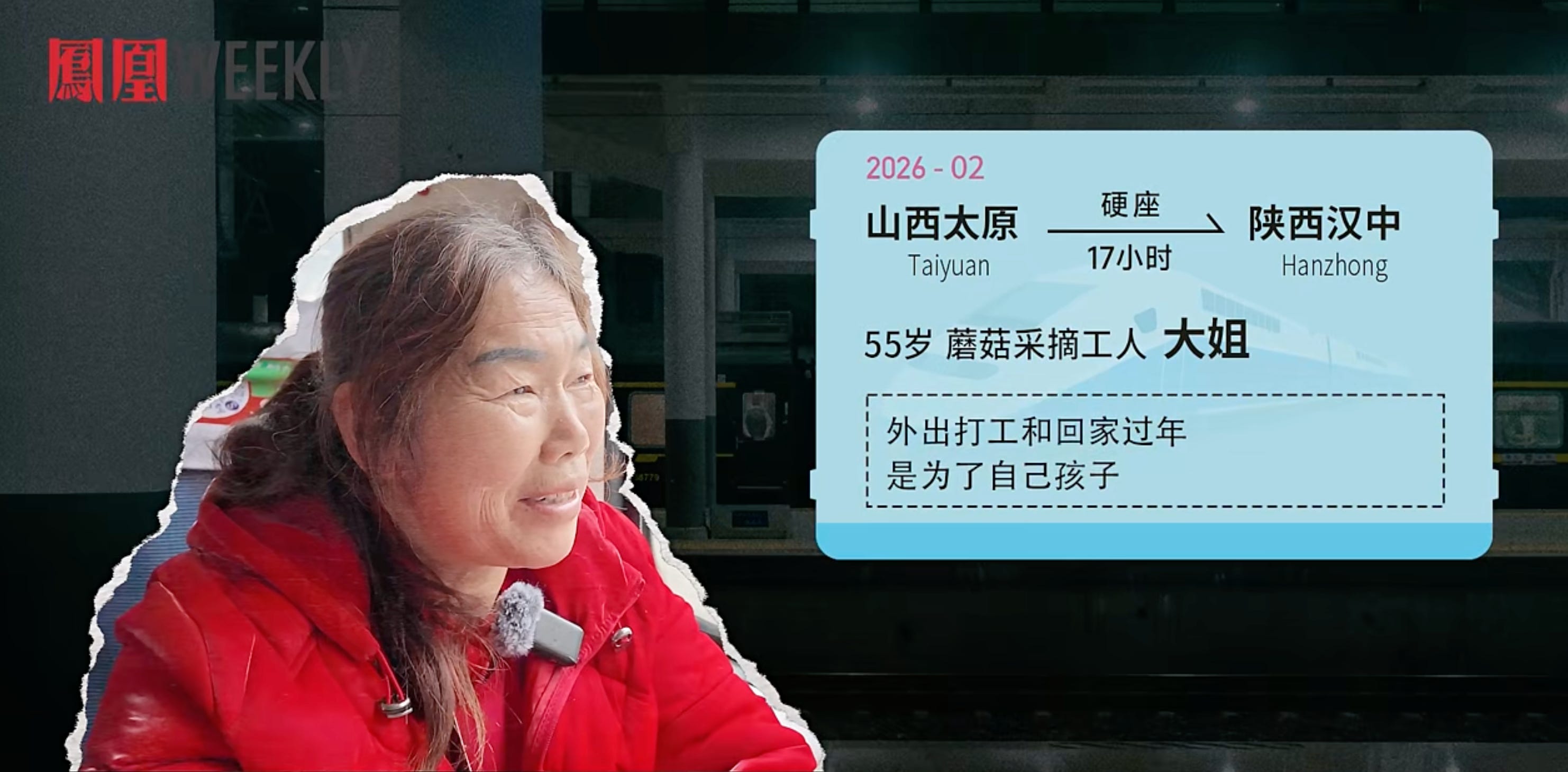
Reporter 07:48
You boarded in Shanxi?
The female 07:50
Yes, I got on in Shanxi.
I worked on construction sites for five years, just doing odd jobs, picking up and sorting rebar. The construction work was okay, and those years I could make over 200 yuan a day. Now there's no site work any more.
Now we're picking mushrooms. I don't make much, just a bit over 100 yuan a day.
I've always been working outside on my own. My husband had a car accident, his leg's bad, he can't walk.
I've also got a child in school. He's at a private school and the tuition's high. There's no way around it, and I have to come out to work.
Just his tuition is thirty-seven, thirty-eight thousand. On top of that I have to pay boarding fees, and give him pocket money every month. Altogether it's more than forty thousand a year.
The female 08:45
So I spend as little as I can on myself out here. My employer cover food, so a few hundred yuan is enough — two, three hundred.
I got on the train at 8:56 yesterday. I think it's about 24 hours to get home.
For me, going home is all because of my child. Earning money is for the child too.
We're used to being out working. Going home, I wouldn't even say I'm super happy. Sometimes I feel happier outside. There are lots of workmates out here. Once you get familiar, you’ve got lots of buddies, lots of people around. Back home I'm actually not so used to it, haha.
Reporter 09:23
The Year of the Horse is almost here. What are your hopes for the coming year?
The female 09:28
Ah, just to earn a bit more money and get my kid through school, hahaha. That's all I hope for, nothing else.
Passer-by A 09:34
Find a better job, find a good boss.
Passer-by B 09:36
Do more work, get more shifts.
Mr. Zhu 09:40
For our whole family to be safe and sound, and in good health, that's enough. Whether there's much money or not, that's not such a big deal.
Mr. Chen 09:45
As long as I have food to eat and clothes to wear, I'm fine. A person just has to be content and take joy in what they have.
Mr. Kang 09:51
Work hard and make some money, save up that first pot of gold. Later on I'd like to change trades, get out of the mine.
I want to send my best wishes to all the miners out there like me: you've got to keep going, keep working hard. For a better life, you have to hold on.
And for everyone who doesn't do this kind of work too, I hope you have a good New Year, and that your whole family stays healthy and happy.
Touching. Awesome way to finish too. I thank you for sharing this and keeping some spotlight on lesser reported/flashy parts of China.
Happy New Year, hǎoyùn.
Thanks for this insight. I read a lot about China's progress and, while most don't gloss over the challenges still faced by many, it is good to get a view into the harder side of life.