

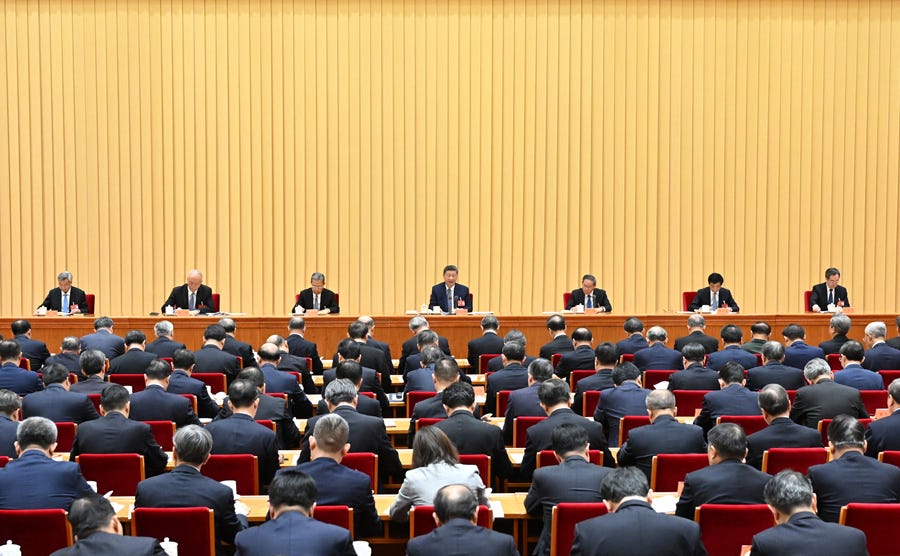
The annual Central Economic Work Conference (CEWC) was held in Beijing from Wednesday to Thursday, setting out China’s economic policy priorities for 2026, according to the state news agency Xinhua.
This year’s Chinese readout runs to just over 3,600 characters, slightly shorter than last year’s 4,000-plus-character text.
Below is some notes, along with the full translation of the Chinese readout.
1. Re-emphasis of "cross-cyclical adjustment" may signal a view that the economy is back on track
明年经济工作在政策取向上,要坚持稳中求进、提质增效,发挥存量政策和增量政策集成效应,加大逆周期和跨周期调节力度……
In terms of policy orientation for next year’s economic work, the meeting pointed out, efforts must be made to pursue progress while maintaining stability and improve quality and efficiency. It stressed the need to bring into full play the combined effects of existing and new policies, increase the intensity of counter-cyclical and cross-cyclical regulation…
Note: In the near term, “counter-cyclical” and “cross-cyclical” adjustment are key phrases to watch for how much weight policymakers place on stabilizing growth and how forcefully they are prepared to act. When “counter-cyclical adjustment” is stressed, more forceful policy support is usually in sight; when “cross-cyclical adjustment” is emphasized, the stance tends to be more conservative.
At the Sept. 26, 2024 Politburo meeting, “cross-cyclical” disappeared entirely from the readout. That signaled a shift in priorities: from balancing long-term development and short-term stability to focusing squarely on shoring up current growth.
More than a year later, the Politburo meeting earlier this week formally brought back “cross-cyclical,” and today’s CEWC has carried that wording through. This is a very important change.
It likely reflects a top-level judgment that China’s economy has moved back onto a more normal track, and that policy is shifting from “extraordinary” responses toward a more normalized and balanced approach.
That judgment is also reflected in how the situation is described: last year, the focus was to “prevent and resolve risks in key areas and external shocks,” whereas this year the wording has shifted to “better coordinate domestic economic work and the country’s international economic and trade endeavors,” suggesting a more proactive approach to managing and responding to current challenges.
2.“More proactive” fiscal policy and “moderately loose” monetary policy: wording unchanged, stance likely tighter
要继续实施更加积极的财政政策。保持必要的财政赤字、债务总规模和支出总量……要继续实施适度宽松的货币政策
The country should continue to adopt a more proactive fiscal policy….It should maintain an appropriate level of fiscal deficit, overall debt and total expenditure, strengthen scientific fiscal management…
The country should continue to implement a moderately loose monetary policy.
Note: Taken together with the renewed emphasis on “cross-cyclical adjustment” above, monetary policy in practice may already be shifting onto a more cautious footing. Expectations for further easing next year should probably be tempered, even though the official description of a “moderately loose” stance has been preserved for various reasons.
This stance can be echoed by a piece on Financial News金融时报, a newspaper under the People’s Bank of China back in November:
货币政策虽然还有一定空间,但边际效率已明显下降。必须警惕过度放松货币金融条件可能产生的一些负面效果。比如,资金空转、资本市场波动加大等
While monetary policy still has some room, its marginal effectiveness has clearly declined. We must be vigilant against potential negative consequences of excessively loose monetary and financial conditions, such as funds circulating within the financial system without reaching the real economy, and increased volatility in capital markets.
3. 2026 task-setting: No.1 priority is expanding the domestic circulation
一是坚持内需主导,建设强大国内市场。深入实施提振消费专项行动,制定实施城乡居民增收计划……优化“两新”政策实施……优化实施“两重”项目……
First, efforts should be made to uphold the leading role of domestic demand and build a robust domestic market. A special campaign dedicated to stimulating consumption should be implemented, and plans should be formulated and implemented to increase the incomes of urban and rural residents…the implementation of projects for implementing major national strategies and building security capacity in key areas should be optimized…
Note: For the second year in a row, domestic demand tops the list of economic tasks. This is hardly a surprise. The renewed focus comes against the backdrop of China’s goods trade surplus reaching a record US$1 trillion in the first 11 months of this year.
Within domestic demand, boosting consumption is the core priority.
On incomes, this year’s wording is: “plans should be formulated and implemented to increase the incomes of urban and rural residents.” Last year, the phrase was: “efforts should be made to increase the incomes, alleviate the burdens of low- and middle-income groups.”
Two changes stand out:
• The target group is broader. Last year the focus was explicitly on low- and middle-income groups; this year it is “urban and rural residents,” a clearly wider universe.
• The tools are more concrete. Last year’s “make efforts” was vague; this year’s “formulate and implement plans” is more specific and implementation-focused. That suggests there may be room to expect somewhat stronger, more targeted pro-consumption policies.
In addition, many of last year’s measures are set to continue, such as the “special campaign dedicated to stimulating consumption” and the optimization of the “two new” policies on equipment upgrades and consumer goods trade-in.
4. 2026 task-setting: No.2 priority is innovation and new growth drivers
二是坚持创新驱动,加紧培育壮大新动能。制定一体推进教育科技人才发展方案……深化拓展“人工智能+”,完善人工智能治理。创新科技金融服务。
Second, efforts should be made to follow an innovation-driven strategy and speed up fostering and strengthening new growth drivers… The “AI Plus” initiative should be deepened and expanded, and AI governance should be improved. Financial services for science and technology should be innovated.
Note: The top two tasks — expanding domestic demand and accelerating innovation — both reflect the particular context of 2026.
Next year marks the start of the 15th Five-Year Plan, which is expected to focus heavily on big pushes in science, technology and industrial upgrading.
It is also a key year in what might be called a pause in “China-U.S. trade war 2.0.” Both sides have incentives to use this window to reduce or resolve critical choke points where they depend on the other side.
Against that backdrop, the two core priorities for 2026 fall into place:
• Build out the domestic circulation to cushion the impact of any renewed trade frictions.
• “Speed up” the cultivation of new growth drivers to cut technological and industrial vulnerabilities more quickly.
Moreover, the AI Plus initiative, first raised last year, will also continue and deepen, with an emphasis on embedding AI across the real economy and broader society.
5. 2026 task-setting: Risk prevention (especially real estate) pushed down to the last slot
八是坚持守牢底线,积极稳妥化解重点领域风险。着力稳定房地产市场,因城施策控增量、去库存、优供给,鼓励收购存量商品房重点用于保障性住房等……有序推动“好房子”建设。加快构建房地产发展新模式。
Eighth, efforts should be made to firmly guard the bottom line and actively and prudently defuse risks in key areas. Focus should be placed on stabilizing the real estate market. City-specific measures should be taken to control new supply, reduce inventory and optimize supply, and the purchase of existing commercial housing should be encouraged, with a focus on using it as government-subsidized housing and for other purposes…and efforts should be made in an orderly manner to advance the construction of “good housing.” The country should accelerate its efforts to foster a new development model for the real estate sector.
Note: The way housing appears and disappears in policy language throughout 2025 arguably reflects ongoing hesitation and internal debate at the top over how to approach the property sector.
For example, at the July Politburo meeting, real estate was not mentioned explicitly at all. The readout only said “implement the spirit of the Central Urban Work Conference and carry out urban renewal in a high-quality way,” effectively folding the property issue into urban work — a clear downplaying.
In August, however, Premier Li Qiang chaired the ninth plenary meeting of the State Council and called for “strong measures” to consolidate the nascent stabilization in the housing market, a tone that cut against the downplaying seen in July.
In the December Politburo meeting a few days ago, real estate once again dropped out of the wording, only to reappear at this CEWC.
In practical terms, there have been very few substantive support measures for housing this year, aside from limited easing of purchase restrictions in outer rings of some first-tier cities in September. The stance has been hesitant and cautious.
For 2026, the work on the housing market is framed around three concrete approaches:
• Control new supply: “control new supply” through city-specific measures;
• Reduce inventory: “reduce inventory,” with an emphasis on government-backed purchases of existing commercial housing, especially for subsidized housing and related uses;
• Optimize supply: “optimize supply” by “advancing the construction of ‘good housing’ in an orderly manner,” while “accelerating efforts to foster a new development model for the real estate sector.”
6. First-ever mention of “positive attitudes toward marriage and childbearing”
七是坚持民生为大……倡导积极婚育观,努力稳定新出生人口规模……
Seventh, efforts should be made to put people’s wellbeing first…Positive attitudes toward marriage and childbearing should be advocated, and efforts should be made to stabilize the number of newborns…
Note: This is an interesting formulation, indicating that demographic challenges, especially around fertility, have risen on the leadership’s agenda.
Below is the full translation of the readout by Yuzhe He:
BEIJING, Dec. 11 (Xinhua) -- The Central Economic Work Conference was held in Beijing from Dec. 10 to 11. Xi Jinping, general secretary of the Communist Party of China (CPC) Central Committee, Chinese president and chairman of the Central Military Commission (CMC), attended the conference and delivered an important speech. Li Qiang, Zhao Leji, Wang Huning, Cai Qi, Ding Xuexiang and Li Xi, all members of the Standing Committee of the Political Bureau of the CPC Central Committee, also attended the conference.
In his speech, Xi summarized the economic work in 2025, analyzed the current economic situation and arranged the economic work for 2026. Li Qiang delivered a summary speech, in which he laid out requirements for implementing the guiding principles of Xi’s speech and doing a good job in economic work next year.
2025 is a truly extraordinary year, the meeting noted. In the face of difficulties, the CPC Central Committee with Comrade Xi Jinping at its core has united and led the entire Party and the Chinese people of all ethnic groups to forge ahead with resolve and work hard. It has unswervingly applied the new development philosophy, promoted high-quality development, coordinated both domestic and international imperatives, and implemented more proactive and impactful macro policies, ensuring that the main goals and tasks of economic and social development will be successfully completed. China’s economy has forged ahead under pressure and achieved development toward greater innovation and higher quality, the building of a modern industrial system has continued to advance, fresh progress has been made in reform and opening up, positive headway has been made in defusing risks in key areas, and people’s livelihood has been better safeguarded. Over the past five years, China has effectively dealt with various shocks and challenges and promoted new major achievements in the cause of the Party and the country. The 14th Five-Year Plan (2021-2025) is drawing to a successful close, and a good start has been made in embarking on the new journey toward the second centenary goal.
The meeting noted that, through practice, we have gained new understanding and experience in doing a good job in economic work under the new circumstances. It is imperative to fully tap the potential of the economy. It is essential to advance policy support and reform and innovation in parallel. It is necessary to ensure both an economy that is dynamic thanks to appropriate deregulation and one that is well-regulated thanks to effective governance. It is important to closely combine investment in physical assets with investment in people. It is also crucial to strengthen our internal strengths in order to cope with external challenges.
The meeting pointed out that China still faces many long-standing problems and new challenges in its economic development. The impacts of changes in the external environment have deepened, while at home, the contradiction between strong supply capacity and weak demand is prominent, and there are many risks and hidden dangers in key areas. Most of these are problems that have arisen in the course of development and transformation and can be resolved through hard work. The supporting conditions and fundamental trend for China’s long-term sound economic growth remain unchanged. It is necessary to strengthen confidence, make good use of our strengths, and rise to the challenges, so as to continuously consolidate and expand the sound momentum of steady economic performance.
The meeting emphasized that to do a good job in next year’s economic work, it is necessary to follow the guidance of Xi Jinping Thought on Socialism with Chinese Characteristics for a New Era, and fully implement the guiding principles of the 20th CPC National Congress and all plenary sessions of the 20th CPC Central Committee. The new development philosophy must be fully and accurately applied on all fronts, efforts to foster a new development paradigm must be accelerated, and high-quality development must be promoted with a strong focus. It is imperative to adhere to the general principle of pursuing progress while maintaining stability, better coordinate domestic economic work and the country’s international economic and trade endeavors, and better coordinate development and security. More proactive and impactful macro policies should be implemented, with enhanced forward-looking, targeted and coordinated macro regulation. Continuous efforts should be made to expand domestic demand and optimize supply, make better use of incremental resources and revitalize existing resources, and develop new quality productive forces in light of local conditions. Efforts should be made to push ahead with the building of a unified national market in greater depth, continue to prevent and defuse risks in key areas, and focus on stabilizing employment, enterprises, markets and expectations. The goal is to promote a qualitative improvement in economic performance and reasonable quantitative growth, maintain social harmony and stability, and secure a good start to the 15th Five-Year Plan (2026-2030).
In terms of policy orientation for next year’s economic work, the meeting noted, efforts must be made to pursue progress while maintaining stability and improve quality and efficiency. It stressed the need to bring into full play the combined effects of existing and new policies, increase the intensity of counter-cyclical and cross-cyclical regulation, and enhance the effectiveness of macroeconomic governance. The country should continue to adopt a more proactive fiscal policy. It should maintain an appropriate level of fiscal deficit, overall debt and total expenditure, strengthen scientific fiscal management, optimize the structure of fiscal expenditure, and regulate tax incentives and subsidy policies. Greater attention should be paid to resolving fiscal difficulties at the local level and ensuring that basic living needs are met, salaries are paid, and governments function smoothly at the primary level. Fiscal and economic discipline must be strictly observed, and CPC and government departments should keep their belts tightened.
The country should continue to implement a moderately loose monetary policy. Promoting steady economic growth and a reasonable rebound in prices should be taken as important considerations for monetary policy. It is necessary to flexibly and efficiently make use of various policy tools, including cuts in the reserve requirement ratio and interest rates, maintain ample liquidity, and ensure smooth transmission of monetary policy, so as to guide financial institutions to increase support for expanding domestic demand, boosting scientific and technological innovation, and serving micro, small and medium-sized enterprises and other key areas. The RMB exchange rate should be kept basically stable at a reasonable and balanced level.
It is important to enhance the consistency and effectiveness of macro policy orientation. Economic and non-economic policies, as well as existing and new policies, should all be included in the evaluation of the consistency of macroeconomic policy orientation. A sound expectation management mechanism should be established to boost social confidence.
The meeting outlined the following key tasks for 2026.
First, efforts should be made to uphold the leading role of domestic demand and build a robust domestic market. A special campaign dedicated to stimulating consumption should be implemented, and plans should be formulated and implemented to increase the incomes of urban and rural residents. Efforts should be made to expand the supply of quality goods and services. The implementation of large-scale equipment upgrades and consumer goods trade-in programs should be further optimized. Unreasonable restrictions in the field of consumption should be removed to unleash the potential of service consumption. Work should be done to halt the decline in and stabilize investment. Investment from the central government budget should be appropriately increased, the implementation of projects for implementing major national strategies and building security capacity in key areas should be optimized, the management of the use of local government special-purpose bonds should be improved, and new-type policy-based financial instruments should continue to play their role, so as to effectively stimulate the vitality of nongovernmental investment. Urban renewal should be advanced in a high-quality manner.
Second, efforts should be made to follow an innovation-driven strategy and speed up fostering and strengthening new growth drivers. An integrated plan for the coordinated development of education, science and technology, and talent should be formulated. International science and technology innovation centers should be built in Beijing (Beijing-Tianjin-Hebei region), Shanghai (Yangtze River Delta) and the Guangdong-Hong Kong-Macao Greater Bay Area. The principal role of enterprises in innovation should be strengthened and the intellectual property protection system for emerging fields should be improved. An action plan for expanding the capacity and improving the quality of the service sector should be formulated and implemented. A new round of actions should be taken to promote the high-quality development of key industrial chains. The “AI Plus” initiative should be deepened and expanded, and AI governance should be improved. Financial services for science and technology should be innovated.
Third, efforts should be made to press ahead with reform in key areas and enhance the driving force and vitality for high-quality development. A regulation on building a unified national market should be formulated, and rat-race irrational competition should be thoroughly addressed. Plans should be formulated and implemented to further deepen the reform of state-owned capital and state-owned enterprises, and supporting regulations and policies for the private sector promotion law should be improved. Work should be accelerated to clear overdue payments owed to enterprises. Efforts should be made to promote win-win development for platform enterprises and the operators and workers on their platforms. Trials for market-based allocation of production factors should be expanded. A sound local tax system should be established. Further efforts should be made to streamline and upgrade small and medium-sized financial institutions, and the comprehensive reform of investment and financing in the capital market should be continuously deepened.
Fourth, efforts should be made to stay committed to opening up and promote win-win cooperation in multiple fields. Institutional opening up should be steadily advanced, voluntary opening up in the service sector should be expanded in an orderly manner, and the layout and scope of pilot free trade zones should be optimized, while solid progress should be made in building the Hainan Free Trade Port. Integrated development of trade and investment and of domestic and foreign trade should be promoted. Service exports should be encouraged and supported, and digital trade and green trade should be actively developed. The institutions and mechanisms for promoting foreign investment should be further reformed. The overseas comprehensive service system should be improved. High-quality Belt and Road cooperation should be promoted, and efforts should be made to advance the conclusion of more regional and bilateral trade and investment agreements.
Fifth, efforts should be made to promote coordinated development and advance integrated urban-rural development and regional collaboration. Work should be done in a coordinated manner to advance urbanization with county seats as an important vehicle and to promote all-around rural revitalization, so as to boost high-quality development of county economies. The red line for the total area of China’s farmland must be resolutely safeguarded, and grain production must be pursued with unrelenting efforts, so as to keep the prices of grain and other key farm produce within a reasonable range. Gains made in poverty alleviation should be further consolidated and expanded, regular assistance should be incorporated into the overall strategy of rural revitalization, and the bottom line of preventing large-scale lapses or relapses into poverty should be firmly guarded. Major economically developed provinces should be supported in playing a leading role. Coordination among key city clusters should be strengthened and cooperation across administrative regions should be deepened. Overall planning for major bays should be strengthened to promote the high-quality development of the maritime economy.
Sixth, efforts should be made to follow the “dual carbon” goals as a guiding principle and promote a comprehensive green transition. Work should be further advanced to upgrade energy conservation and carbon reduction in key industries. A master plan for building China into an energy powerhouse should be formulated, the development of a new-type energy system should be accelerated, and the use of green electricity should be expanded. Efforts should be stepped up to develop the national market for carbon emissions trading. An action plan for the comprehensive treatment of solid waste should be implemented, and continued and intensive efforts should be made to keep the skies blue, waters clear and lands clean, with strengthened governance of new pollutants. Solid progress should be made in the tough battle for the Three-North Shelterbelt Forest Program, and efforts should be made to integrate and optimize nature reserves. The meteorological monitoring, forecasting and early warning system should be strengthened, and shortcomings in flood control, drainage and disaster mitigation infrastructure in northern regions should be addressed at a faster pace, so as to enhance the capacity to cope with extreme weather events.
Seventh, efforts should be made to put people’s wellbeing first and strive to do more practical things for the people. Actions should be taken to stabilize jobs, expand employment and improve job quality, with a focus on stabilizing employment for key groups such as college graduates and migrant workers, and encouraging and supporting people in flexible and new forms of employment to participate in employee insurance schemes. The layout and structure of education resources should be adjusted and improved, with increased supply of senior high school places and expanded enrollment in quality undergraduate programs at higher education institutions. The centralized procurement of medicines should be optimized, and reform of medical insurance payment methods should be deepened. A project to expand and upgrade rehabilitation and nursing services should be implemented, the long-term care insurance system should be promoted, and care and assistance for disadvantaged groups should be strengthened. Positive attitudes toward marriage and childbearing should be advocated, and efforts should be made to stabilize the number of newborns. Solid efforts should be made to ensure work safety, disaster prevention, mitigation and relief, and food and drug safety.
Eighth, efforts should be made to firmly guard the bottom line and actively and prudently defuse risks in key areas. Focus should be placed on stabilizing the real estate market. City-specific measures should be taken to control new supply, reduce inventory and optimize supply, and the purchase of existing commercial housing should be encouraged, with a focus on using it as government-subsidized housing and for other purposes. Reform of the housing provident fund system should be deepened, and efforts should be made in an orderly manner to advance the construction of “good housing.” The country should accelerate its efforts to foster a new development model for the real estate sector. Active and orderly measures should be taken to defuse local government debt risks, and local authorities should be urged to take the initiative in debt resolution, with no new hidden debt allowed in violation of laws and regulations. Debt restructuring and swap arrangements should be optimized, and multiple measures should be taken to defuse operating debt risks of local government financing vehicles.
The meeting urged that thinking and actions be unified with the CPC Central Committee’s scientific assessment of the situation and that the overall trend of China’s development be accurately grasped, so as to strengthen confidence in future development. It called for comprehensively implementing the overall requirements and policy orientation for next year’s economic work, adhering to an active and pragmatic target-oriented approach, focusing on resolving existing difficulties and problems, making greater breakthroughs in achieving effective qualitative improvement, and enhancing the sense of gain among residents and enterprises. It emphasized the need to strengthen the synergy between reform and policies, and continue to improve economic performance and market expectations.
The meeting stressed the need to identify the key focal points of next year’s economic work within the broader picture. Efforts should be made to focus on strengthening the domestic circulation and opening up new space for domestic demand growth; to focus on developing new quality productive forces and promoting deep integration between scientific and technological innovation and industrial innovation; to focus on stimulating the driving force and vitality for high-quality development and unswervingly deepen reform and expand opening up; to focus on continuously improving people’s wellbeing and increase efforts to ensure and improve people’s livelihood; and to focus on firmly guarding the security bottom line and prudently defusing risks in key areas.
The meeting emphasized that it is necessary to strengthen the CPC’s overall leadership over economic work and form unified will and strong synergy. It stressed the need to uphold the centralized and unified leadership of the CPC Central Committee, and for all regions and departments to fully implement the CPC Central Committee’s thinking, tasks and policies on next year’s economic work in light of their own realities and local conditions. It is important to establish and apply a correct view of political achievements, stay committed to delivering governance outcomes for the people and achieving solid results through hard work, consciously act in line with objective laws, and improve differentiated evaluation systems for assessing performance. In line with the proposals adopted at the fourth plenary session of the 20th CPC Central Committee, national and local 15th Five-Year Plans and special plans should be drawn up to promote high-quality and sustainable development. Efforts should be made to foster a sound political environment, talent environment, business environment and public-opinion environment, strengthen policy communication and interpretation, and fully stimulate positive energy in society.
The meeting demanded efforts to ensure the supply of key livelihood-related commodities at the turn of the year, care for people in difficulty in their production and daily life, and resolutely prevent and curb major and serious accidents.
The meeting called on the whole Party and all sectors of society to closely unite around the CPC Central Committee with Comrade Xi Jinping at its core, forge ahead with unity and resolve, work hard to achieve next year’s economic and social development goals and tasks, and ensure a good start to the 15th Five-Year Plan (2026-2030).
Members of the Political Bureau of the CPC Central Committee, secretaries of the Secretariat of the CPC Central Committee, vice chairpersons of the Central Military Commission, leaders of the Standing Committee of the National People’s Congress, state councilors, president of the Supreme People’s Court, procurator-general of the Supreme People’s Procuratorate, leaders of the National Committee of the Chinese People’s Political Consultative Conference, members of the Central Military Commission, and others attended the meeting.
Also present at the meeting were leading officials of provinces, autonomous regions, municipalities directly under the central government, municipalities with independent budgetary status, and the Xinjiang Production and Construction Corps, as well as leading officials from relevant central Party and government departments, people’s organizations, some financial institutions and enterprises under central management, and relevant departments of the CMC. Enditem