

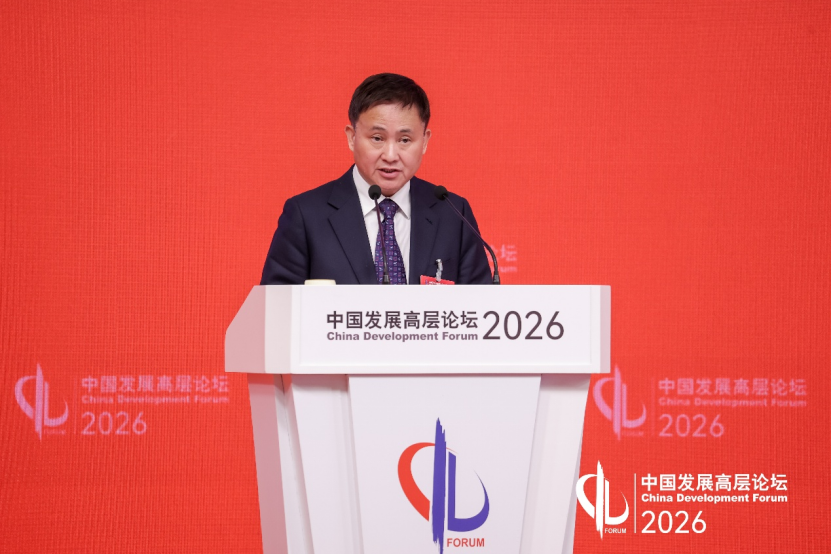
Below is the full translation of the speech by Pan Gongsheng, governor of the People's Bank of China (PBoC), delivered at the China Development Forum 2026 on 22 March.
Key takeaways for international observers include:
In a direct acknowledgment of domestic involutionary competition, Pan confirms that Beijing is actively stepping in. The central government is now prohibiting local municipalities from offering unreasonable tax and land subsidies to attract investment, and the PBoC is actively restricting financing to over-saturated sectors.
Furthermore, addressing fears of a looming currency war amidst trade frictions, Pan explicitly shuts down speculation of a competitive devaluation, saying: "China has no need, nor any intention, to acquire trade competitive advantages through exchange rate depreciation."
Pan also pushes back against the narrative that China's trade surplus is the root of global imbalances, instead pointing to the structural flaws of the US dollar-dominated international monetary system and the weaponization of trade policies.
The following English translation has not been reviewed by Mr. Pan.
中国高质量发展与全球经济再平衡——中国人民银行行长潘功胜在2026中国发展高层论坛上的主题演讲
China's High-Quality Development and Global Economic Rebalancing—Keynote Speech by Pan Gongsheng, Governor of the People's Bank of China, at the China Development Forum 2026
Distinguished guests,
Good afternoon!
It is a great pleasure to attend this year's China Development Forum. I would like to extend sincere thanks to friends from all sectors for your continued interest in and support for China's financial development.
Taking this opportunity, I would like to share three observations under the theme of "China's High-Quality Development and Global Economic Rebalancing".
I. Global Economic Rebalancing and China's Contribution
At present, geopolitical conflict and trade frictions are occurring with increasing frequency. Discussion of global economic imbalances and rebalancing has grown markedly, and the issue has also become an important topic on this year's G20 agenda.
Since the beginning of this century, the global economy has gone through three major phases of dynamic rebalancing. China has been deeply involved in all three and has made positive contributions throughout.
The first phase came between 2001 and 2007, after China joined the WTO. By leveraging its cost advantages, China integrated into the global division of labor, effectively expanding global supply, raising productive efficiency, easing inflationary pressures worldwide, and supporting global growth.
The second phase came between 2008 and 2017, in the aftermath of the global financial crisis. During that period, global demand was generally weak, and the world economy was characterized by "three lows and one high": low growth, low inflation, low interest rates, and high debt.
China responded proactively by significantly expanding domestic demand and imports, helping to support global growth and prevent the world economy from slipping into deflation. China's contribution to global growth has remained at around 30 percent, making it the main engine of world economic growth, and this has continued to the present day.
The third phase has unfolded since the pandemic. Supply shocks and strong stimulus on the demand side, together with the rise of protectionism and de-globalization, once pushed global inflation sharply higher. China's supply chain system remained stable, continuing to make an important contribution to global price stability and overall economic balance.
China's own economy has also undergone profound structural adjustment and dynamic rebalancing. The contribution of consumption to economic growth rose from 37 percent in 2010 to 52 percent in 2025. The current account surplus as a share of GDP has fallen from around 10 percent in 2007 to an average of less than 2 percent over the past decade, which is within a reasonable range.
Here, I would like to briefly discuss two issues.
First, how should we understand the source of China's industrial competitiveness?
The rise in China's industrial competitiveness is first and foremost the result of more than 40 years of reform and opening up. In the course of opening up, China has learned from international partners, including the many outstanding global companies represented here today. China has learned through competition, and grown through learning.
Meanwhile, the following four factors have played a vital role in elevating China's industrial competitiveness:
A mega-sized market. Technological innovation can be industrialized, scaled up, commercialized, and iterated rapidly, generating both technological leadership and cost advantages.
A complete industrial and supply chain system. Industrial ecosystems, supply networks, R&D institutions, and digital infrastructure are highly clustered in certain regions, facilitating efficient division of labor and synergy.
Abundant, high-quality, skilled, and diligent labor resources, especially technical talent. China has over 72 million highly skilled professionals, and its total number of R&D personnel has ranked first in the world for many years, making it the country with the largest and most comprehensive talent pool globally.
Technological innovation capabilities driven by sustained R&D investment. Over the past five years, China's R&D expenditure has grown by an average of more than 10% annually. In 2025, China's total R&D expenditure was second only to the United States, ranking second globally; its R&D intensity (R&D expenditure as a percentage of GDP) exceeded the OECD average.
Internationally, there is still a perception that China's industrial competitiveness stems from unreasonable government subsidies. For those who hold such doubts, I encourage you to travel and see more of China, which will help foster a more accurate and comprehensive understanding of Chinese industries.
As Premier Li Qiang emphasized in his speech earlier, China advocates for fair, benign, and healthy competition. Addressing the "involutionary" competition among certain enterprises, the central government has taken measures to regulate local government investment attraction practices, prohibiting unreasonable preferential policies such as tax and land use subsidies, in order to build a unified national market.
China is also strictly enforcing industrial and environmental technical standards to restrict low-level competition. Concurrently, the People's Bank of China (PBOC) is guiding financial institutions to scientifically assess risks, curbing financing for industries plagued by "involutionary" competition from a financial perspective.
These efforts have already yielded positive results. The decline in China's PPI narrowed from -3.6% in July last year to -0.9% in February this year, and corporate operating conditions have also improved.
Second, how should we view and analyze the issue of global economic imbalances?
This is a frequently discussed topic internationally, and I would like to share my perspective.
When analyzing global economic imbalances, we must look at both goods and services trade, as well as both current and financial accounts. China is the largest surplus country in goods trade, but it is also the largest deficit country in services trade. The current account surplus accumulated by China is allocated to different regions and industries globally through outbound investments by enterprises and banks, injecting liquidity into global financial markets and strongly supporting global economic development and financial stability.
We must analyze this not only from a static perspective but also from a dynamic one. From a temporal dimension, the balance of supply and demand is a relative concept. Whether globally or within a single economy, the expansion and contraction of supply-demand gaps are subject to various disturbances.
For instance, recent conflicts in the Middle East caused a supply-side shock to oil, leading to a surge in prices. However, over a longer cycle, market forces will self-adjust to achieve a dynamic equilibrium. Economic development, income growth, changes in consumer preferences, and technological advancements create new forms of supply and demand, thereby creating new markets.
From a spatial dimension, whether between nations or among different regions within a country, building a unified market and engaging in division of labor and trade based on comparative advantages can maximize overall welfare. Thinking back to the 1980s and 1990s when I studied economics at university, a fundamental consensus in the global economic academic community was that a free trade system based on comparative advantage is the foundation of global prosperity and helps enhance global well-being. International trade is not coercive; it is the result of voluntary choices made by hundreds of millions of enterprises and households.
We must pay attention to not only economic factors but also non-economic ones. Last year, tariff and trade wars triggered a "rush to export," and the overstretch of national security concepts led to increased export control measures. These factors have disrupted the expectations of enterprises and households, causing significant disturbances to the global economic balance.
We must analyze not only the international economic and trade system but also the international monetary system. Trade surpluses are the result of the evolution of the global industrial division of labor. Over the past 40 years, the major global surplus countries have generally been those with strong manufacturing competitiveness, such as Japan, Germany, Switzerland, and China, and in recent years, this has gradually shifted to some emerging market economies in Southeast Asia. However, the major deficit countries have remained largely unchanged. This is related to the inherent flaws of the international monetary system.
In an international monetary system dominated by a single sovereign currency, the issuer of the major reserve currency can implement deficit financing over the long term at lower financing costs, exporting its currency through large-scale current account deficits. Meanwhile, sustained capital inflows objectively cause the major reserve currency to be overvalued, which to some extent weakens that country's manufacturing competitiveness.
Currently, stable, rational, and predictable cooperation is particularly precious. Trade fragmentation is undermining the foundation of free trade. We need to more resolutely oppose all forms of trade protectionism, consolidate and develop the rules-based multilateral framework and international economic and trade order with the WTO at its core, and promote inclusive economic globalization.
II. China is Actively Promoting the Transformation of its Economic Growth Model to Enhance Growth Quality and Sustainability
The recently concluded "Two Sessions" in China reviewed and approved the 2026 Government Work Report and the Outline of the "15th Five-Year Plan," clarifying the economic and social development goals and major policies for this year and the next five years. There are five key features that deserve special attention:
Setting scientific and reasonable economic growth targets. Mathematically, the economic growth rate is the ratio of the annual GDP increment to the total volume. In 2025, China's total GDP exceeded 140 trillion RMB (around USD 20 trillion); the annual increment is equivalent to the entire annual economic output of a medium-sized economy. China needs to maintain a reasonable economic growth rate, but the quality and sustainability of that growth are even more important. The Government Work Report set this year's economic growth target at 4.5%-5%, leaving greater room for structural adjustment and high-quality development.
Focusing on the transformation of the economic growth model. The 15th Five-Year Plan focuses on high-quality development, strengthening the domestic economic circulation, and persisting in domestic demand-led growth. China will implement policies to boost consumption, improve the income distribution system, optimize the social security system, expand investment and consumption in areas such as education, healthcare, and elderly care, and significantly increase the household consumption rate. China will vigorously develop the service sector and promote its reform, innovation, opening up, and cooperation. Building upon its foundation as a global manufacturing powerhouse, China will accelerate its transition into a core global demand market.
Emphasizing sci-tech innovation to drive productivity growth. Sci-tech innovation is China's clear and firm long-term strategic choice, which not only aligns with the trend of the global technological revolution but also meets the requirements of China's high-quality development. China will continue to promote the deep integration of sci-tech innovation and industrial innovation, strengthen the protection and application of intellectual property rights, and boost productivity.
Accelerating green transition and sustainable development. China has built the world's largest renewable energy system and the most complete new energy industry chain, driving a substantial decline in global wind and solar power costs. China will continue to vigorously develop a green and low-carbon economy, striving to peak carbon emissions before 2030 and achieve carbon neutrality before 2060, while upholding the multilateral climate process and facilitating global green and low-carbon development.
Further improving economic governance. China will scientifically manage and balance the boundaries between the government and the market, respecting and leveraging the market's decisive role in resource allocation. China will advance the construction of a unified national market, foster a sound legal environment for the economy, and create a fairer, more dynamic market environment.
The dynamic balancing and structural transformation of the economy require medium- to long-term reform plans and commitments that must be executed resolutely, rather than constantly "flip-flopping" on policies. This year, China will begin implementing its 15th Five-Year Plan. The scientific formulation and sequential implementation of Five-Year Plans is a vital experience in China's reform and development, as well as a significant institutional advantage.
III. Intensifying Financial Support for China's Economic Structural Transformation
The PBoC will maintain a supportive monetary policy stance to create a favorable monetary and financial environment for stable economic growth, high-quality development, and the smooth operation of financial markets.
China will continue to implement a moderately accommodative monetary policy. Currently, China's social financing conditions remain accommodative, and total financial aggregates are growing reasonably. We will balance the relationships between the short term and long term, between supporting real economy growth and maintaining the health of the financial system itself, and between internal and external equilibrium. We will comprehensively utilize various monetary policy tools, such as reserve requirement ratios, policy interest rates, and open market operations, to maintain ample liquidity.
According to the IMF's classification standards, China implements a managed floating exchange rate system. Since the beginning of this year, the RMB exchange rate has appreciated by approximately 1.3% against the US dollar, 3.7% against the Euro, 3.2% against the Japanese Yen, and 2.4% against the British Pound.
China has no need, nor any intention, to acquire trade competitive advantages through exchange rate depreciation. The PBoC's stance has always been clear: we adhere to the decisive role of the market in exchange rate formation, maintain exchange rate flexibility, and simultaneously strengthen expectation guidance to keep the RMB exchange rate basically stable at an adaptive and equilibrium level. The PBoC's expectation guidance, along with the use of transparent macro-prudential management tools that align with international rules and practices, corrects market "herd behavior" and market failures, helping to prevent the destructive equilibria that have repeatedly occurred in international financial history.
China will steadily promote high standard opening up of the financial sector. It will deepen the inter-connectivity of financial markets and cross-border payment systems to facilitate more investors in accessing Chinese financial markets. The scale of China's stock and bond markets both rank second globally, with market depth, resilience, and liquidity continuously improving. By the end of 2025, RMB financial assets—including domestic stocks, bonds, deposits, and loans—held by overseas institutions and individuals exceeded 10 trillion RMB. We welcome overseas investors to participate and invest in China's financial markets.
In recent years, the internationalization of the RMB has made positive progress, providing domestic and foreign entities with more diversified currency choices. Currently, RMB financing costs are relatively low. In 2025, multinational governments, international development institutions, financial institutions, and large enterprises issued Panda bonds exceeding 170 billion RMB, and the scale of offshore RMB bonds issued in Hong Kong was even larger.
China will continuously improve the institutional arrangements and financial infrastructure for the cross-border use of the RMB. It will carry out diversified monetary and financial cooperation, promote the development of the offshore RMB market, and facilitate cross-border trade and investment activities.
China will actively practice the Global Governance Initiative proposed by General Secretary Xi Jinping and actively participate in and promote the reform and improvement of global financial governance. It will strengthen international macroeconomic policy communication and coordination, improve the governance of international financial organizations, and build a diversified and efficient global financial safety net to more effectively maintain global economic and financial stability.
Distinguished guests, against the backdrop of rising global uncertainty, China will, with responsibility and courage, continue to play its role as the main engine of world economic growth, providing strong growth momentum and a stabilizing force to the world. We stand ready to work with all parties to steer the global economy toward a more open, inclusive, and balanced direction.
Thank you!
Mr Pan's noteworthy explanation that it is the US dollar-dominated international monetary system, and weaponization of trade policies that are the central challenge here, and not China's trade surplus. Thankyou.
Highlights: https://igreaterchina.substack.com/p/chinas-high-quality-development-and?r=gf5z1