

The scandal that brought down Nvidia's Jensen Huang has thrust the U.S.-China chip war back into the spotlight, giving Washington's China hawks fresh ammunition to push for tighter export controls. But the race for AI supremacy is about more than access to advanced chips. At its core, it is also a contest over capital: who can afford to invest billions, and who can afford to lose them.
As Mei Yonghong recently argued, the second half of the U.S.-China technology contest will be fought over the strength of each country's innovation ecosystem. And a crucial part of that ecosystem is whether capital is willing to back unproven ideas, and whether investors can stomach failure.
This question lies at the heart of an October 16 speech by Peng Wensheng (彭文生), former chief economist of China International Capital Corporation (CICC). Peng notes that AI is transforming the economics of innovation, with deep-pocketed technology giants and private credit increasingly taking center stage in financing the boom.

His more pointed observations concern China. Despite lower interest rates, Chinese investors show less appetite for risk. Even government-backed funds created to support innovation often face pressure to preserve capital, deliver predictable returns and exit investments early. Money intended to nurture risky ventures may end up avoiding risk altogether.
America, meanwhile, seems more willing to finance the AI revolution with a healthy dose of speculation. Even if the bubble bursts, private investors may lose their money while society keeps the technological gains.
For China, Peng proposes greater use of government procurement to create demand for emerging technologies, reforms to make government-backed investment funds more willing to take risks, and, above all, stronger consumer demand. His argument is that innovation ultimately depends not just on the money available to finance it, but on whether there is a market for what it produces.
Peng added that China's challenge is not simply to mobilize more capital or lower financing costs. It is to create an environment in which investors are willing to take risks and have good reason to believe those risks will pay off.
Below is an edited transcript of Peng's speech delivered at the Tianjin Wudadao Forum on 16 October 2026, originally published on his personal WeChat account. The English translation is mine and has not been reviewed by Peng.
彭文生 | 关于AI创新融资的几点观察和思考
Peng Wensheng | Financing AI Innovation: Observations and Reflections
Distinguished leaders and guests,
Under the guidance of President Chen Yulu, a joint research team from the Institute of National Innovation and Finance at Nankai University and the CICC Global Institute has completed the 2026 Report on the Development of Sci-Tech Finance. Preview copies have been provided.
Combining academic research, industry experience, and financial-market perspectives, the report is a collaborative effort between academia, industry, and research institutions. It systematically analyzes and measures the innovation ecosystem, sets out the theoretical foundations of sci-tech finance, traces the development of indirect and direct financing, and examines the relationship between government and the market. It then offers targeted policy recommendations. Comments and criticism from experts and fellow academics are welcome.
Today, drawing on the report's framework, I want to examine the relationship between finance and innovation in large AI models. Why focus on these models? Recent discussions of sci-tech finance have centered on how finance supports innovation. But large AI models represent a revolutionary technological advance. What role has finance played in their rise? How might AI, in turn, change the sci-tech finance model? These questions offer broader lessons on financing innovation.
I. Large AI Models: From Scaling Laws to Economies of Scale
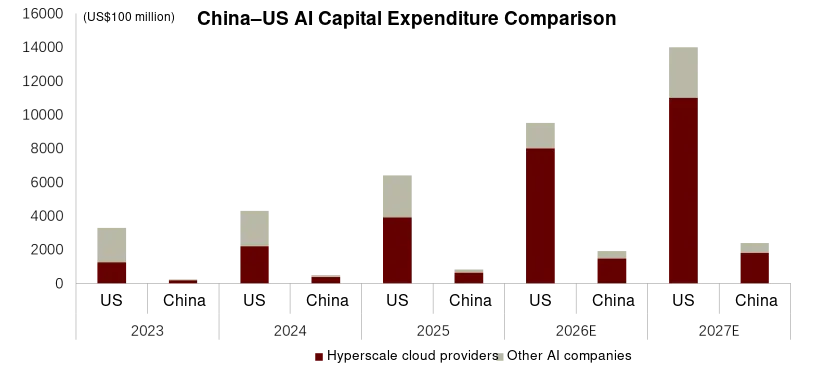
China and the U.S. currently lead the development of large AI model, but it is worth noting that U.S. AI capital spending is far higher. This raises two concerns: could America's spending fuel an asset bubble, especially after the recent sharp correction in U.S. equities? And could China's lower investment slow model development and widen the gap? AI capital expenditure is ultimately investment in future productive capacity. What economic forces shape it, and how does finance fit in?
The most obvious benefit of AI is simple: instead of searching for information, people can ask it a question. Its deeper breakthrough is the ability to produce cognitive capabilities at scale. In the past, building knowledge and understanding took decades of study, work, and human interaction. Even then, expertise remained largely confined to one's field, and learning beyond it was costly. Large AI models partly overcome that limit. Economically, they make cognitive capabilities scalable. And this raises two questions: how efficient is this large-scale production of cognitive capabilities, and how much economic and social value can they create? Two concepts help answer these questions.
First, scaling laws. Better models require more computing power, data, and electricity, but additional inputs yield progressively smaller gains in performance — what economists call diminishing returns to scale. Sustained improvements therefore require heavy, sustained investment. As Vice-Minister Li Meng noted, computing power brings together manufacturing, critical minerals, and technology. Unlike earlier, asset-light software innovation, large AI models are capital-intensive and demand substantial upfront spending, as the U.S. experience shows.
But will this investment generate returns for society? That brings us to the second concept: economies of scale. The value created when AI-generated cognitive capabilities are used in the economy depends on scale. The larger the economy and population, the broader the industries served, and the richer the applications, the greater the value large AI models can create.
Together, these two concepts explain China's and America's lead in AI. Scaling laws tell us that, as the world's two largest economies, both countries can mobilize the resources needed to overcome AI's high investment threshold and sustain model development. Economies of scale, meanwhile, suggest that the two countries also stand to gain the most from its applications, giving them strong incentives to invest. Their lead rests on both the capacity and the motivation to innovate.
But resources and incentives alone are not enough. How should innovation be organized, and how effective are its mechanisms? First, who brings together the funding, technology, and other resources needed to turn ideas into reality? In Schumpeter's terms, innovation requires entrepreneurship. In large AI models, is that role played by independent venture capital, corporate investors, or government?
Second, innovation creates positive externalities: innovators bear the risks, while society shares the gains. Markets alone may therefore underinvest. Public policy can help internalize those externalities and improve market-based resource allocation. Has government played that role in AI, and how?
II. Corporate Venture Capital (CVC), Not Independent Venture Capital (IVC), Leads AI Innovation Financing
In the digital economy 1.0 era, independent venture capital (IVC) financed the rise of internet platforms. Today, corporate venture capital (CVC) leads investment in foundational AI models. Early internet platforms were asset-light, with manageable project costs. Sohu, Sina, Tencent, and Alibaba drew early backing from IDG Capital, Sequoia Capital, SoftBank, and Goldman Sachs. These investors sought financial returns as the companies grew, allowing investors to exit through IPOs or acquisitions. CVC took off only after the first generation of internet firms had listed and amassed large cash flows.
Large technology companies, not independent VCs, now drive the development of AI models. The shift is from financial capital funding business-model innovation to corporate capital funding capital-intensive core technologies. Today's tech giants inherited a head start from digital economy 1.0: leading platforms had accumulated data and computing resources, while mature business models generated steady cash flow. This also helps explain why other major economies, including Europe, Japan, and India, lag behind China and the U.S.: they did not develop comparable domestic platforms in that earlier era.
Despite China's lower overall AI capital expenditure, spending in both countries has a similar structure: large technology companies, especially hyperscale cloud providers, account for most AI capital spending, including investment in computing infrastructure (Figure 1).
Their role extends beyond funding their own projects. Through CVC, they also back start-up teams. Their industry experience, technological expertise, data, and computing resources give them an investment advantage.
Figure 1: Large technology companies account for most AI capital expenditure
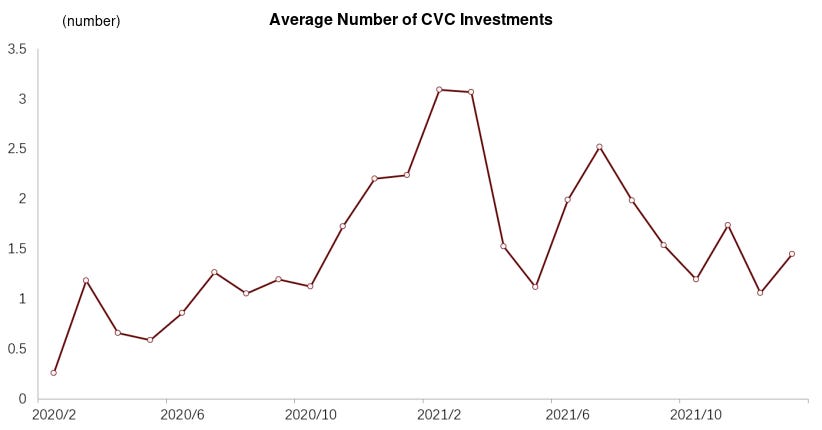
The U.S.–China comparison also reveals a reversal. China's major internet companies once invested more in venture capital than their U.S. peers. However, since the rise of generative AI models, they have fallen behind (Figure 2). One possible reason is U.S. export restrictions on advanced semiconductors to China. Another is China's 2021 platform antitrust policies, after which CVC activity among leading domestic technology companies—and their investment in start-ups—fell sharply (Figure 3). Antitrust regulation sought to curb excessive platform concentration, a question of fairness. Platform market power is also contested in the U.S., and balancing innovation and fairness remains central to digital-economy governance.
Figure 2: AI venture capital investment by China's tech giants shifts from leading to lagging the US
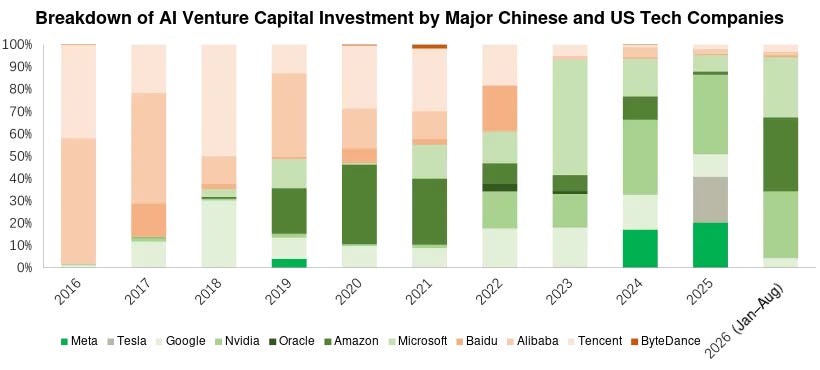
Figure 3: CVC investment by large technology companies fell after the 2021 platform antitrust rules
This raises a further question: does the dominance of established technology giants in AI development risk creating new monopolies? The key distinction lies in the underlying business models. Digital economy 1.0 platforms were asset-light and enjoyed powerful network effects. Take social media and short-video platforms, for example. Once users become accustomed to a platform, rivals struggled to dislodge it. Large AI models, by contrast, are capital-intensive, with weaker network effects and lower switching costs. Users can move from Doubao to Kimi to Qwen or an overseas model with little friction. Loyalty is low, and network effects are far weaker than those of earlier internet platforms.
Monopoly risks in large AI models should therefore be less troubling than in the previous digital era. But this raises another important question: how can developers make money when building models is costly and durable competitive barriers are hard to establish? That question is central to assessing today's high AI valuations.
This is my first departure from conventional thinking. In the past, early-stage investment in small technology companies was led by independent VCs and financial capital. This AI wave, however, is led by corporate capital, above all large technology companies.
III. Lessons from U.S. Private Credit
The second departure concerns debt. Financing early-stage companies and hard technologies is usually associated with equity. Yet credit, especially U.S. private credit, has played a major role in this AI wave. The reason is straightforward: AI requires fixed investment in assets such as computing infrastructure. Unlike software and other intangibles, these assets can serve as collateral, though less effectively than land. Private credit has thus helped finance data-center construction by large U.S. technology companies.
At the same time, private credit also serves growing small and medium-sized technology companies in the U.S. Debt lets founders raise funds without diluting their stakes. Yet innovation's high risks and potential returns sit uneasily with traditional bank lending. Private credit in the U.S. draws on institutional investors with greater risk tolerance and longer investment horizons. Contracts are tailored to borrowers, with pricing based on computing assets, long-term orders, and expected future cash flows. This makes it a high-risk, high-return form of finance.
Banks, by contrast, are constrained by the relatively rigid nature of deposit liabilities, regulatory requirements, and risk controls. They favor hard collateral and near-term, verifiable cash flows, using more standardized credit assessments. Such lending is ill-suited to smaller AI innovators with heavy capital needs and uncertain prospects.
In recent years, China's government-backed industrial and sci-tech guidance funds have partly offset the country's venture capital shortfall relative to the U.S. In practice, however, although these funds are structured as equity investments, some investments include buyback clauses that blur the line with debt. Some are effectively debt disguised as equity: their cash-flow returns resemble U.S. private credit, though they are not classified as credit for accounting or regulatory purposes. Similar arrangements were once common in China's shadow banking system, where they served credit-like functions. This reveals a structural mismatch in China's financing instruments: China has debt-like financing arrangements but lacks a standardized, compliant private credit market.
China has introduced sci-tech innovation bonds, but issuers are mainly large companies. Banks have also been expanding investment–loan linkage, though this better suits growing technology firms with manageable risks and emerging cash flows. An important question worth considering is how to develop debt instruments suited to high-risk, high-return projects at early and high-growth stages, including advances in large AI models and their applications.
IV. Patient Capital Is Primarily About Risk Appetite
The third dimension is patient capital. Does buying a 50-year government bond qualify? It is certainly a long-term investment, but duration alone does not make capital patient. The essential quality is a willingness to bear risk. Even relatively short-term financing can ease the constraints that short investment horizons place on innovation if investors have sufficient risk appetite. Patient capital is therefore about more than time: risk tolerance matters most.
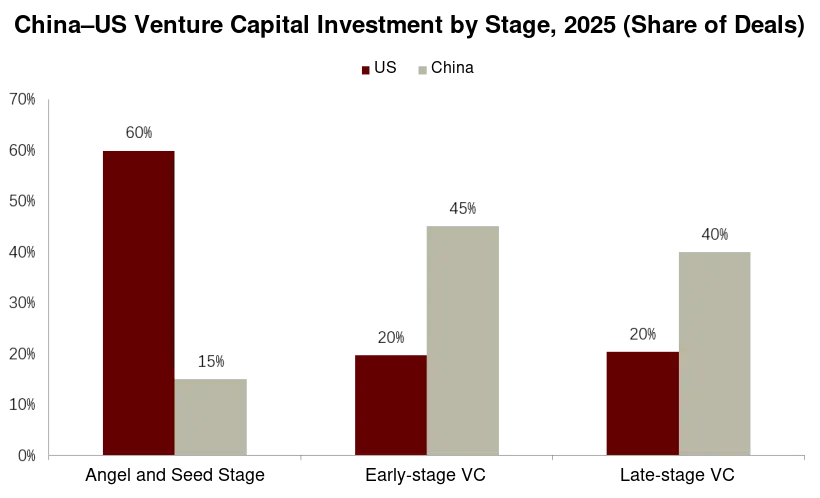
A comparison of data from China and the U.S. illustrates this point. Angel and seed-stage investments account for 41% of US venture capital deals, against just 9% in China. U.S. investors are thus more willing to back young companies and take risks—precisely the quality of patient capital.
Figure 4: Angel and seed-stage deals account for a larger share of U.S. venture capital investment
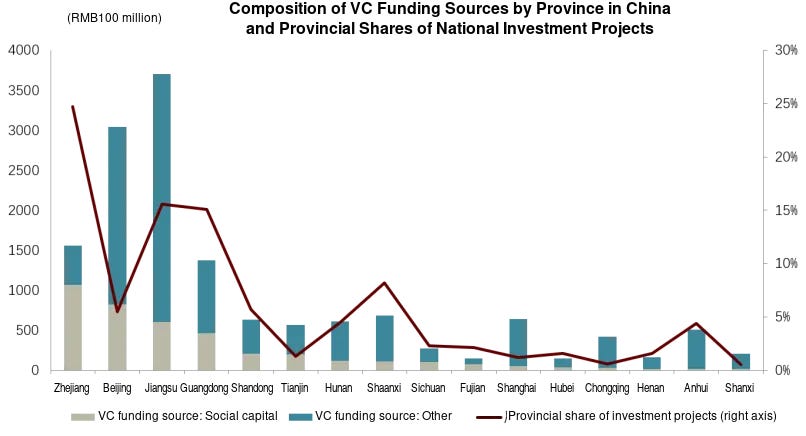
Evidence from China also supports this argument. Take the sources of venture capital in Zhejiang Province as an example. Private capital accounts for the largest share of the province's venture capital funding. Although Zhejiang invests less overall than Beijing or Jiangsu, it leads China in the number of projects receiving investment (Figure 5). The reason lies in the characteristics of private capital. Private investors are more willing to back smaller, earlier-stage ventures, so the same amount of capital can reach more start-ups.
Figure 5: Privately backed venture investments in China are more numerous but smaller on average
There is an interesting macroeconomic paradox here. The risk-free interest rate in the U.S. is currently higher than in China. In theory, interest rates indicate patience: lower rates mean waiting longer for returns, while higher rates offer greater short-term returns. Yet in practice, U.S. investors retain a strong appetite for risk despite high rates. The extra return they demand on the S&P 500 relative to 10-year Treasury bonds is close to zero. In other words, they seek almost no additional compensation for holding equities rather than government bonds—a sign of their optimistic market expectations.
China has lower risk-free rates but weaker risk appetite and higher risk premiums. In the A-share market, investors demand roughly three percentage points more than the yield on 10-year government bonds, reflecting cautious expectations. With risk appetite unchanged, falling risk-free rates encourage investors to shift from safe to risky assets. But causality can run the other way: stronger risk appetite prompts investors to buy risky assets and sell safe ones, lowering risk premiums and raising risk-free rates. Therefore, one very important way to cultivate patient capital is to foster more optimistic expectations about the future among investors.
Some may, of course, question whether a high risk appetite could fuel asset bubbles and financial instability, as the rapid growth of U.S. private credit illustrates. Yet it is worth noting that AI's capital-intensive model differs fundamentally from real estate.
Put simply, physical AI assets, such as chips, benefit from economies of scale: over time, higher demand lowers unit costs and prices. Land, by contrast, exhibits diseconomies of scale. Greater demand can only be met through higher prices—which also raise costs for other industries. This gives land an unusual value as collateral and amplifies financial procyclicality. An AI bubble, and its associated financial risks, should therefore be less severe and damaging than the collapse of the 2007–08 property bubble and the financial crisis that followed.
This brings us back to innovation's positive externalities. A striking feature of today's AI breakthroughs is that leading commercial models began without direct government support. The U.S. government did not fund ChatGPT's development; teams such as DeepSeek in China likewise started without government investment. Market forces drove the early growth of leading models in both countries. How, then, could markets finance innovation with such wide social benefits without direct subsidies? One possibility is that high capital-market valuations substantially lowered the barriers to raising funds. Looking ahead, if AI firms deliver the expected profit growth, earnings will eventually justify those valuations. If not, the bubble will deflate and some private investors will suffer losses—but their investment will still have helped drive major technological advances.
5. Government's Role in a New Geopolitical Landscape
This brings us to the role of government. If this AI wave appears not to need direct public funding, what does the government do? Two forms of involvement stand out.
First is direct administrative intervention, defining what companies may or may not do. One example is the U.S. restrictions on advanced semiconductor exports to China. The second is direct equity ownership. The U.S. government's acquisition of a 9.9% stake in Intel, making it the company's largest single shareholder, is one example. The move was intended to bring advanced chipmaking capacity back to the United States for geopolitical and national security reasons. China has seen similar moves: the government previously acquired shares and voting rights in DeepSeek. As countries increasingly emphasize sovereign AI, the state's role now extends beyond supporting innovation to geopolitics.
Finally, what does this mean for China? At the beginning of this discussion, I noted that China's AI capital expenditure lags behind that of the U.S., where optimistic stock-market expectations—even bubbles—help fund innovation. Chinese markets are less optimistic. How, then, can public policy support technological innovation, including AI? Three areas deserve attention.
First, fiscal spending. In 2020, leading AI companies specializing in image recognition, or computer vision, earned much of their revenue from government procurement for smart cities and security. Public procurement can create early demand and play an important role in guiding technological innovation.
Second, optimize industrial guidance funds. As mentioned earlier, these funds have helped fill innovation funding gaps, but several problems persist when government capital acts as a limited partner (LP). These include unstable policy expectations, a shortage of professional, market-oriented investment teams, short investment horizons, limited risk tolerance, and credit-like arrangements in some projects. These mechanisms need further reform.
Third, and most importantly, strong consumer demand is the fundamental driver of innovation. Fiscal and monetary policy should work together to tackle weak aggregate demand, boost consumption, and support growth. This matters not only for short-term stabilization but also for innovation and long-term economic growth. Enditem