

Today's newsletter looks at an investigative report on the long-shut gates of Tsinghua and Peking University, China's two most prestigious universities, and the grey economy that has grown around them.
The physical closure brought by the pandemic over the past five years apparently has seeped into the minds of many Chinese people, and may last far longer. I was surprised to find that people—both outsiders and students on campus—have become, at the very least, numb to the prolonged closure of university gates, if not outright comfortable with it. In the decades before COVID, such a situation would have been unthinkable.
Just look at the comment sections on Chinese social media. Whenever someone argues that campuses should reopen, waves of hostile replies follow. Here is a typical one:
(真开放了)你猜谁会在路上找女生要微信,谁会盯着女生并猥亵,谁会去图书馆自习室偷电脑,谁会去搞诈骗坑学生???
"If they really open up, guess who will be asking girls for WeChat on the roads, staring at them and harassing them, stealing laptops from libraries, or running scams against students?"
This is the psychology of closure at work. The longer a campus remains off limits, the more mysterious it becomes to those outside. The more mysterious it becomes, the more nervous those inside become about the imagined crowds pressing at the gate. And the solution, somehow, is always more closure, which only makes the mystique more powerful.
In my view, the answer is simple: open the gates. Leave them open long enough, and the magic wears off. A campus becomes a campus again, not a forbidden city with lecture halls.
And when the universities in question are not just any universities, but Peking and Tsinghua, the issue becomes more complicated. Given the deep anxiety Chinese families attach to education, these two institutions are no longer merely campuses. For many Chinese people, they are symbols. Every holiday season, parents bring their children to Beijing from across the country just to catch a glimpse of them.
That is where the grey industry finds its opening. When official reservation slots remain almost impossible to secure, some people exploit personal connections, working with insiders and outsiders to smuggle large numbers of visitors onto campus. It is a highly profitable business. Chinese parents are rarely reluctant to spend money for their children's education.
Credit is due to the Hong Kong–based Phoenix Weekly for its reporting. The article below was first published on its WeChat account on May 14 and the English translation is mine. The author appears to be a Peking University alumnus.
高校大门开放争议背后:一个人的抗争,一群人的生意
Behind the Debate Over University Gate Closure: One Man's Fight, a Business for Many
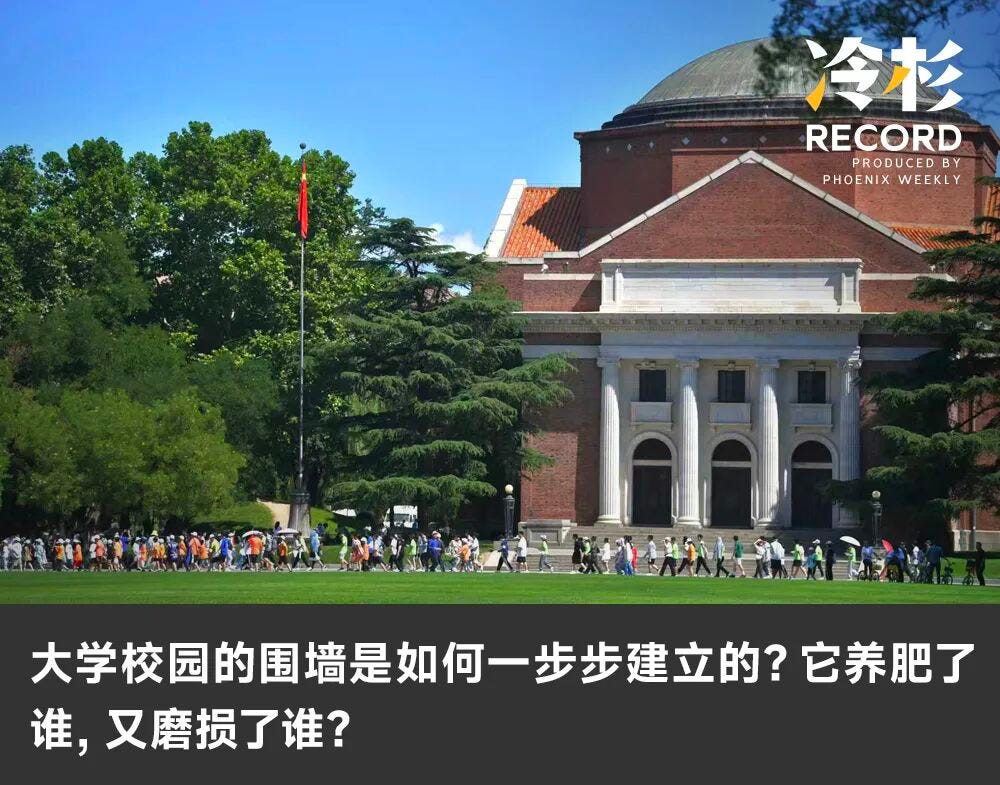
On May 13, Wuhan University announced the cancellation of its reservation system for public visitors, allowing people to enter the campus simply by showing their ID cards. The move brings to an end the entry-by-reservation system the university introduced in July 2023.
The decision to "tear down the walls" sparked heated discussions on social media. Supporters argue that universities ought to be free and open public spaces, while opponents maintain that campuses require order, fearing an influx of visitors would disrupt the tranquility needed for research and teaching.
In recent months, we have been tracking and investigating the "campus-entry business" thriving outside the gates of China's two top academic institutions: Tsinghua University and Peking University. By interviewing scalpers, brokers, university staff, and Li Zhi, an associate professor at Peking University's College of Engineering, we have tried to piece together how this "wall" was built step by step, who is profiting from it, and who is being worn down by it.
At Peking University, there are two ways to get through the gates without a reservation: vault the turnstiles in broad daylight, as Associate Professor Li Zhi does, or pay 120 yuan (about 17 U.S. dollars) to be smuggled in.
Since 2021, more than 10 million students have sat the Gaokao, China's national college entrance examination, every year. For decades, Tsinghua and Peking University have stood at the apex of this brutal competition. The almost religious reverence for elite universities has made both campuses pilgrimage sites for countless families. In 2018, the two universities introduced a reservation system with daily visitor quotas. Applicants had to apply online under their real names, with spots allocated by time slots. Demand has long far exceeded supply, leaving huge numbers of would-be visitors locked out through official channels.
As a result, what was once free admission acquired a clear black-market price within a few kilometers of the campus gates: 80 yuan for Tsinghua, and 120 yuan for Peking University.
In our recent undercover investigation into the grey network linking scalpers, brokers, faculty, and students, it became clear that this is not just a story about easy money. The scalpers exploiting loopholes are only the outer edge of the system. What really sustains and fuels the trade is the ever more impenetrable campus wall.
As we traced these transactions, another question emerged: when did university campuses start to close themselves off? Li Zhi, an associate professor at Peking University’s College of Engineering, offers a particularly revealing case. For 18 years, he has held firm to the view that universities should be fully open. He refuses to voluntarily show his staff ID, declines to use facial-recognition scans, and often simply vaults the turnstiles.
His long resistance forms a striking contrast with the tourists trying every possible way to get in. On one side is a host who rejects the rules; on the other are visitors willing to pay to get around them. The campus gate is no longer just a physical barrier. It has become a flashpoint where rules and desire, privilege and profit, resistance and compromise collide in new ways.
I. A History of Campus Closure
In Li Zhi's memory, China's most famous university was once entirely open, at least in practice.
Having grown up in Beijing with relatives living near Peking University, Li frequently went into the campus to play. In his recollection, entering and exiting never required any formalities. No one checked IDs, no one registered names, "you simply came and went as you pleased." Later, after joining the university as a faculty member, he lived in the Changchun Garden outside the west gate, crossing the campus every day to commute.
There were guards at the gates, but they were largely there for show. They paid little attention to the people passing through. Forget ID cards—no one even checked student or staff passes. To Li, the idea of being stopped and questioned just to enter Peking University was once unimaginable.
That changed in the summer of 2008.
With Peking University's Khoo Teck Puat Gymnasium hosting the table tennis events for the Beijing Olympics, the university abruptly tightened access in June and July for security reasons. Notices appeared at the gates saying that, in principle, entry required a student or staff ID and that outsiders were no longer allowed.
Li vividly remembers a confrontation with a security guard that summer. Entering through the west gate, he was stopped and asked for ID. His first reaction was to resist: why should anyone check his ID when he had lived there for decades? He did not force his way through, but nor did he back down. Since the guard would not let him pass, he simply stood there. "I'm not afraid of wasting time. If you want to wait it out, I'll wait it out with you."
In the end, the guard called the police. Once the officers arrived and established that Li was a PKU faculty member, the matter was dropped.
From that point on, Peking University's ID-checking system was formally in place. The Olympics ended, but the system remained, and it is still there today. Li recalls that enforcement was loose at first. Many relatives of staff lived nearby. Some elderly residents had family passes, while others were so familiar to the guards that they were waved through. Even with checks in place, many auditors and other outsiders could still get in—with so many gates, trying enough of them usually lead you one with lax security.
What really made the campus gates close ever tighter came later, when universities became tourist attractions.
With the rise of the influencer economy and social media, Wuhan University's cherry blossoms, Xiamen University's Furong Tunnel, Tsinghua's Old (Second) Gate, and Peking University's Weiming Lake gradually became viral check-in spots. During blooming seasons or holidays, crowds poured in.
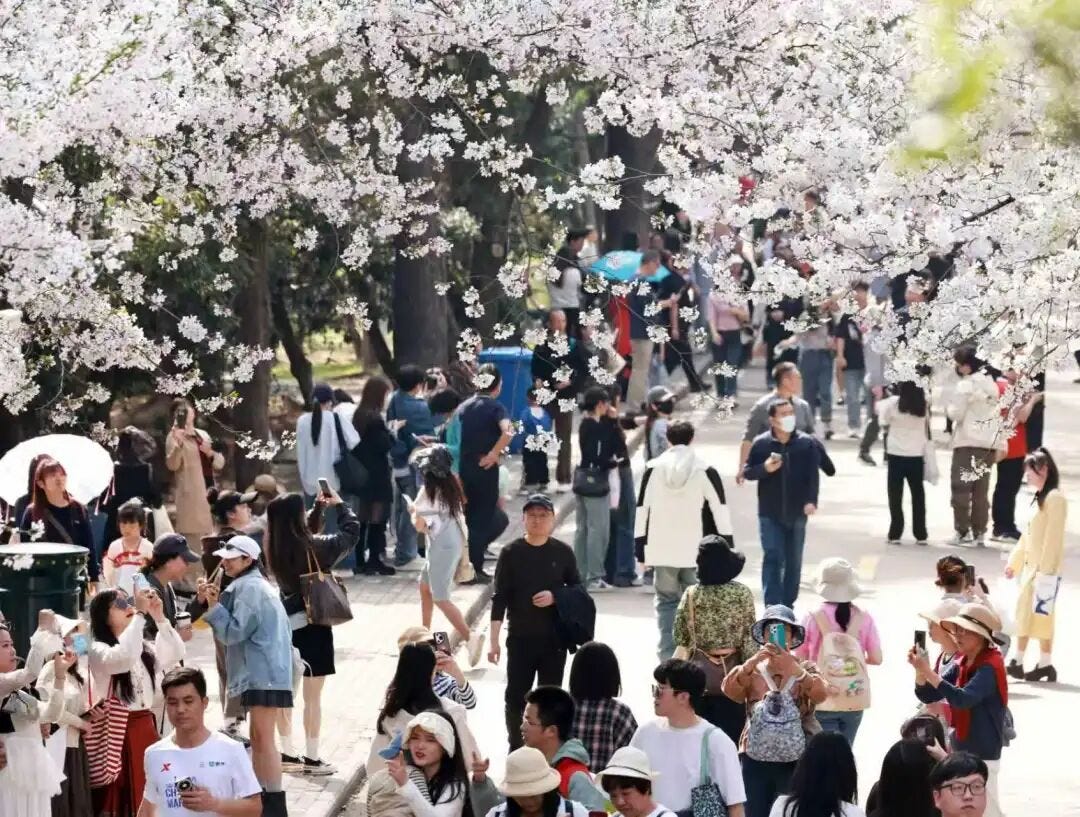
Among them, Xiamen University, hailed as "China's most beautiful university," saw daily tourist numbers climb to nearly 10,000 during peak travel seasons, with even larger crowds on weekends. Under growing pressure, the university formally imposed restrictions on campus visits in December 2012. At the time, Tao Yuansheng, deputy director of Xiamen University's security department, said registering visitors' ID details would help improve behavior and serve as a strong deterrent to "fake tourists" intent on theft.
A few years later, Tsinghua and Peking University also tightened control over outside visitors.
On July 7, 2018, Peking University officially launched an online reservation system for individual campus visits. The system required bookings to be made seven days in advance and set clear rules on entry time slots and identity checks. It marked the definitive end of the walk-in era.
To Li Zhi, however, this enclosure in the name of "order" does not conceal its flawed logic. His starting point is simple: a university is meant to be open.
"Since childhood, going in and out of campus was always casual. Then suddenly you have to show ID just to enter. That is unacceptable to me, no matter how high-minded the justification sounds," Li said. "Look at universities abroad—unless they are military academies or classified institutions, which ones do not let people in freely? You can even eat in their cafeterias. A university is part of public life. It absolutely does not belong only to students and staff."
Some argue that too many visitors disrupt the normal study and daily life of teachers and students. Li sees that as a management problem, not a reason to shut the gates.
"Most people who come to Peking University want to see Weiming Lake and the old historic buildings. They generally do not go into teaching buildings or dormitories. The university could easily separate teaching areas from scenic areas, and place reasonable limits on access to teaching spaces. But it cannot seal off the entire campus. Besides, the area around Weiming Lake is basically a park and should be open to the public."
That belief is why Li began his long-running standoff with campus security in 2008.
His position was clear: the guards had no right to check his ID. "You can call the police, and I will go to the station with you, but you have no right to stop me." He ended up at Yanyuan police station many times because of it. In the most serious scuffle, a guard accidentally fell during the altercation and then rather ceremoniously went to hospital for an injury assessment, which found nothing. Li was called in to give a statement and later paid the guard a small sum on humanitarian grounds.
After repeated clashes, the guards gradually got to know him and usually let him through. Li suspects Peking University's security department may even have a "list" telling guards not to hassle certain people. For a while, he and the guards reached a tacit understanding: at the gates he used most often, they recognized him and waved him through; at others, he could still be stopped. He also went to the security department and the president's office to argue that this style of management was unreasonable. The university, unsurprisingly, had its own explanations—too many visitors, disorder, and so on.
This cat-and-mouse game entered a second phase in the autumn of 2019.
That was when Peking University began installing turnstiles and facial-recognition systems. Li recalls that the East Gate got them first, apparently promoted by the university as a technological advance in administration. From that point on, entry no longer meant just flashing an ID; it meant handing over biometric data. Li has never voluntarily registered his facial data. "Under the law, I have not authorized the university to use my biometric information." Worried that his face might still be scanned, he began using his backpack to block the facial-recognition screen as he passed through the gates.
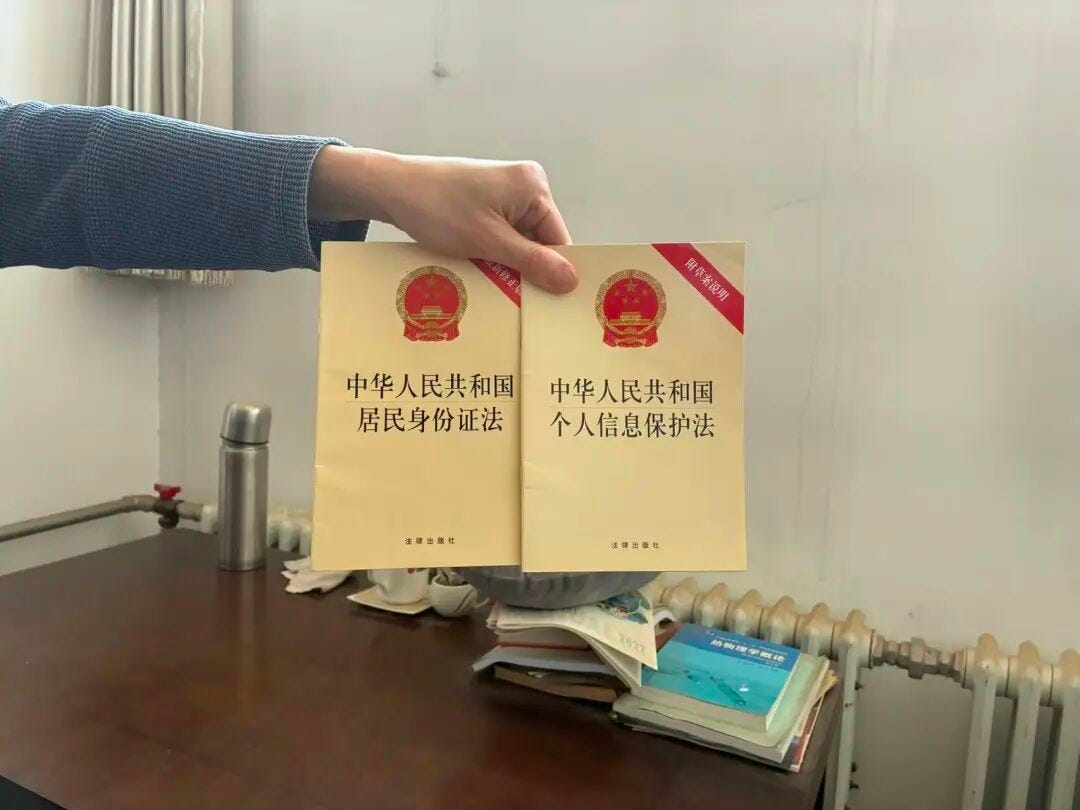
Eventually, he stopped even doing that. He decided to simply vault the turnstiles.
"The barriers aren't that high. I can just lift a leg and step over them. Some even have gaps wide enough for me to squeeze through."
The guards, of course, would question him, and sometimes give chase. On one occasion, after Li vaulted the turnstile at the East Gate, a guard ran after him. Li broke into a run. By his own account, he was a poor sprinter in school, close to failing, but fairly good at long-distance running. Before long, the guard gave up running, got on a bicycle, and radioed in: "Target spotted."
Half-joking, Li told him, "Your fitness really isn't up to scratch. You still can't catch me?" The guard replied, "You do run fast, and this heavy coat is slowing me down." Li then showed his staff card and said that as long as the guard reported his name to his superiors, everything would be fine. And it was.
In recent years, this cat-and-mouse routine has become part of Li's daily life.
Once, while he was leaving campus, a guard told him to use facial recognition again.
"So it's this much trouble even to leave?" Li said he could not make sense of it.
The guard replied, "You leave the same way you came in."
Li immediately picked up on that. "That was exactly what I wanted to hear." He lifted his leg, stepped over the barrier on his way out, and told the guard, "This is how I came in."
On another occasion, after he had stepped outside, a guard grabbed his backpack and refused to let go. The two ended up in a two-minute tug-of-war. The bag was sturdy enough not to tear. Li later went back onto campus and filed a complaint with the security department about the gate rules. There, he was told some of the logic behind them—for example, the university worried that students with psychological problems might get into trouble off campus, so exits also had to be monitored.
Li found that reasoning unconvincing. "People like that exist everywhere. You can't sacrifice everyone else's freedom just to protect them."
His resistance did produce one small change. Not long after the "turnstile chase" incident, facial scans were no longer required to leave campus. Colleagues joked with him: thanks to your hurdling, the rest of us can walk straight out now. Li, though, did not find it funny.
"It has been four years since the COVID-19 pandemic ended. Universities need to rethink what kind of gate-control system they actually need. A modern university reflects how modern a society is. Universities must be open. The question should be how to open them, not whether to open them."
II. Admission Quotas With a Price Tag
While Li Zhi was sparring with security guards over ID checks, a very different drama was playing out just outside the campus gates.
Especially after July 2023, when Tsinghua and Peking University lifted their pandemic restrictions and reopened under a "limited reservation system", what was meant to be free campus access quickly turned into a highly organized, openly priced, and wildly profitable black-market business within a few kilometers of the gates.
"Tsinghua University, 80 yuan; Peking University, 120 yuan."
That is now the going underground rate for getting into China's two most elite universities. For an upgraded service, a current student can escort visitors and provide a guided tour for 300 yuan an hour. Package it as an "Elite Teacher Study Tour", and the price can jump to several thousand, or even tens of thousands, of yuan.
Every winter and summer holiday, the trade becomes even more feverish. On one side are official reservation slots that disappear in seconds. On the other are waves of parents eager to get their children inside, if only to let them absorb some of the prestige.
For many ordinary families, a few hundred yuan in "guide fees" is not cheap. But against the backdrop of a child's future, it can seem negligible. For scalpers and gate fixers, by contrast, this is an almost cost-free business. All they need is a student ID, a familiar face at the gate, or access to an internal account that can work the reservation system.
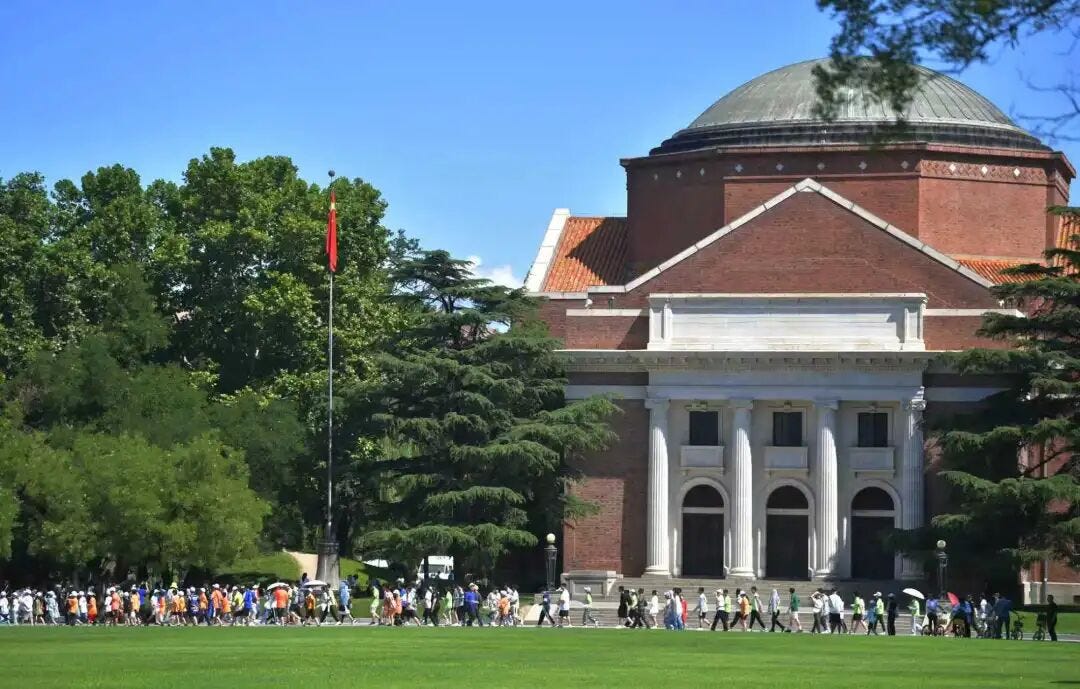
This underground trade has already developed into a mature, closed-loop ecosystem.
At 8:30 a.m., at Qinghua Donglu Xikou subway station, a gate fixer named Dong Fan showed up as arranged.
He gestured for his client to unlock a shared bike, handed over a student ID card belonging to a female student at Tsinghua's Academy of Arts & Design, and told the client to follow his e-scooter closely. The entry slot had been bought on an e-commerce platform for 80 yuan. On those platforms, listings for "Tsinghua and Peking University visits" rise and fall from a few dozen to several hundred yuan depending on demand.
The destination was Tsinghua's East Gate. Near the last traffic light, Dong Fan signaled for the client to wait and watch, then slipped into the crowd streaming towards the gate. At that point, he hung a badge around his neck and claimed to be technical support staff at a Tsinghua college. Whether because of the student ID or simply the sheer number of people, the guards did not stop them. They walked straight in.
Just like that, an outsider had entered Tsinghua.
In the trade, this is known as the "bring-in" method. Dong Fan said he had been doing it for three years, meaning the business started as soon as the campus reopened. He said his job gives him frequent access to students, for example by "taking students out for exchange activities". He also claimed to know students at Peking University, so he takes clients there as well, at 120 yuan a head.
A deeper look at online platforms shows that, compared with the "bring-in" method, some operators are far more professionalized.
In online shops offering such services, the division of labor is remarkably clear. One person handles customer service, another manages the operating channels, and the boss controls the "resources"—connections with two or three master's or PhD students at Tsinghua and Peking University who can make reservations on behalf of others, since students are allowed two visitor bookings a day for family or friends. Customer-service staff said they also provide student guides for 300 yuan an hour, while entry alone costs 160 yuan per person. They acknowledged that as campus controls have tightened in recent years, fewer students are willing to take the risk.
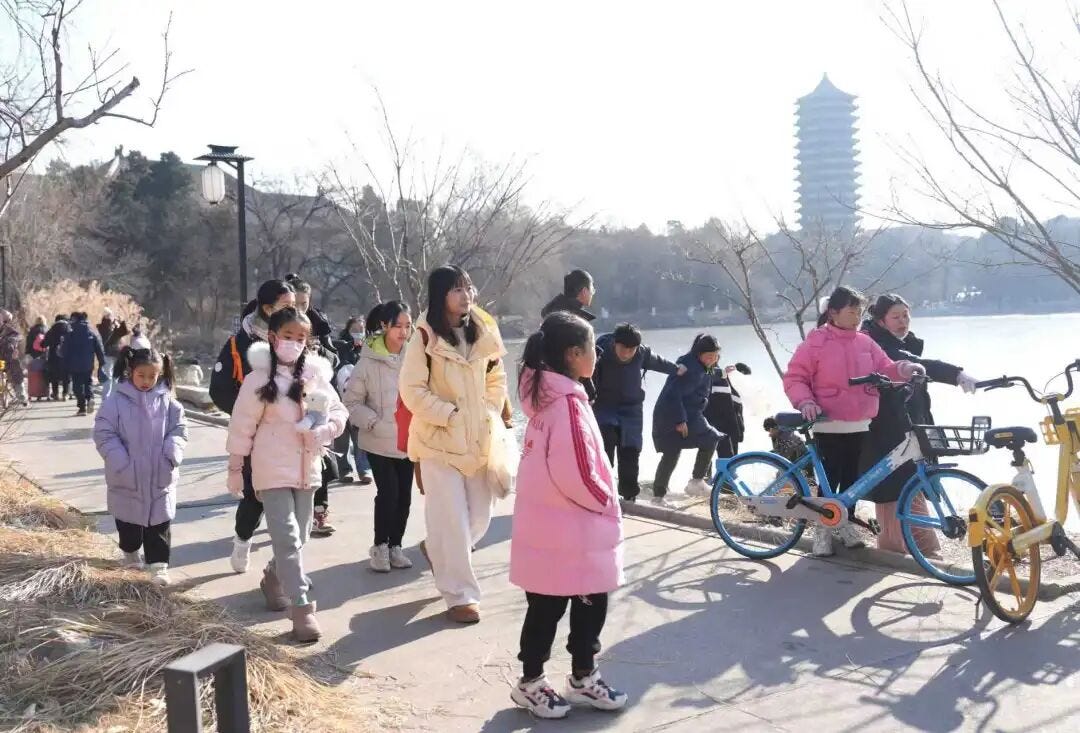
Compared with these small-time operators, study-tour agencies prefer what they call "safe channels."
One broker said his agency's Tsinghua and Peking University study tours could "guarantee entry," rather than just taking photos outside the gates. For a group of about 20 people, the fee was 200 yuan per person. Adding a current student as an on-campus guide raised the price to 600 yuan a head. Entry without a guide still cost 200 yuan.
"We're a legitimate travel agency, not just privately sneaking people in via students," the broker said. Their main contacts, he claimed, were university staff or long-term campus residents, each with their own reporting channels. In practice, he said, this was "more convenient than collaborating with students", and even if the university discovered it, "the impact would be limited".
III. The Backdoor Inside the "System"
The biggest revenue streams, however, lie hidden inside the universities' own administrative systems.
A source at Peking University said the university has many secondary units, such as departments and institutes, and almost all of them have the authority to reserve visitor entry. Within each unit, that power is typically held by a small number of administrative staff.
For years, one loophole has been repeatedly exploited: "cancel and reapply."
"For example, say I work in student affairs and still have 50 slots left today after covering faculty and student needs. Once those 50 people enter campus, I can immediately cancel their reservations in the back-end system. The slots are restored at once, and I can register another 50 people."
Through this snowball method, reservation slots can effectively become unlimited.
In the insider's account, most illicit entries happen this way. He said the practice became so rampant over the past two years that one research institute under Peking University was internally disciplined. The institute reportedly had only a few dozen staff, yet used this method to get 3,000 people into Peking University in a single day. At a market rate of 200 yuan per person, that would amount to 600,000 yuan in revenue in one day.
In July 2023, Peking University issued a notice about a study-tour program called "Peking University Golden Autumn Customized Course." The group had been organized by several alumni, who split 139 participants into accompanying-visitor reservations. Each participant was charged 10,800 yuan, bringing the total to about 1.5 million yuan.
Beyond this more organized trade, there is also a business built on student networks. Under university rules, each student gets eight guest passes a month. In some departments, student-union cadres use their connections to mobilize ordinary students to contribute their quotas.
For insiders, this trade is far from risk-free. In a warning notice issued in September 2025, Tsinghua University disclosed four cases in which insiders had colluded with outside tour guides and scalpers to register visitors illegally for profit. The staff involved were placed in administrative detention, and one student was stripped of their recommendation for graduate study.
Yet as long as the gap between supply and demand persists on either side of the gates, the grey market that thrives in the cracks is unlikely to disappear.
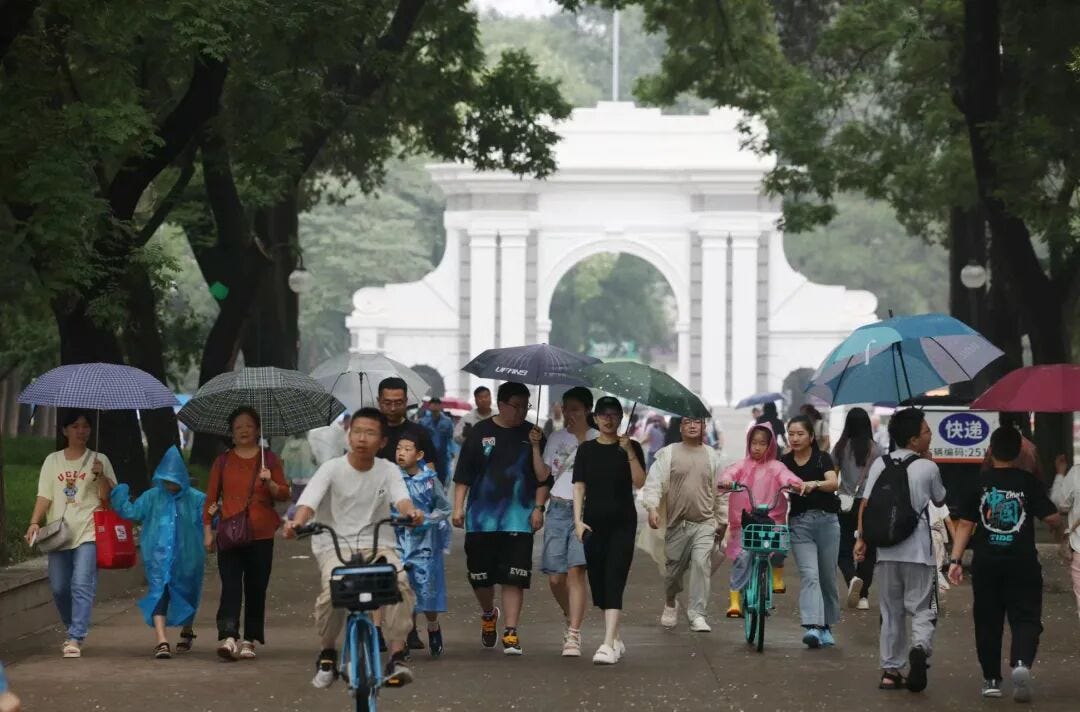
For well-connected study-tour agencies, there is another "legal" cover: borrowing official school stamps.
Zhao Lei, who once worked for such an agency, said that during winter and summer holidays many primary and secondary schools have formal school-to-school channels for visits to Tsinghua and Peking University. Study-tour agencies strike deals with those schools, using their official stamps and application letters to package paying tourists recruited from the public as "visiting students" from the schools.
"Once a school stamps the paperwork and submits the roster, it is almost impossible for the university to verify whether every child actually attends that school," Zhao said. Under this legal cover, agencies can bring tourists onto campus on a large scale. "One stamp can mean hundreds of spots. The reviewers simply can't check them one by one."
In practice, though, the time spent inside Tsinghua or Peking University may amount to only half a day. The rest is spent touring other sites in Beijing or listening off campus to so-called teachers talk about their experiences.
Even this brazen method is not foolproof. Zhao recalled one study-tour group that was hit by a surprise inspection from Peking University, which checked the entry roster on the spot. The scheme was exposed, and the insiders who helped arrange the reservations were penalized.
IV. The Cost of Closure
Whether in Li Zhi's stubborn turnstile-vaulting or the feverish demand reflected in the scalping trade outside the gates, the same question keeps surfacing: when a university chooses to wall itself off, what exactly does it lose?
In Li's view, the most immediate loss is academic exchange.
"In the past, if a professor from another university happened to be passing through Peking University and wanted to drop in or attend a lecture, they could simply walk in. Now they have to go through an application process. Many find it too much trouble and stop coming altogether. Academic exchange and interaction between universities are gradually being eroded." He says he often hears the same complaint from peers at academic conferences. If many intellectual sparks once came from chance encounters, then spontaneous exchanges without a fixed purpose or prior booking have now all but disappeared from campus.
What is also fading is the old "drop-in culture" among universities in Haidian District. It used to be normal for students from nearby campuses to arrange football matches, sit in on classes, or attend lectures together. For generations of students, those were ordinary shared experiences.
Today, unless there is a formal inter-university event or someone inside can help with reservations, it is extremely difficult for students to meet on campus. "There are so many universities in Haidian, all close to one another. We used to go wherever we liked, whenever we liked. Now if we want to meet, we can only do it off campus," Li said.
In his view, campus closure has also driven a deeper wedge between universities and the surrounding community. University campuses are an important part of urban public space. Peking University’s Weiming Lake, Tsinghua’s Grand Auditorium, and its library were once places where nearby residents could walk and relax. Since access was restricted, those spaces have effectively become exclusive internal resources.
"And that is breeding public resentment towards universities," Li said. "People come all this way and still cannot get through the gates—of course they are angry. They will only think Peking University is arrogant and aloof. That is clearly damaging to the university's reputation."
Against the backdrop of an openly priced grey market, meanwhile, the claim that closing the gates is necessary to maintain order looks increasingly hollow.
At least judging from this investigation, closure has not solved the problem. It has only pushed it underground: scalpers, illegal reservations, borrowed official stamps, stolen IDs. Because legitimate access is scarce, these practices have only become more widespread. People smuggled in by scalpers operate entirely outside the university’s supervision. Rather than removing hidden risks, the wall has made campus access even harder to control.
Faced with that wall, Li's position has always been clear: universities must remain open.
He points to international practice: campuses stay open, while core academic areas are restricted. Or universities can prioritize teaching and research on weekdays, while opening more fully to the public on weekends and holidays. "Opening without any regulation certainly creates pressure, but it can absolutely be managed through more refined governance."
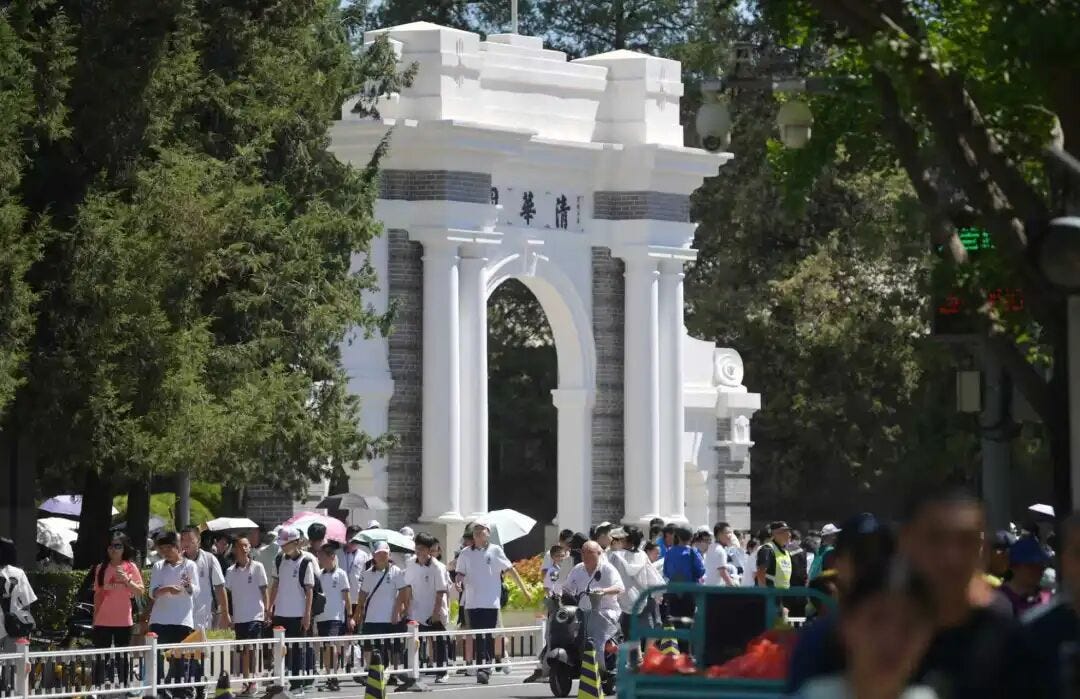
In a country where more than 10 million students sit the national college entrance exam each year, Tsinghua and Peking University carry a significance that goes far beyond their campuses.
They are social symbols of class mobility, reverence for knowledge, and the hope of moving up. And that powerful yearning cannot be stopped by a turnstile. It will either find a way in through official channels, or slip through the cracks in the dark.
For 18 years, Li Zhi has tried to defend what he sees as the public character of the university, vaulting turnstiles and arguing with security guards. Outside the gates, the parents and children who queue, pay, and pull strings are expressing the same desire in a different way: they want to get in.
Perhaps one day the campus gates will fully reopen. The only questions are when, and how.
(Dong Fan and Zhao Lei are pseudonyms)

"Perhaps one day the campus gates will fully reopen. The only questions are when, and how."
Maybe when AI, or even AGI makes the university credential industry approach superfluous.