

Today/Nov. 26, China releases a new plan to promote consumption, titled "Implementation Plan for Enhancing the Alignment Between Consumer Goods Supply and Demand to Further Boost Consumption《关于增强消费品供需适配性进一步促进消费的实施方案》".
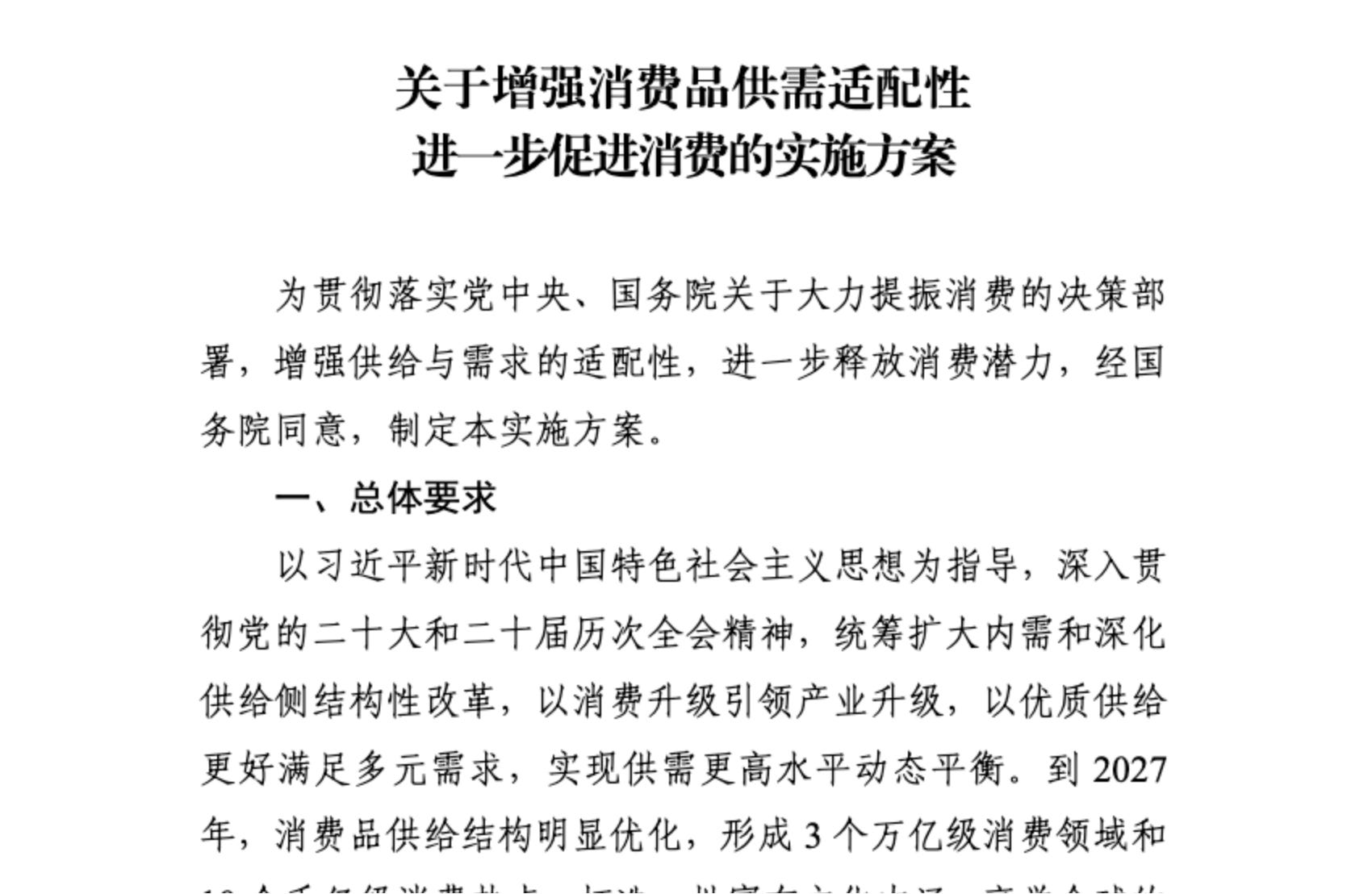
The document is released by six government bodies: the Ministry of Industry and Information Technology, the National Development and Reform Commission, the Ministry of Commerce, the Ministry of Culture and Tourism, the People's Bank of China, and the State Administration for Market Regulation.
Its primary goal is to:
增强供给与需求的适配性,进一步释放消费潜力
enhance the alignment between supply and demand and further unleash consumption potential
However, the measures outlined in the plan are almost exclusively focused on the supply side, with little direct support for demand.
The document outlines the following key objectives:
To lead industrial upgrading through consumption upgrading, and to better meet diverse needs through high-quality supply, aiming for a more dynamic balance between supply and demand.
By 2027, the structure of consumer goods supply is expected to be significantly optimized.
It seems that decision-makers attribute insufficient consumption demand to businesses not offering better products and services. Therefore, the plan advocates stimulating demand by encouraging businesses to improve their offerings.
This mindset is particularly evident in the realm of service consumption. For example, in May this year, China's central bank established a special loan program for service consumption and elderly care, encouraging financial institutions to increase support for key service sectors such as accommodation, dining, entertainment, education, and the elderly care industry.
This approach, however, differs from the views widely held by academics, who argue that consumption is fundamentally tied to income. The most effective way to boost consumption is by increasing INCOME on the demand side.
Countless scholars and economists share this perspective. To name a few:
Yang Ruilong (杨瑞龙), Professor at Renmin University of China and co-founder of China Macroeconomy Forum (CMF), stated in a speech at the CMF quarterly forum in September:

Consumption is a function of income. When income is stagnant or falling, even lower prices are not enough to revive spending.
Households' main source of income is wages, whose level and stability depend on employment and job quality. In recent years, the unemployment rate among young people in China has remained elevated. At the same time, job quality has been deteriorating in two main ways. First, positions are retained but working hours are cut; overtime and corresponding overtime pay are reduced, directly squeezing wage income. Second, working hours are not reduced, but wage levels fall, most notably for the middle class with annual incomes between 300,000 and 800,000 yuan, whose earnings have dropped significantly. Together, these factors reduce households’ disposable income and thus depress consumption demand.
A household's ability to pay also depends on its assets and property income. The prolonged decline in real estate prices has worsened household balance sheets and lowered expectations about future income. Even if current income has not yet fallen, households tend to increase their saving rate to cope with future uncertainty, thereby further curbing consumption.
…
Boosting consumption is fundamentally about income; the key to boosting consumption is increasing income.
If we hope for labor income to gain a larger share in the primary distribution of national income, the pressure on corporate profits and the long adjustment time lag mean this would be like “distant water cannot quench immediate thirst.”
Another approach concerns the orientation of fiscal policy: shifting from the traditional emphasis on “investment” to emphasizing “consumption,” focusing on “investing in people”. This includes issuing consumption vouchers, providing fiscal subsidies for consumption, and improving social security for low-income groups and rural residents.
That said, the fundamental way to stabilize consumption is to stabilize incomes, and the core of stabilizing incomes is to stabilize employment. The foundation of stable employment, in turn, is having stable firms. Only when firms can survive and grow, especially when they possess sustainable profitability and a willingness to expand, can wage income gain an endogenous engine of growth.
Li Xunlei 李迅雷, Chief Economist at Zhongtai Financial International Limited, also underscores the importance of increasing income and improving marginal consumption propensity in his latest WeChat blog: "Thoughts on Current Economic Hotspots":

Long-term consumption growth still requires income growth and an increase in marginal consumption propensity.
The former is hard to achieve during a real estate downturn unless there is significant central government subsidy for households. However, fiscal deficits are already high, with more public funds being allocated to fill the social security gap, expected to exceed 4 trillion yuan by 2030, more than 12% of public fiscal expenditure. This is due to the accelerating aging population and the growing ratio of retirees to the working population.
The latter (marginal consumption propensity) requires improving social security or reducing interest rates. Household debt repayment ratios in China are relatively high, almost double that of Japan and the U.S., indicating a heavier debt burden.
Finally, reforms to the fiscal and taxation system, as well as the redistribution of national income, are essential. During Japan's "lost 30 years," its Gini coefficient remained relatively low, yet the effectiveness of consumption stimulation was not ideal. This is because the main consumers are from the middle and low-income groups, and increasing their share of income through reforms would benefit consumption. However, reforms are often easier said than done, and they come with a time cost, which requires a sense of urgency.
Zhang Bin 张斌, Senior Fellow at Institute of World Economics and Politics, Chinese Academy of Social Sciences, and a non-resident senior fellow at China Finance 40 Forum (CF40), says in a recent interview that:
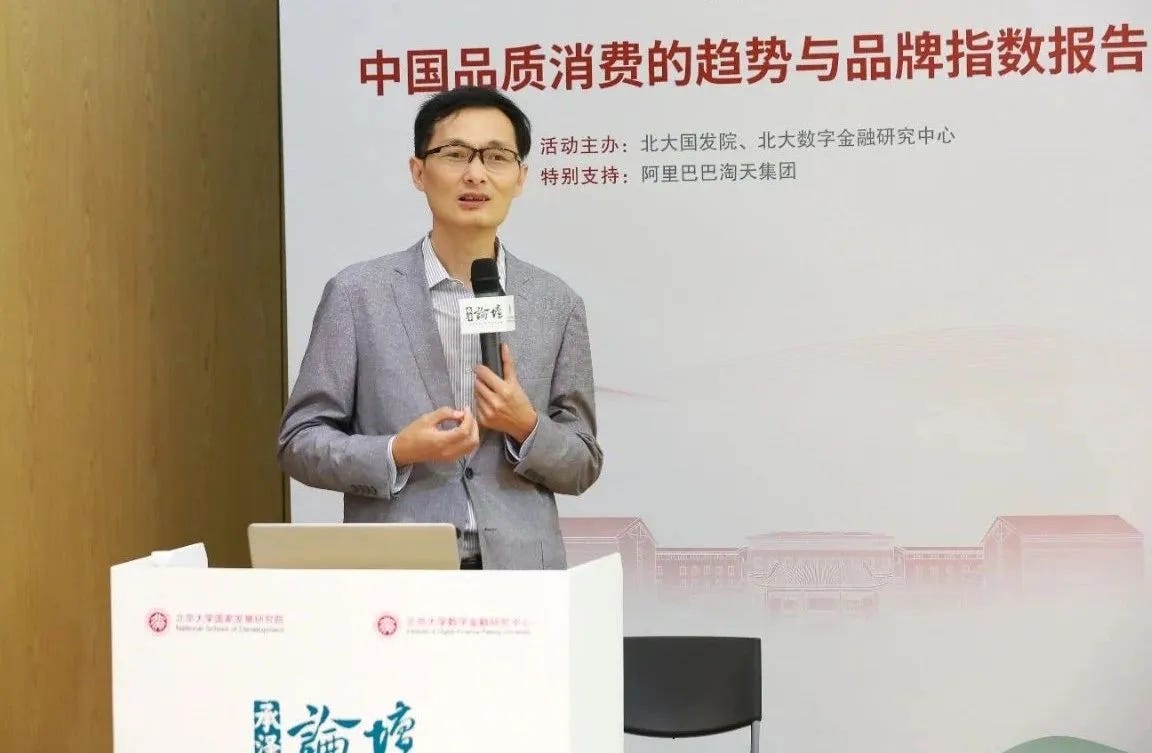
…in order to effectively expand domestic demand in the short term, GDP needs to increase, and consumption will naturally follow. This is because GDP represents household income, corporate profits, and government tax revenue. If GDP doesn't rise, corporate profits don't increase, and household income remains stagnant, consumption will lack a source of growth.
The most effective policy to change GDP in the short term is counter-cyclical policy. Policies that directly target consumption, such as trade-in policies or improving urban and rural residents' consumption policies, may not have a significant impact on overall consumption growth.
I believe that expanding the total income of residents is the most important goal, and this must be achieved through counter-cyclical policies.
Expanding residents' total income requires expanding nominal GDP, and expanding nominal GDP requires implementing counter-cyclical fiscal and monetary policies.
Specifically, this involves sufficiently lowering interest rates and increasing public spending to expand GDP. Expanding GDP increases residents’ income, and expanding residents’ income in turn boosts consumption. This logic holds.
One cannot expect to increase consumption without increasing income — that's very difficult.
When discussing the 15th Five-Year Plan, Dr. Lu Ting (陆挺), Chief China Economist at Nomura, noted in a recent interview in November:

I believe that compared to the 14th Five-Year Plan, the 15th Five-Year Plan needs to place greater emphasis on income distribution issues. Specifically, China's social welfare system and pension system need appropriate reforms, especially to increase the basic old-age benefits for 55% of rural and non-working urban residents. This is not only crucial for social equity but also essential for boosting consumption and domestic demand.
To achieve stable and sustained consumption-driven growth, it is important not only to emphasize technological innovation and research and development to improve economic efficiency and expand the economic pie, but also to address social distribution issues. Of course, this does not mean advocating for egalitarianism, but rather appropriately improving the social welfare system within the context of national development, so that people feel more secure in their consumption and can increase their actual consumption capacity.