

Today's newsletter features a speech by Pan Gongsheng, governor of China's central bank, the People's Bank of China (PBOC), at the 2026 Financial Street Forum in Beijing on Monday, October 19. Pan addressed a range of issues, from China's monetary policy reforms to the international role of the renminbi, but was particularly forthright in defending China's exchange rate policy.
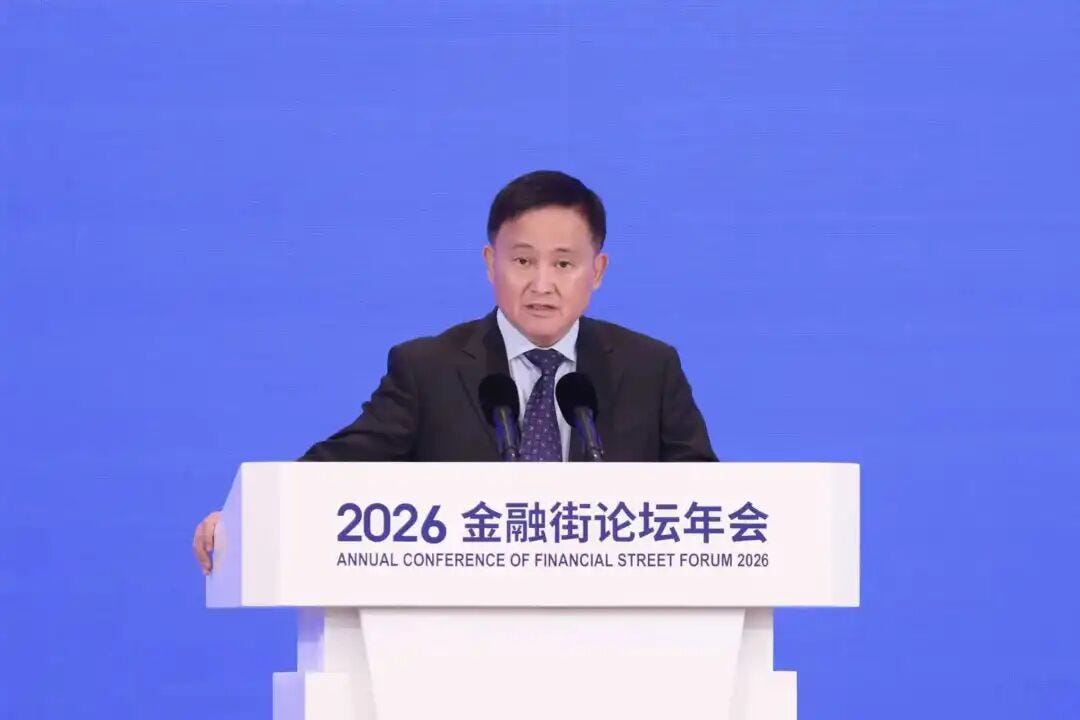
Rejecting the notion that Beijing keeps its currency weak to give Chinese exporters an edge, Pan said China had "no need, nor any intention, to gain a competitive advantage in trade through currency depreciation." He argued that China's export strength came from its industrial competitiveness, not currency policy, and that central banks could not keep exchange rates artificially low over the long term. In an apparent swipe at the United States, he also criticized countries that blame their persistent fiscal deficits and declining industrial competitiveness on another country's exchange rate rather than confront problems at home.
Beyond the currency debate, Pan announced plans for a new liquidity backstop for non-bank financial institutions facing large-scale redemptions, expanded central bank lending access for foreign banks operating in China, and greater access for offshore renminbi clearing banks to the domestic foreign exchange market. He also outlined a possible shift to an overnight policy rate, plans to expand the renminbi's international use, and the central bank's approach to the economic and financial implications of artificial intelligence.
Below is the translation of his speech. It has not been reviewed by Mr. Pan.
中国人民银行行长潘功胜在2026金融街论坛年会上的主题演讲——《关于当前市场关注若干问题的思考》
Pan Gongsheng: Reflections on Several Issues Currently Drawing Market Attention
Distinguished Party Secretary Yin Li, Mayor Yin Yong, and guests from China and abroad,
Good day, everyone! First, I would like to thank the Beijing Municipal Party Committee, the Beijing Municipal Government, particularly Secretary Yin and Mayor Yin, and all sectors of society for their longstanding interest in and support for the work of the People's Bank of China (PBOC).
The Financial Street Forum enjoys considerable international influence and is widely followed by financial markets. It serves as an important platform for communication between the central bank and the market. I would like to take this opportunity to announce several policy measures that the PBOC will introduce shortly.
First, we will work with the National Financial Regulatory Administration (NFRA) and the China Securities Regulatory Commission (CSRC) to establish a liquidity support facility to address large-scale redemptions at non-bank financial institutions.
The PBOC has discussed this facility with market participants on several occasions. Its purpose is to establish a mechanism for stabilizing the bond market, adding a new instrument to the PBOC's macroprudential policy toolkit.
The facility is designed to strike a balance between preventing systemic risks in financial markets and avoiding moral hazard. It will be activated under specific circumstances, when asset management institutions face widespread liquidity stress and the bond market enters a vicious cycle of redemptions and forced selling. Institutions seeking to transact with the central bank must meet macroprudential requirements and provide high-quality collateral. These safeguards are intended to prevent distortions in financial market pricing, avoid creating expectations of a bailout, and preserve market discipline.
Eligible institutions will include wealth management subsidiaries of banks, managers of publicly offered investment funds, and their respective parent banks and securities firms, among others. We will specify the operational details of the facility in our open market operation announcements.
Second, we will expand the range of institutions eligible to access the Standing Lending Facility (SLF). At present, the SLF is an open market operation instrument through which the central bank provides collateralized financing primarily to city commercial banks and rural financial institutions. It offers overnight, seven-day and one-month maturities, mainly to meet temporary liquidity needs.
We will now expanded access to central bank liquidity for locally incorporated foreign banks in China and clarify that nationwide banks will be subject to the same operational arrangements. This will ensure that the facility covers all deposit-taking financial institutions in China. Including locally incorporated foreign banks will also give them access to central bank liquidity support, helping them conduct their business more effectively.
Third, we will establish connectivity between the interbank and exchange bond markets. Connecting financial market infrastructures will facilitate bond issuance and trading across markets, improve market liquidity and price formation, and allow financial markets to play a more effective role in price discovery and resource allocation.
The PBOC and the CSRC have already undertaken a series of preparatory measures, and the necessary conditions for implementation are now in place. The connection can be launched once bond market infrastructure operators and market participants have completed testing.
Fourth, we will launch a pilot program to make it easier for overseas financial institutions to buy and sell renminbi in China's domestic foreign exchange market. In recent years, the international use of the renminbi has expanded, increasing demand among overseas financial institutions for renminbi liquidity management. The PBOC plans to launch a pilot program allowing eight Chinese and foreign banks designated as offshore renminbi clearing banks to conduct proprietary trading in the domestic interbank foreign exchange market, in line with international financial market practices and trading conventions.
This will enable overseas institutions to participate more extensively in China's domestic foreign exchange market and promote greater integration between the onshore and offshore markets. We will consider further opening up the foreign exchange market based on the results of the pilot program.
Fifth, we will work with the Ministry of Science and Technology and nine other government departments to issue the Guiding Opinions on Financial Support for the Development of International Science and Technology Innovation Centers in Beijing (the Beijing–Tianjin–Hebei Region), Shanghai (the Yangtze River Delta), and the Guangdong–Hong Kong–Macao Greater Bay Area.
Developing international science and technology innovation centers in the Beijing–Tianjin–Hebei region, the Yangtze River Delta and the Guangdong–Hong Kong–Macao Greater Bay Area is a major national strategy. We will advance a technology finance system that meets the core functional needs and international ambitions of these innovation centers, expand the availability of diversified financial services across the entire innovation and development process, and guide financial institutions in strengthening their specialized service capabilities.
We will also promote information sharing, mutual recognition of standards and infrastructure connectivity within these regions. We will encourage greater use of relending facilities, the science and technology innovation segment of the bond market, and cross-border investment and financing policies in these regions, including through pilot programs, helping to foster a high-quality financial ecosystem for technological innovation.
In addition, the PBOC established a renminbi repo facility for foreign central banks in June this year. The facility allows foreign central banks and monetary authorities, international financial organizations and sovereign wealth funds to obtain renminbi liquidity from the PBOC through bond repurchase transactions, facilitating their renminbi liquidity management and allocation of renminbi assets. The initiative has attracted widespread attention and been well received.
Foreign banks designated as renminbi clearing banks are an important part of the cross-border renminbi clearing network. The PBOC plans to extend eligibility for the repo facility to these banks, enabling them to better support offshore renminbi business.
At the beginning of this year, the PBOC also completed a smooth transition to a new accounting framework for the digital renminbi, changing its classification from cash to deposit money. The Digital Renminbi Operations and Management Center, established in Beijing last year, is now fully operational. It has become an integrated digital renminbi business platform providing services covering issuance management, retail and wholesale transactions, blockchain and smart contracts. The number of institutions authorized to operate digital renminbi services has increased from 10 to 30, now encompassing all systemically important banks.
I would now like to share some thoughts on several issues that have recently attracted considerable market attention.
I. The Transformation and Improvement of China's Monetary Policy Framework
Monetary policy theory and practice have continued to evolve around the world. At the 2024 Lujiazui Forum, I shared some thoughts on how China's monetary policy framework might evolve in the future.
Over the past two years or so, we have undertaken considerable work and made positive progress. We have established the seven-day reverse repo rate in open market operations as our policy rate, introduced overnight operations, and begun buying and selling government bonds in the open market. These measures have further expanded our monetary policy toolkit and made our market-based interest rate management framework clearer.
At the same time, we have continued to strengthen the implementation and supervision of interest rate policies, standardize deposit and lending rate pricing practices, and improve banks' pricing capabilities. We have refined the system of structural monetary policy instruments and their design parameters, strengthened coordination with fiscal, industrial and other policies, and placed greater emphasis on market communication and expectation management.
The transformation of the monetary policy framework is a gradual and ongoing process. We will continue to assess and refine the framework. In the near to medium term, our priority will be to give interest rates a greater role in monetary policy, with a focus on the following areas.
First, we will further improve the mechanism for managing short-term interest rates. As the policy rate has become more effective in guiding money market rates, and as the interest rate corridor has been improved, monetary policy has become increasingly precise and effective in managing overnight interest rates. The interbank overnight repo rate, commonly known as DR001, is one of the most actively traded and widely used benchmark rates in the money market. It responds quickly to short-term changes in the supply of and demand for funds, and has become more stable in recent years.
In practice, the interbank overnight repo rate has already become the target rate for the central bank's monetary policy operations. However, the tenor of the central bank’s main open market operations and its principal policy rate remains seven days. There is therefore a degree of misalignment between the two. To improve the precision of interest rate management, we will explore shifting the tenor of our main open market operations to overnight when conditions are appropriate. The overnight repo rate used in open market operations would then become the principal policy rate.
Second, we will reform loan pricing benchmarks, moving away from reliance primarily on the Loan Prime Rate (LPR) towards a more diversified set of benchmarks.
Over the past several decades, benchmark lending rates and the LPR have served as effective reference rates for loan pricing at different stages of China's development. Recently, under the guidance of the PBOC, some financial institutions have reached agreements with their customers to adopt market-based interest rates, including the interbank overnight repo rate, as benchmarks for pricing floating-rate loans. This has helped meet increasingly diverse loan pricing needs and improve the transmission of monetary policy.
As loan pricing benchmarks becomes more diversified, companies with strong financial positions will be able to negotiate with financial institutions and choose either the interbank overnight repo rate or the LPR as the benchmark for their floating-rate loans. The LPR can continue to serve as a benchmark for loans to small businesses and individuals. The interbank overnight repo rate could also be considered as an alternative benchmark for pricing bonds and financial derivatives.
The PBOC will issue policy guidance when appropriate to help financial institutions carry out these changes. We will also continue to reform and improve the LPR quotation mechanism and enhance the quality of quotations.
Third, we will phase out benchmark deposit and lending rates. For many years, the central bank directly set benchmark deposit and lending rates for financial institutions. As interest rate liberalization has progressed, these administratively determined rates have gradually been replaced by market-based pricing benchmarks. Banks now have several benchmarks for pricing loans, including the LPR and the interbank overnight repo rate. Since the first quarter of this year, we have also begun publishing average deposit interest rates across different maturities to provide banks with references for deposit pricing.
The benchmark deposit and lending rates for financial institutions have remained unchanged since October 2015. In practice, they no longer play a role in determining deposit and lending rates and are now used only as a basis for calculating interest in a small number of judicial contexts.
Going forward, the PBOC will work to replace these remaining references with market-based interest rate indicators, thereby completing the phase-out of benchmark deposit and lending rates for financial institutions.
II. The Renminbi Exchange Rate
As an important price in financial markets, the renminbi exchange rate has attracted considerable attention both at home and abroad. Ten days ago, the PBOC published an important document setting out its policy position on the renminbi exchange rate, responding to a number of domestic and international concerns in a professional and objective manner.
Two days ago, while attending the Annual Meetings of the International Monetary Fund and the World Bank, as well as the G20 Finance Ministers and Central Bank Governors Meeting in Bangkok, Thailand, I also discussed this issue with the heads of several international organizations, government officials from various countries and fellow central bank governors.
China operates a managed floating exchange rate regime based on market supply and demand, with reference to a basket of currencies. Since 2017, the PBOC has withdrawn from regular intervention in the foreign exchange market. In recent years, the renminbi has gone through several cycles of appreciation and depreciation, with greater two-way fluctuations and increased flexibility.
Under certain circumstances, the PBOC uses macroprudential policy instruments and, in extreme situations, may even intervene directly in the foreign exchange market, to counter herd behavior and the self-reinforcing effects of irrational market expectations. These measures are consistent with international rules and practices.
In fact, the global foreign exchange market is enormous, with average daily trading volume approaching US$10 trillion in 2025. Average daily trading in the renminbi exceeds US$800 billion, with approximately 80% of transactions taking place offshore. Central banks cannot exert a sustained influence on exchange rate movements over the medium to long term, much less use such interventions to secure a lasting advantage in trade competitiveness.
The growth of China's trade is fundamentally rooted in the increasing international competitiveness of its industries. This competitiveness has been built on more than four decades of reform and opening-up, an enormous domestic market, comprehensive industrial supply chains and infrastructure, an abundant, highly skilled and hardworking labor force, and sustained research, development and innovation.
As Chinese exports have moved towards higher-value-added and more sophisticated products, Chinese foreign trade companies have gained considerably greater pricing power. They are also making increasing use of foreign exchange hedging instruments and renminbi settlement. One important change in China's trade in recent years is that it has become significantly less sensitive to exchange rate movements.
China has no need, nor any intention, to gain a competitive advantage in trade through currency depreciation. During successive episodes of severe external shocks, including the Asian financial crisis, the global financial crisis and trade wars initiated by certain countries, China has never pursued competitive devaluation. Instead, it has taken effective measures to prevent excessive depreciation of the renminbi.
As an important macroeconomic variable, the exchange rate is influenced by a wide range of factors, including economic growth, monetary policy, financial markets, geopolitics and unexpected risk events. There is no simple linear relationship between exchange rates and the current account. Using selected findings from international assessments as evidence that a country's currency is undervalued or overvalued amounts to a misinterpretation and misuse of those assessments. It also reveals a lack of the necessary professional understanding of exchange rate issues.
Addressing global economic imbalances is a shared responsibility of both deficit and surplus countries. In an international monetary system dominated by a single sovereign currency, the issuer of the principal reserve currency has long run large fiscal and current account deficits. To attribute one's own persistently large fiscal deficits, declining industrial competitiveness and complex structural problems simply to another country’s exchange rate is to evade responsibility for making necessary domestic adjustments.
China will firmly implement the strategic priorities and key measures set out in the 15th Five-Year Plan (2026-30), continue transforming its model of economic growth, expand domestic demand and pursue high-standard opening-up, contributing to a new phase of dynamic balance in the global economy.
III. Renminbi Internationalization
The internationalization of the renminbi formally began in 2009. Driven by market demand and reinforced by changes in the international environment and geopolitical landscape, demand for the renminbi in international markets has increased significantly, and the currency's internationalization has continued to advance.
The renminbi is now the most widely used currency for settling China's cross-border receipts and payments, the world's second-largest currency for trade finance and its third-largest currency for payments. According to SWIFT statistics, the renminbi accounts for approximately 3–4% of international payments, ranking fifth globally.
However, when both cross-border renminbi payments and offshore renminbi payments are taken into account, including transactions settled through the Cross-Border Interbank Payment System (CIPS) and banks' internal systems, the renminbi's share of international payments currently fluctuates around 6–7%, placing it consistently third in the world. The international use of the renminbi is also expanding rapidly into a broad range of areas, including monetary cooperation, investment and financing, and financial market transactions.
Going forward, the PBOC will improve its policy support and create a more favorable environment for institutions and individuals, both in China and abroad, to hold and use renminbi.
First, we will better serve the real economy by facilitating trade, investment and financing. In recent years, we have introduced a series of policies integrating renminbi and foreign currency services, covering securities investment, cross-border financing, cash pooling and other activities. These measures have made cross-border renminbi transactions more convenient and reduced the cost of using the currency.
We support Chinese and foreign financial institutions in providing comprehensive renminbi financial services to businesses operating in China and overseas, including cross-border settlement, investment and financing, and hedging. Recently, the PBOC has authorized several foreign banks to serve as renminbi clearing banks. Going forward, we will continue to improve the renminbi clearing bank network so that renminbi financial services can reach a wider range of businesses.
Second, we will expand the global supply of high-quality renminbi assets and promote more active trading in offshore renminbi financial products. On the one hand, we will make better use of the onshore financial market, which represents the world's largest pool of renminbi assets. We will continue to improve market connectivity arrangements such as "Bond Connect" and "Swap Connect," and promote links between domestic and overseas financial market infrastructures. We will explore the introduction of multi-tiered custody arrangements as part of efforts to further open up the bond market, work towards making renminbi bonds eligible collateral in global markets, and make it easier for international investors to invest in and allocate funds to renminbi bonds.
On the other hand, we will continue to support the development of offshore renminbi markets. We will support the development of an offshore renminbi market structure centered on Hong Kong, with London, Singapore, Dubai and other financial centers playing complementary roles. We will also support Shanghai in developing an offshore financial services system commensurate with its status as an international financial center.
Moreover, we will continue to issue central bank bills regularly in offshore markets. We will also promote more active secondary-market trading in offshore renminbi-denominated government bonds and central bank bills, encourage financial institutions to act as market makers, support the development of offshore repo markets, and foster a renminbi yield curve.
We will expand the range of offshore renminbi government bond futures and develop the interest rate swap market to better meet market participants’ needs for hedging interest rate risks. We will also develop a comprehensive offshore financial trading platform and broaden the services provided by offshore financial market infrastructure.
Third, we will provide offshore markets with a stable, multi-layered supply of renminbi liquidity. We will make full use of currency swap arrangements and encourage more swap counterparties to establish regular mechanisms for using swap funds in their local markets. We will support the Hong Kong Monetary Authority in providing medium- to long-term liquidity with maturities exceeding one year through renminbi funding arrangements.
We will make effective use of the renminbi repo facility for foreign central banks and similar institutions, and support foreign banks designated as renminbi clearing banks in obtaining renminbi liquidity through onshore repo transactions, interbank borrowing and lending, and the issuance of negotiable certificates of deposit. We will continue expanding our policy toolkit to cover short-, medium- and long-term maturities, providing offshore markets with stable, multi-layered renminbi liquidity support.
IV. The Impact of AI and the Financial Policy Response
In recent years, artificial intelligence (AI) has developed rapidly around the world, with profound implications for productivity, investment, employment, income distribution, financial stability and other areas. Discussions among international organizations and central banks around the world have highlighted several issues that deserve particular attention.
First, the demand-side and supply-side effects of AI may emerge at different times. In the short term, AI could improve efficiency at the microeconomic level, stimulate investment and push up inflation. Over the medium to long term, however, it could raise overall productivity and lower inflation.
Second, the impact of AI will be uneven across countries, regions and industries. Although AI has not yet had a significant effect on aggregate employment, it has already begun to reshape the structure of employment.
Third, enthusiasm for AI has become one of the main drivers of rising global stock markets, while global financial markets are exhibiting high levels of interconnectedness and volatility.
Benefiting from China's well-developed infrastructure and skilled workforce, AI is being adopted across a wide range of applications in the country and is playing an increasingly important role in driving economic growth. From the PBOC's perspective, our work going forward will focus on three areas.
First, we will closely monitor and assess the macroeconomic implications of AI development. We will carefully evaluate the effects of advances in AI technology on the macroeconomy, financial markets and monetary policy, and take a forward-looking approach to policy assessment and preparation.
Second, we will strengthen financial support for the development of the AI industry. We will further improve financing support for AI companies, focusing on priority areas such as innovation in core technologies and the "AI Plus" initiative. We will increase both the scale and diversity of financial support for scientific and technological innovation.
Third, we will promote the prudent adoption of AI in the financial sector. AI has already been deployed in numerous areas of finance, including identifying suspicious transactions, improving the efficiency of risk management and expanding financial inclusion. The PBOC, working with relevant government departments, has previously examined approaches and priorities for promoting the use of AI in finance. This work has covered improvements to infrastructure, stronger application capabilities, expanded use cases and the prevention and control of security risks. We have also formulated and issued relevant policy documents on "AI Plus Finance".
We will continue exploring the use of AI to support monetary policy analysis, identify financial risks, and improve services relating to payments, credit reporting and anti-money laundering supervision. At the same time, we will guide financial institutions in managing risks associated with data security, the application of AI models and other areas.
Finally, I wish this year's forum every success. Thank you, everyone! ■