

On June 1, 2026, the Organization for Economic Co-operation and Development (OECD) released a report on its MAGIC (Manufacturing Groups and Industrial Corporations) database of industrial subsidies. One of the key takeaways is that China-based industrial firms appear to receive subsidies on a scale not matched by their competitors in any other economy, as the report stated:
Industrial firms based in China receive more subsidies than their competitors based everywhere else. Between 2005 and 2024, Chinese firms received on average three to eight times more government support than firms based in the OECD, a conservative estimate. These subsidies were also considerably higher than the support received by firms based in non-OECD economies such as Brazil, India, and Indonesia.
In today's newsletter, I am delighted to feature a critique of the OECD report and other related studies from Dr. Fan CUI (崔凡).
Dr. Fan CUI is a Professor and Ph.D. advisor at the School of International Trade and Economics, University of International Business and Economics (UIBE). He also serves as Director of the Research Department at the China Society for WTO Studies, and an Arbitrator at the China International Economic and Trade Arbitration Commission.
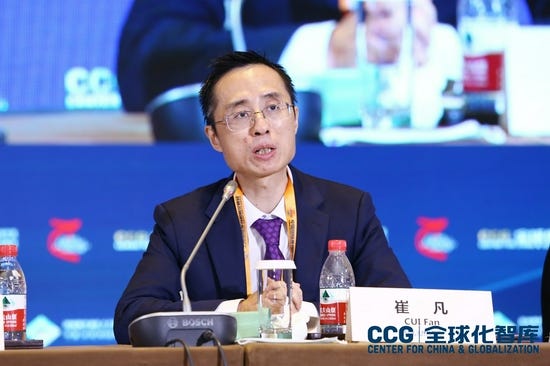
Dr. CUI holds a master's degree in international trade from UIBE, as well as an LL.M. in International Business Law and a Ph.D. in Economics from the London School of Economics and Political Science.
With research focus on China's trade and foreign direct investment policies, laws, and regulations, he was actively involved in drafting China's Foreign Investment Law and its implementing regulations.
In his critique, Dr. CUI takes issue with several core assumptions behind the OECD report:
Biased framing and flawed measurement: The report, he argues, starts from a predetermined narrative about Chinese subsidies and applies inconsistent benchmarks, especially in its treatment of below-market borrowing, which risks overstating support to Chinese firms.
Weak causal claims on market share: Dr. CUI questions the report's claim that subsidies explain a large share of Chinese firms' market-share gains, pointing to inconsistent sample selection, weak instruments, and the omission of key factors such as China's scale economies and manufacturing depth.
Missing the real sources of competitiveness: The critique argues that the report downplays the role of industrial capabilities, market size, innovation, and supply-chain efficiency, while conflating legitimate, WTO-consistent policy tools with unfair trade distortion.
The critique was first published in Chinese on Dr. CUI's personal WeChat public account. With his authorization, I translated the original article into English, and Dr. CUI reviewed the translation and made revisions to the English text.
A Critique of the OECD MAGIC Database of Industrial Subsidies and Related Reports
The OECD released a report on its MAGIC (Manufacturing Groups and Industrial Corporations) database of industrial subsidies on the 1st June, 20261. We hereby present a critique of it and other related reports.
I. Biased research objectives lead to double standards in data processing
In recent years, research on subsidies conducted by certain organizations has shared a common pattern: adopting an arbitrary definition that differs from that used by the World Trade Organization (WTO), abandoning any discussion of the WTO-compliance and economic rationality of subsidies, disregarding official subsidy notification data submitted by WTO members, ignoring the historical reality of trade distortions caused by competitive agricultural subsidy of the European Union and the United States, and in an attempt to prove that subsidies in China are disproportionately larger than those in other countries. The objective of such research is clear: to attribute the growth of China’s manufacturing sector mainly to subsidies. It is precisely because of this predetermined objective that, despite the input of significant research resources, those studies often remain riddled with errors.
Some organizations seek to reinforce stereotypes about China and portray China as a violator of international subsidy rules, which is inconsistent with the facts. Turning to the WTO dispute settlement database, it could be found a total of 145 cases related to the Agreement on Subsidies and Countervailing Measures. Among the three largest trading members, China, the United States, and the European Union, the number of cases in which each has been a respondent is as follows: 19 against China; 45 against the United States; and 24 against the European Union (this does not include cases brought against individual EU member states alone)2.
In several of these cases, both the United States and the European Union have refused or delayed compliance with adverse rulings. For example, in cases DS217, DS234, and DS577, the United States, after losing, refused or delayed implementation, leading the WTO to authorize the prevailing parties to retaliate. The European Union acted similarly in case DS316. China, for its part, has respected and complied with the binding rulings in all relevant cases hence has never been subject to any WTO-authorized retaliation.
It is precisely because it is difficult to portray China as a rule-breaker in WTO dispute settlement proceedings that, in recent years, numerous studies targeting China have explicitly stated that their findings cannot be used as a basis for WTO dispute settlement and that their scope is not limited to subsidies as defined by the WTO. Beneath these seemingly objective disclaimers, however, the predetermined research objectives inevitably lead to double standards in identifying subsidies.
The OECD report names its subsidy database the "MAGIC" (Manufacturing Groups and Industrial Corporations) database. The acronym is telling. Let us take a closer look at what tricks this database performs.
The MAGIC database currently covers three types of subsidies: government grants, income-tax concessions, and below-market borrowings (BMB). The relevant reports do not disclose the specific firms covered, nor do they provide detailed data sources. They merely state that the data are derived from firms' annual reports, financial statements, bond prospectuses, IPO prospectuses, etc., supplemented by government-sourced data. The 525 firms covered, whose headquarters are located across various countries and regions, are all leading players in their respective industries in terms of sales, output, or production capacity.
In studies conducted by other organizations, authors typically disclose their data sources. For example, data on Chinese firms often come from financial databases such as Wind, making it relatively easy to check and/or identify potential issues. Because the OECD has indicated that it publishes aggregate data and that firm-level data are confidential, some of its conclusions regarding government grants and income-tax concessions are indeed difficult to verify. Although firm-level data are not disclosed, the OECD's methodology for calculating below-market borrowings is described in its relevant documentation.
According to an OECD report published in October 20253, "the estimation of below-market borrowings compares the actual interest rates charged to firms against hypothetical benchmark interest rates that could have been charged in a private market, based on the characteristics of the borrower......". It is claimed that the benchmark interest rates are constructed by combining a risk-free base rate and additional risk-adjusted spreads, which themselves include credit risk spreads and government guarantee spreads. For borrowings in different countries and regions, the MAGIC database selects risk-free base rates from the following categories: common banking reference rates (e.g. the US Secured Overnight Financing Rate, Euro Interbank Offered Rate, Tokyo Interbank Offered Rate, etc.); one-year government bond yields; or other commonly used one-year base rates, such as the base rates published by the People's Bank of China (e.g. the Loan Prime Rate, LPR).
However, as other researchers correctly noted4, the LPR that the OECD uses for China is not a risk-free base rate at all. The LPR represents the average lending rate that major quoting banks (currently 20 banks) charge to their highest-credit-quality clients. It is quoted on the 20th of each month (or the next business day if that falls on a holiday), with the highest and lowest quotes excluded before the average is calculated, and is updated monthly. The core anchors for the quotes are the Medium-term Lending Facility (MLF) rate, the banks’ comprehensive cost of funds, and the average risk premium for their highest-credit-quality clients. Notably, the final LPR is determined by taking the arithmetic average of the quotes from the major banks and rounding to the nearest 0.05%. The firms included in the MAGIC database are all leading firms, which are likely to be highest-credit-quality clients as well. For specific clients, banks may either add a premium to, or grant a discount on, the LPR. Even before the LPR was introduced in China, the central bank base rate was not a risk-free base rate either; it already incorporated risk spreads, and the People’s Bank of China allowed banks to add a premium or grant a discount based on specific situations.
By contrast, the base rates the OECD selects for other countries are essentially, or very close to, risk-free base rates, and corporate borrowing rates are generally set at a premium above them. In China, indicators much closer to a risk-free rate do exist. For example, China's one-year LPR is currently 3.0%, while the one-year government bond yield, which may be used as a risk-free rate, is, at the time of writing, 1.1670%. It seems that the spread between the two, which fluctuates with market conditions, is entirely counted by the OECD as subsidies to Chinese firms. Given these definitions of interest rates, Figure 3 on page 9 of the OECD (2026)5 becomes quite easy to explain. The figure shows that borrowing rates for Chinese firms frequently fall below the benchmark rate. This is a result of the differences in the choice of risk-free base rates made by the MAGIC database itself, rather than a reflection of actual subsidies in China. From the methodology the MAGIC database uses to select interest rates, it is clear that its data and estimates suffer from fundamental errors.
II. The problem in explanation of market-share growth
Box 1 on page 15 of OECD (2026)6 argues that 59% of the increase in the market share of Chinese companies is caused by subsidies. For all companies in the database whose market share increased, it claims that 22% of their market-share growth is caused by subsidies.
The model used in this analysis comes from another OECD report (OECD, 2025b)7. In calculating the above results, the 22% figure in Box 1 is obtained after excluding all samples whose market share declined or remained unchanged. That in fact leads to estimation bias. At the same time, when Box 1 estimates the 59% figure for Chinese companies, it does not make clear whether this result applies only to Chinese companies whose market share increased. The two figures are therefore not calculated on a consistent basis.
Although the model in (OECD, 2025b)8 uses some control variables, including a series of dummy variables, and also uses instrumental variables to partially address endogeneity, it still has obvious econometric shortcomings. China’s ultra-large domestic market is conducive to the development of industries with scale economies. Similar factors may need to be captured in the model through interaction terms between country-level variables and industry- or firm-level variables. The model used in the report lacks explanatory variables that reflect important influencing factors.
Meanwhile, in (OECD, 2025a)9, the test results for a similar model show that the instrumental variables used are quite weak. Even if the significance of the coefficient for the core explanatory variable is acceptable, some of the quantitative conclusions drawn, including the 59% and 22% quantitative results in Box 1 of (OECD, 2026)10, are highly misleading.
III. Further comments
Let us look at the industries that the OECD (2026)11 identifies as most heavily subsidized. The largest is the new-energy industry. As we know, the five-year average of global temperatures is about to exceed the threshold of 1.5 degrees Celsius above pre-industrial levels. Countries should use subsidies in a reasonable and WTO-consistent manner to promote the development of new energy and related industries. So-called overcapacity in some new-energy sectors should be examined together with insufficient capacity in areas such as power transmission and transformation, and energy storage. What we should oppose are discriminatory new-energy subsidies, such as those under the U.S. Inflation Reduction Act, rather than opposing new-energy subsidies in general. The fact is that China has made a tremendous contribution to the development of the global new-energy industry and to addressing climate change.
The next sector is chips and semiconductors. China faces comprehensive blockades in the field of high-end chips. China's related subsidies are not prohibited subsidies, nor are they linked to imports or exports. In the face of external blockades, it is necessary for China to use subsidies for research and development as well as production.
As to the steel sector, some researchers showed that the actual amount of China's steel subsidies was very small12. In the shipbuilding sector, developed countries have long used export credits, while China uses export credits in accordance with WTO rules and with reference to the standards of the OECD Arrangement on Officially Supported Export Credits. In recent years, China's shipbuilding industry has developed rapidly. The fundamental reason is the improvement of China's overall manufacturing capabilities.
The analysis by OECD (2026)13 is, on the whole, untenable. On the one hand, reports by the OECD argue that subsidies do not raise productivity. On the other hand, they attribute the increase in the market share of Chinese companies mainly to subsidies. Such reports ignore the real sources of Chinese companies’ competitiveness and seem to attribute the declining competitiveness of their own member countries to Chinese subsidies. When one fails to identify the real cause of their disease, they will never find the right cure.
China's subsidy system is not perfect. For many years, China has continued to work on improving its compliance and scientific soundness. This is because China is very clear-headed in recognizing that subsidies can play a role in targeted efforts to address market failures such as climate change, but they are by no means the fundamental means of enhancing firms' market competitiveness, including international competitiveness.
In recent years, China has continued to refine relevant policies such as fair competition review, trade policy compliance, and negative lists for local fiscal subsidies, creating a level playing field for state-owned enterprises, private enterprises, and foreign-invested enterprises. Through those measures, various bottlenecks and blockages within China's ultra-large domestic market have continued to be cleared, and the unified national market has become more integrated. China should not slow down the pace of further market-oriented reforms no matter what biased studies may claim. Building a fair and competitive business environment is always a work in progress. By strengthening the governance of local subsidies and advancing the construction of a unified national market, China's industries with economies of scale and innovation-intensive industries may become even more internationally competitive.
Although China runs a surplus in trade in goods, it simultaneously registers deficits in trade in services as well as in the non-reserve capital and financial account. China does not deliberately pursue a trade surplus. It seeks to expand imports and, through outbound investment, carry out industrial capacity cooperation with its trading partners to help them restore or develop manufacturing sectors aligned with their respective comparative advantages.
China remains open to further refining and strengthening subsidy rules, as well as to engaging in dialogues and negotiations on disciplines governing state-owned enterprises. At the same time, China advocates reinstating the validity of the non-actionable subsidy provisions under the WTO Agreement on Subsidies and Countervailing Measures, which grant clear authorization for all WTO members to adopt reasonable subsidies for green development, research and development, and subsidies addressing regional development imbalances based on the principle of non-discrimination. Enditem
OECD (2026), OECD MAGIC Database of Industrial Subsidies, OECD Publishing, Paris, https://doi.org/10.1787/ce94f33b-en.
OECD(2025a), "The Drivers and Impacts of Subsidies to Steel Firms", OECD Science, Technology and Industry Policy Papers, No. 184, October, 2025. OECD Publishing, Paris. Page 39.
Zhu, H., & Guo, K. (2026). Why the OECD narrative that China’s emerging industries rely on subsidies is outdated and erroneous. China Finance 40 Forum CF40 Research. https://mp.weixin.qq.com/s/HGyH1oi5DPVAIaaBqOzBAg.
OECD (2026), OECD MAGIC Database of Industrial Subsidies, OECD Publishing, Paris, https://doi.org/10.1787/ce94f33b-en.
OECD (2026), OECD MAGIC Database of Industrial Subsidies, OECD Publishing, Paris, https://doi.org/10.1787/ce94f33b-en.
OECD (2025b), "The Market Implications of Industrial Subsidies", OECD Trade Policy Papers, No. 296, OECD Publishing, Paris.
OECD (2025b), "The Market Implications of Industrial Subsidies", OECD Trade Policy Papers, No. 296, OECD Publishing, Paris.
OECD(2025a), "The Drivers and Impacts of Subsidies to Steel Firms", OECD Science, Technology and Industry Policy Papers, No. 184, October, 2025. OECD Publishing, Paris. Page 39.
OECD (2026), OECD MAGIC Database of Industrial Subsidies, OECD Publishing, Paris, https://doi.org/10.1787/ce94f33b-en.
OECD (2026), OECD MAGIC Database of Industrial Subsidies, OECD Publishing, Paris, https://doi.org/10.1787/ce94f33b-en.
Fritz, J., & Evenett, S. (2018). Going spare: Steel, excess capacity, and protectionism (22nd Global Trade Alert Report). Global Trade Alert. https://globaltradealert.org/reports/102 .
OECD (2026), OECD MAGIC Database of Industrial Subsidies, OECD Publishing, Paris, https://doi.org/10.1787/ce94f33b-en.
Know I'm not saying anything I have not said in the past, but all of the studies are ignoring exchange rates which to be honest are not typically considered when addressing trade imbalances. It is an accounting identity that when a person outside of China buys a good from China, someone in China now holds additional currency such as Euros or USD.
They can use that currency in any number of ways such as to buy oil, some other good. If they do not buy a good, the exchange rate should theoretically adjust, but if that person uses the dollar to buy say a US Treasury bond, they in effect loaned the money to the country the buyer of the good resides in so they created demand for USD and exchange rate might not adjust. Exchange rates might not adjust for other reasons such as this Korean minister is suggesting that foreigners are selling Korean Won they have after selling Korean shares and buying USD.
https://www.reuters.com/world/asia-pacific/south-koreas-finance-minister-says-current-fx-level-excessive-2026-06-23/
China has avoided appreciation because China is acquiring US debt. It is difficult to know how much as reporting is not as clean as one might like, but it is happening. One can say that trade rules do not address currency rates and they are right, but to ignore the long term consequences would be foolish as it tends to lead to financial panics such as the Asian financial crisis of the late 1990s. In China's case, because the government limits the ability of individuals to buy foreign assets, the debts tend to be held by the government or government controlled banks which is just too risky for my taste and has the potential to cause conflicts if say the US were to create an inflation to reduce the cost of paying back the debt.
It is finally getting talked about, but I have no idea why the issue has not been front and center for a long time. I think that the whole Bessent/Trump idea of tariffs was a way of US government capturing much of the benefit of China loaning so much money to US. It was cynical, but it made sense. Europe is now talking about the exchange rate and to be honest, they are not being cynical and I hope Chinese economists will begin to acknowledge the merits of their position.